
Key Takeaways for Aerospace Quality Management
- Aerospace quality standards such as AS9100D, AS9102 Rev C and 14 CFR Part 21 define documented controls, traceability and inspection requirements for flight-critical components.
- AS9100D is the core quality management standard for precision machining suppliers, while AS9110 and AS9120 apply to MRO organizations and distributors.
- AS9102 Rev C governs First Article Inspection Reports and defines when full, partial or delta FAIs apply after design or process changes.
- 14 CFR Part 21 production approval is separate from AS9100D certification, and ITAR registration is mandatory for defense, military and space work.
- Precision Advanced Manufacturing applies these standards daily through its AS9100D- and ISO 9001:2015-registered, ITAR-compliant operations, and buyers can review compliance documentation for their program.
AS9100D as the Core Quality Management System
AS9100D is the IAQG quality management standard for organizations that design, manufacture, assemble or service aerospace products. It builds on ISO 9001:2015 and adds aerospace-specific requirements such as configuration management, operational risk management, counterfeit parts prevention and traceability. This standard fits precision machining and fabrication suppliers.
AS9110 applies to maintenance, repair and overhaul organizations, and AS9120 applies to distributors and stockists of aerospace parts and materials. These standards do not cover production transformation work. Aerospace prime contractors often require manufacturers to conform to AS9100, while stockist distributors conform to AS9120.
AS9100D Clauses That Drive Audit Findings
Two AS9100D clauses generate many audit findings in precision machining environments.
- Clause 7.5, Document Control: CNC programs must be identified by part number, revision level and operation number. Only authorized personnel may modify them, and all changes require Engineering Change Notice review. Programs must be distributed from controlled sources, and superseded versions must be archived rather than deleted.
- Clause 8.5.2, Traceability: Parts must be marked and linked to material lot tracing through a traveler system with direct linkage to Material Test Reports. A single missing heat-lot link can block shipment even when all dimensions pass inspection.
Required documentation outputs under AS9100D include a quality manual, process travelers, material certifications, calibration records and nonconformance and corrective action logs. Calibration records must be maintained with appropriate traceability information. These records protect measurement validity and support audit reviews.
Supplier Audit Questions on Core Systems
Structured audit questions help confirm that a supplier’s management system functions in daily production.
- How are CNC program revisions controlled and distributed to machines?
- Can the shop trace any shipped part back to its raw material heat lot within minutes?
- How are engineering changes rendered to operators before the next production run?
- What is the process for disposition of nonconforming material?
The company applies these clause requirements across every production order through its registered quality systems.
Inspection and Testing Compliance with AS9102 Rev C
AS9102 Rev C, published June 28, 2023, is the current revision of the aerospace first-article inspection standard and remains in force as of 2026. It governs the First Article Inspection Report process and provides objective evidence that a production process has been validated before rate production.
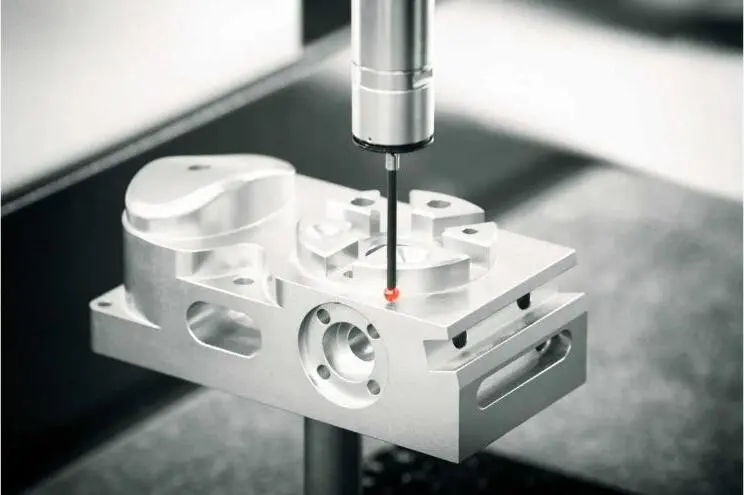
Rev C improved guidance for digital implementations, partial and delta FAI handling, and configuration and data management practices. The three FAI scenarios are:
- Full FAI: Required for a new part number and covers all design characteristics.
- Partial FAI: Used when manufacturing process, location, tooling or equipment changes while design data remains unchanged.
- Delta FAI: Used for engineering or design changes that affect only specific characteristics.
The FAIR consists of three forms. Form 1 documents design documentation review. Form 2 documents raw material and special process compliance. Form 2 specifically requires documentation of the supplier, heat lot number, material specification conformance, hardness verification and MTR linkage. Form 3 documents dimensional inspection results.
AS9102 Rev C supports digital FAI workflows, including digital signatures and electronic approvals, provided traceability and control are maintained. Precision Advanced Manufacturing links FAI reports directly to heat-lot traceability records, which creates a complete, auditable chain from raw material receipt through first-article approval.
Inspection-Focused Audit Questions
Inspection audits confirm that FAI and routine inspection data remain controlled and traceable.
- Are FAI reports stored in a controlled system with revision linkage?
- How is Form 2 heat-lot data connected to the production traveler?
- What triggers a partial or delta FAI when process changes occur?
Regulatory Requirements for Aerospace Production
AS9100D does not replace FAA production approval under 14 CFR Part 21. Organizations producing FAA-certificated articles must hold a Production Approval, such as a Production Certificate, PMA or TSOA, separate from AS9100 certification. AS9100D provides documented quality-system infrastructure, while Part 21 provides regulatory authorization to produce conforming articles.

AS9100D Clause 8.1.2 requires that product configurations be defined, documented and controlled throughout the product lifecycle, including engineering change orders, design freeze protocols and traceability of as-designed versus as-built states. This clause supports Part 21 conformity requirements by keeping the shop floor aligned with the approved design.
Required airworthiness documentation for Part 21-related work includes conformity inspection records, authorized release certificates, material certifications and configuration status accounting records. Prime contractors typically require third-party AS9100 registration from accredited registrars.
For defense programs, ITAR registration is a separate and mandatory requirement. Precision Advanced Manufacturing maintains ITAR registration, which enables support for military, defense and space programs subject to export control requirements.

Audit checkpoints for regulatory compliance include:
- Does the supplier hold current AS9100D registration from an IAQG-accredited certification body?
- Is ITAR registration current and documented?
- How does the supplier manage configuration control between engineering releases and the shop floor?
Review certifications and compliance documentation for a program with Precision Advanced Manufacturing’s team.
Supplier-Qualification Checklist for Precision Machining
The following checklist covers primary qualification criteria for precision aerospace machining suppliers.
- Confirm current AS9100D registration from an IAQG-accredited certification body and verify scope covers production machining.
- Verify ISO 9001:2015 registration is current and co-registered with AS9100D.
- Confirm ITAR registration for any defense, military or space program work.
- Review documented traceability procedures linking raw material heat lots to finished part records and shipping documentation.
- Confirm a documented counterfeit-parts prevention process per AS9100D Clause 8.1.4, including approved supplier controls and incoming documentation review.
- Verify calibration program compliance with AS9100D Section 7.1.5.2, including NIST-traceable calibration certificates with as-found and as-left data.
- Confirm CNC program document control procedures under Clause 7.5, including revision identification and controlled distribution.
- Review AS9102 Rev C FAI capability, including digital FAIR workflows and Form 1 through 3 outputs.
- Confirm configuration management procedures under Clause 8.1.2 for engineering change control.
- Verify nonconformance and corrective action processes with documented closure records.
Common Compliance Gaps That Delay Programs
Several recurring failures appear frequently in supplier audits and qualification reviews.
- Missing heat-lot linkage: A single traceability gap discovered during an AS9100 audit can result in production shutdown and loss of approved supplier status. This traveler-based approach at Precision Advanced Manufacturing prevents the traceability gaps that often trigger findings.
- Uncontrolled CNC programs: Programs stored on unmanaged media or lacking revision identification violate Clause 7.5 and create configuration risk. Controlled distribution from a network or DNC server with archived superseded versions closes this gap.
- Incomplete FAI: Partial or delta FAI events triggered by process changes are frequently undocumented. A defined FAI trigger matrix tied to the change management process prevents this failure.
- Inadequate counterfeit prevention: Raw material, hardware and electronics are the three most likely areas for nonconforming or counterfeit events. DFARS 252.246-7007 requires a risk-based counterfeit detection and avoidance system with documented traceability to original manufacturers. Precision Advanced Manufacturing’s counterfeit prevention process includes incoming documentation review and approved supplier controls.
- Calibration gaps: Expired calibration certificates or missing measurement uncertainty data invalidate inspection results. A calibration management system with defined intervals and NIST-traceable records prevents this finding.
Conclusion and Next Steps for Program Teams
Aerospace parts quality standards such as AS9100D, AS9102 Rev C, AS9110, AS9120 and 14 CFR Part 21 form an interconnected framework that governs every stage of precision component production. For procurement and supplier quality teams, these standards translate into specific documentation deliverables, traceability workflows and audit checkpoints that must be verifiable at the supplier level.
Precision Advanced Manufacturing executes these requirements through its registered quality systems, ITAR-compliant operations and documented traceability processes that buyers can review during qualification. The company’s integrated machining, fabrication and finishing capabilities support prototype and full-rate production programs that require complete compliance documentation.
Start a program review with Precision Advanced Manufacturing’s team.
Frequently Asked Questions
What documentation should a buyer request from a precision machining supplier to verify AS9100D compliance?
Buyers should request the supplier’s current AS9100D registration certificate from an IAQG-accredited certification body, including the certificate scope statement confirming it covers production machining. Additional documentation includes the quality manual or quality management system overview, sample process travelers showing part number and revision traceability, sample material certifications with heat-lot linkage, calibration records for key measurement equipment and a sample First Article Inspection Report with Forms 1 through 3 completed. For defense or space programs, ITAR registration documentation is also required. Reviewing these documents before a site visit allows qualification teams to focus audit time on process verification rather than document collection.
What is the difference between a full FAI, a partial FAI and a delta FAI under AS9102 Rev C?
A full FAI is required when a new part number enters production for the first time. It covers all design characteristics and requires complete Forms 1, 2 and 3. A partial FAI is triggered when a manufacturing change occurs, such as a new machine, new tooling, a process change or a facility move, without any change to the engineering design data. Only the characteristics affected by the manufacturing change require reinspection. A delta FAI applies when an engineering or design change is released that affects specific characteristics. Only those characteristics impacted by the design change are reinspected. Suppliers must maintain a documented trigger matrix that defines which type of FAI applies to each category of change so that no FAI event is missed when process or design updates occur.
How does ITAR registration differ from AS9100D certification, and when are both required?
AS9100D certification is a quality management system registration issued by an accredited third-party certification body. It demonstrates that a supplier’s production processes, documentation and controls meet the IAQG aerospace quality standard. ITAR registration is a U.S. government compliance requirement administered by the Directorate of Defense Trade Controls under the International Traffic in Arms Regulations. It is required for any organization that manufactures, exports or provides services related to defense articles and services listed on the U.S. Munitions List. Both are required for suppliers producing components for military, defense and space programs. AS9100D addresses quality system controls, while ITAR registration addresses export control and access restrictions for controlled technical data and hardware. Precision Advanced Manufacturing holds both, supporting programs across commercial aerospace, military and defense, and space and satellite sectors.
What are the most common counterfeit-parts risks for precision-machined aerospace components, and how are they mitigated?
For precision-machined components, the primary counterfeit risk involves raw material fraud, which occurs when received material does not conform to the specified alloy, temper or heat treatment despite documentation that appears valid. Documentation fraud, including forged material test reports and falsified certifications, is a common entry point. AS9100D Clause 8.1.4 requires a documented counterfeit-parts prevention process that includes approved supplier controls, incoming documentation review upon receipt and lot-level traceability back to the original material source. Suppliers should source raw materials from approved distributors or mills, verify MTRs against purchase order requirements at receiving and maintain heat-lot traceability through every operation. For electronic and hardware components used in assemblies, additional controls aligned with SAE AS5553 and DFARS 252.246-7007 apply, including authentication testing for parts sourced outside franchised distribution channels.
Can a supplier transition mid-program without disrupting AS9100D traceability and documentation continuity?
A mid-program supplier transition is manageable when the incoming supplier maintains equivalent or stronger documentation and traceability systems. The transition process should include a review of all existing design documentation, material certifications and FAI records from the outgoing supplier. The incoming supplier should perform validation builds or pilot runs to confirm process capability before assuming full production. Configuration management records must capture the exact revision state of all documentation at the point of transition so that the as-built configuration remains auditable. Precision Advanced Manufacturing supports supplier transitions by providing complete documentation, material traceability and engineering support from the first production order, which allows programs to maintain compliance continuity without restarting qualification.