Last updated: August 7, 2026
Key Qualification Lessons for 2026 Programs
- Selecting the wrong 5-axis CNC machining partner for aerospace or defense programs creates compounding risk including compliance failures, tolerance stack-up, traceability gaps and production delays.
- A structured qualification process confirms five criteria before issuing a purchase order: active ITAR registration and quality certifications, verified single-setup 5-axis capability, demonstrated material and tolerance expertise, audited inspection and traceability systems, and scalable prototype-to-full-rate production capacity.
- Precision Advanced Manufacturing operates under AS9100D, ISO 9001:2015 and ITAR-registered quality systems across California and Texas facilities, satisfying every qualification criterion under one roof.
- Buyers verify current DDTC registration via SAM.gov, request Technology Control Plans, confirm CMMC Level 2 or NIST SP 800-171 compliance, and review material records including MTRs and AS9102 FAI packages.
- Begin the qualification process with Precision Advanced Manufacturing, a supplier that meets every criterion in this framework.
Step 1: Verify ITAR Registration and Core Quality Credentials
ITAR registration functions as an ongoing obligation, not a one-time credential. ITAR governs export of defense articles, defense services and technical data on the USML, and annual DDTC registration must remain current. Procurement teams verify registration status directly through SAM.gov and request a copy of the supplier’s Technology Control Plan, which explains how controlled drawings, CAD files and technical data are stored, transmitted and restricted.
ISO 9001 or AS9100 certification does not imply ITAR compliance, because quality management and export-control systems operate as separate structures. A qualified supplier demonstrates both systems. Procurement teams request current AS9100D and ISO 9001:2015 certificates with valid registration dates and the name of the accredited registrar.
In 2026, CMMC Level 2 requirements apply to suppliers handling Controlled Unclassified Information under DFARS 252.204-7021. Buyers confirm that a candidate supplier has completed or is actively pursuing a CMMC Level 2 assessment and maintains NIST SP 800-171-compliant cybersecurity controls for ITAR-controlled technical data. Procurement teams also request a supplier’s incident and voluntary disclosure history, because a documented, corrected compliance process signals stronger control than a claimed spotless record with no formal procedures.
Evidence to request at this step connects directly to export control and quality system maturity.
- Current DDTC registration confirmation via SAM.gov
- AS9100D and ISO 9001:2015 certificates with registrar name and expiration dates
- Written Technology Control Plan
- CMMC Level 2 assessment status or NIST SP 800-171 self-assessment score
- Employee ITAR awareness training records for machinists, inspectors and engineers
Step 2: Confirm Single-Setup 5-Axis Performance on Complex Parts
Single-setup 5-axis machining delivers measurable performance gains, not just a marketing claim. This approach eliminates datum offset and stack-up errors from multiple 3-axis re-clamps, which improves coaxiality between features and reduces scrap rates. The reduction in re-clamps converts theoretical capability into a concrete quality and cost advantage.

5-axis single-setup machining of complex parts reduces rejection rates compared with multi-setup 3-axis processes by removing cumulative alignment and fixturing errors. DMG MORI’s 2024 5-axis machining benchmark found that producing equivalent parts on 5-axis equipment reduced setups, cycle time and tool count while improving process accuracy by 25 percent in a documented example.
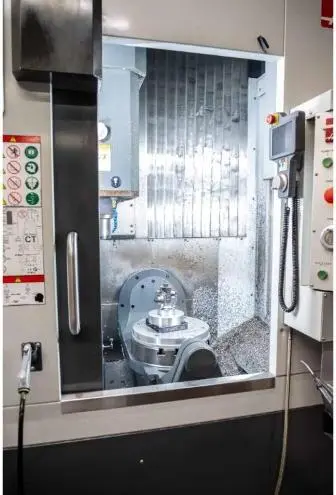
Procurement teams request process sheets or case examples showing single-setup completion of parts with compound angles, internal pockets or contoured surfaces. A 5-axis machine can reach five faces of a workpiece in a single setup while maintaining a consistent datum throughout the machining cycle, directly reducing dimensional error accumulation from repositioning. These examples demonstrate that the supplier uses equipment capability in production, not only in theory.
Evidence to request at this step focuses on real programs, not equipment brochures.
- Equipment list with axis configuration and work envelope specifications
- Process sheets demonstrating single-setup completion of geometrically complex parts
- First-article inspection data showing dimensional conformance on multi-feature components
- Scrap and rework rate history on comparable aerospace or defense programs
Step 3: Evaluate Exotic Material and Tight-Tolerance Capability
Mission-critical aerospace and defense components often rely on titanium alloys, nickel-based superalloys and other exotic materials that demand process discipline beyond standard CNC machining. Ti-6Al-4V delivers tensile strength comparable to many steels at roughly 56 percent of steel’s density and dominates airframe structures and turbine fan blades. Inconel 718 aerospace structural components are typically machined close to final dimension before a two-stage precipitation hardening cycle and then finish-machined to manage distortion.
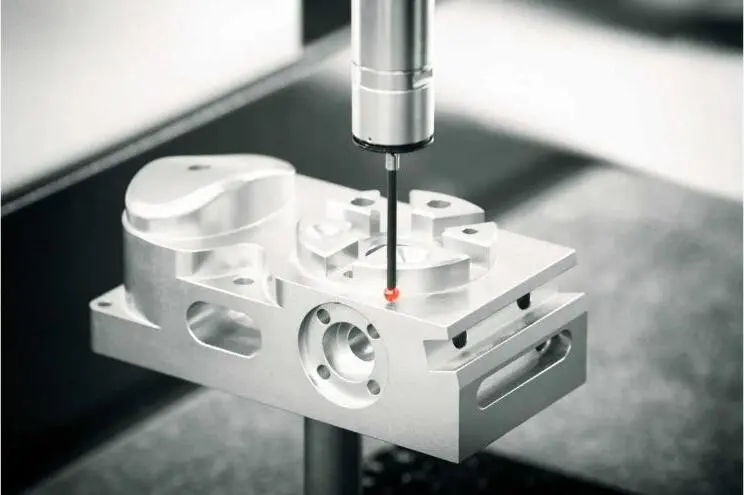
Tight tolerances on exotic alloys require CMM verification because hardness variability and springback make in-process gauging unreliable by itself. Buyers confirm that the supplier uses CMM inspection on first articles and that coolant practices match the thermal demands of titanium and nickel superalloys. These controls protect tolerance integrity across full production runs.
For ITAR-controlled applications involving titanium and nickel superalloys, material sourcing must comply with applicable export control regulations, and certified mill-direct or first-tier distributor material with full MTR traceability is required to mitigate counterfeit risks. This sourcing discipline supports both compliance and structural reliability.
Evidence to request at this step ties directly to alloy behavior and sourcing control.
- Material records including MTRs with chemical composition, mechanical properties and heat or lot numbers
- CMM inspection reports from first articles on titanium or nickel superalloy programs
- Surface finish data on aerospace-grade components
- Coolant and thermal management process documentation for titanium machining
Step 4: Review Inspection, Traceability and Cybersecure Documentation
Traceability functions as a contractual and regulatory requirement, not an optional quality feature. AS9100 Rev D Clause 8.5.2 requires identification and traceability appropriate to the product, including material certifications, special process records and production sequence documentation. ITAR defense program traceability records must meet retention requirements typically exceeding five years per DDTC agreement.
Buyers request AS9102 First Article Inspection packages with ballooned drawings and confirm that the supplier delivers dimensional inspection reports with every shipment. Traceability for ITAR-regulated programs must cover every process step, operator and material lot so that a supplier can prove how a part was controlled. These records support rapid root-cause analysis during investigations.
Cybersecurity controls for technical data carry equal importance. ITAR-registered suppliers should maintain NIST 800-171 compliant cybersecurity for ITAR-controlled technical data. When a supplier serves both ITAR and non-ITAR clients, buyers confirm physical and network segregation measures such as restricted folders, badge-controlled areas or dedicated program cells.
The traceability requirements in this section extend from individual parts to entire supply chains. Executive Order 14415, signed July 20, 2026, requires supply chain mapping from raw materials to end-use products, written procedures to vet suppliers and subcontractors, and mitigation actions tracked to closure for national security-related acquisitions. Buyers confirm that candidate suppliers provide sub-tier visibility that matches part-level records already established in their quality systems.
Evidence to request at this step confirms that documentation supports both audits and investigations.
- AS9102 FAI package from a recent comparable program
- Sample dimensional inspection report and material certification package
- Nonconformance and corrective action records from the past 12 months
- NIST SP 800-171 compliance documentation or CMMC assessment status
- Network and physical segregation procedures for ITAR-controlled data
Step 5: Test Prototype-to-Production Scalability
Prototype success does not automatically translate into full-rate production performance. Strong installed CNC capacity does not automatically translate to reliable delivery, so buyers assess effective capacity, validated throughput and on-time completion rate.
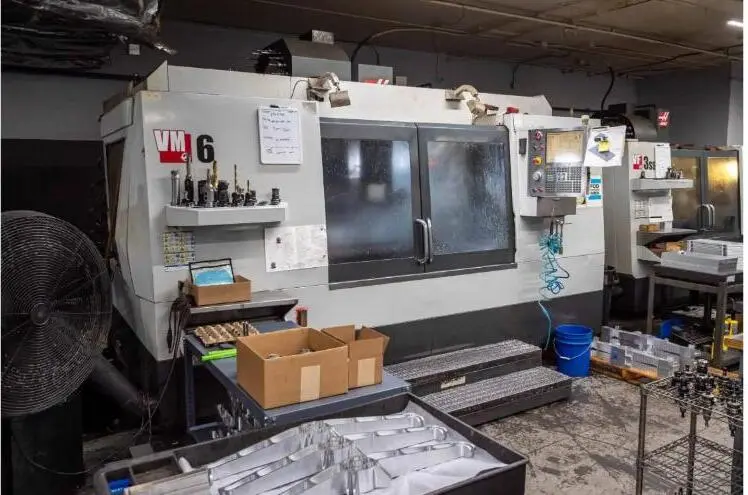
A disciplined CNC scalability workflow includes pilot run validation to test fixture and tool-life stability, process lockdown with formal ECO control to freeze SOPs and CNC programs, and ramp-up with SPC monitoring to detect quality drift. Buyers ask the supplier to describe this sequence and provide on-time delivery metrics from programs that transitioned from prototype to sustained production.
Buyer due-diligence questions to judge CNC supplier scalability include redundancy queries such as which backup machine can run the exact program if the primary machine fails, review of operator training records and SOPs for night-shift consistency, and daily inspection department throughput capacity if order volume doubles. These questions verify that the workflow described above operates under real production pressure.
Engineering-change handling is a key scalability risk: when drawings or material grades shift mid-order, suppliers must respond within the same day to 48 hours to avoid idle time and delivery slippage. Change-handling speed reveals the strength of redundancy and process discipline when conditions shift during production.
Evidence to request at this step focuses on throughput, resilience and change response.
- On-time delivery rate history across prototype and production programs
- Machine redundancy plan for primary 5-axis equipment
- Multi-shift capacity documentation and operator training records
- ECO control and engineering change response procedures
- SPC or Cpk data from a production program at full rate
How Precision Advanced Manufacturing Aligns With the Five-Step Framework
Precision Advanced Manufacturing maintains ITAR registration and operates under AS9100D and ISO 9001:2015 certified quality management systems. These certifications, highlighted in the key takeaways, form the foundation of the company’s compliance framework, supported by a written Technology Control Plan and U.S.-person-only access to controlled technical data across California and Texas facilities.

Advanced multi-axis CNC machining capabilities support single-setup completion of complex geometries in titanium alloys, nickel-based superalloys and other aerospace-grade materials. In-house engineering, CNC programming and tooling development improve manufacturability before production begins and reduce the risk of tolerance failures on difficult materials.
Every program includes comprehensive documentation, including AS9102 FAI packages, dimensional inspection reports and complete quality records. Integrated finishing services, including anodizing, passivation, plating and secondary treatments, run in-house and reduce handoffs that can create documentation gaps and schedule risk.
The production platform supports the full program lifecycle from prototype through sustained full-rate manufacturing. Multi-shift capacity and machine redundancy allow programs to scale without a supplier change, aligning directly with the scalability criteria in Step 5.
Addressing Common Buyer Objections
Cost of certified precision: Certified precision machining carries a higher unit cost than non-certified alternatives. However, when parts meet specifications the first time, programs avoid compounding costs from rework, scrap replacement and schedule recovery. Delivering parts right the first time protects program budgets more effectively than sourcing on unit price alone.
Mid-program supplier transitions: Mid-program supplier transitions introduce risk across documentation, schedule and qualification status. Precision Advanced Manufacturing mitigates that risk by providing complete documentation, robust records and engineering support to maintain continuity. Pilot builds or validation runs support integration into existing supply chains with limited disruption.
Exotic material capability: Standard machine shops often struggle to maintain tolerances on titanium alloys and nickel superalloys. Precision Advanced Manufacturing’s experience with complex materials and advanced fabrication processes, combined with CMM inspection and disciplined coolant practices, addresses the specific challenges these materials present in aerospace environments.
Frequently Asked Questions
How does a procurement team verify that a supplier’s ITAR registration is current and not lapsed?
ITAR registration with the Directorate of Defense Trade Controls requires annual renewal. Procurement teams cross-reference a supplier’s claimed registration against SAM.gov records and request a copy of the current DDTC registration certificate. The certificate shows the registration period, the registered entity name and the facility address. Buyers also request the supplier’s Technology Control Plan, which documents how controlled technical data is stored, transmitted and restricted. Verification repeats at each contract renewal rather than serving as a one-time onboarding step.
What documentation should a supplier provide to confirm AS9102 First Article Inspection compliance?
An AS9102-compliant FAI package includes a ballooned drawing with each characteristic numbered and cross-referenced to the inspection record, dimensional results for every characteristic, material certifications with heat and lot numbers, special process certifications where applicable and a functional test report if required by the design. The package remains traceable to the specific part number, revision level and production lot. Buyers request a sample FAI package from a comparable program before awarding new work, because incomplete or undated FAI packages often signal documentation gaps that surface during audits or nonconformance investigations.
What are the primary cost drivers for 5-axis CNC machining of aerospace-grade exotic alloys?
The primary cost drivers include material cost, cycle time and tooling consumption. Titanium alloys and nickel superalloys cost significantly more per kilogram than aluminum, and machining cycle times on these materials run longer than equivalent aluminum work. Tooling costs represent a meaningful share of total part cost on difficult superalloy jobs because cutting tools wear faster under the thermal and mechanical loads these materials generate. Single-setup 5-axis machining reduces total cost by eliminating multiple fixture setups and reducing scrap from cumulative alignment errors, while programs that prioritize unit price over process capability often incur higher total costs through rework, scrap and schedule recovery.
When should a supplier qualification be re-evaluated during an active program?
Supplier qualifications require re-evaluation when certifications approach expiration, when a nonconformance or corrective action event occurs, when the supplier undergoes ownership changes or facility relocations and when program requirements change in ways that affect material, tolerance or compliance scope. Executive Order 14415, signed in July 2026, reinforces the need for ongoing supply chain visibility beyond initial onboarding, requiring prime contractors to map and monitor sub-tier suppliers throughout program execution. Procurement teams establish a periodic review cadence, at minimum annually, and trigger an immediate re-evaluation if on-time delivery trends decline or if a CMMC or ITAR audit finding is disclosed.
Conclusion
Qualifying an ITAR-registered 5-axis CNC machining supplier for aerospace and defense programs relies on a sequential, evidence-based process. Confirming active ITAR registration and quality certifications, verifying single-setup 5-axis capability, validating material and tolerance expertise, auditing inspection and documentation systems and assessing scalable production capacity together create a repeatable framework that reduces supplier risk.
The five-step qualification framework outlined above, from ITAR verification through scalability assessment, provides a practical process for de-risking supplier selection. Precision Advanced Manufacturing’s integrated capabilities address each step under one roof and reduce the compliance gaps and handoff risks that appear when buyers spread qualification criteria across multiple vendors.