Key Takeaways for UAV CNC Supplier Selection
- UAV precision CNC machining relies on multi-axis milling, turning and certified quality systems to deliver tight-tolerance components for unmanned systems.
- Procurement teams should evaluate suppliers across four dimensions: technical capability, quality and compliance, scalability and integration scope, which together reduce total program risk.
- ITAR registration, AS9100D and ISO 9001:2015 certifications plus full material traceability reduce regulatory exposure and quality escapes.
- A single domestic supplier that supports prototype-to-production scaling avoids re-qualification and maintains consistent tolerances as volumes increase.
- Precision Advanced Manufacturing offers an integrated ITAR-registered, AS9100D-certified solution; start a UAV machining engagement with a dedicated team.
Technical Capabilities for UAV Motor Mounts and 5-Axis Drone Frames
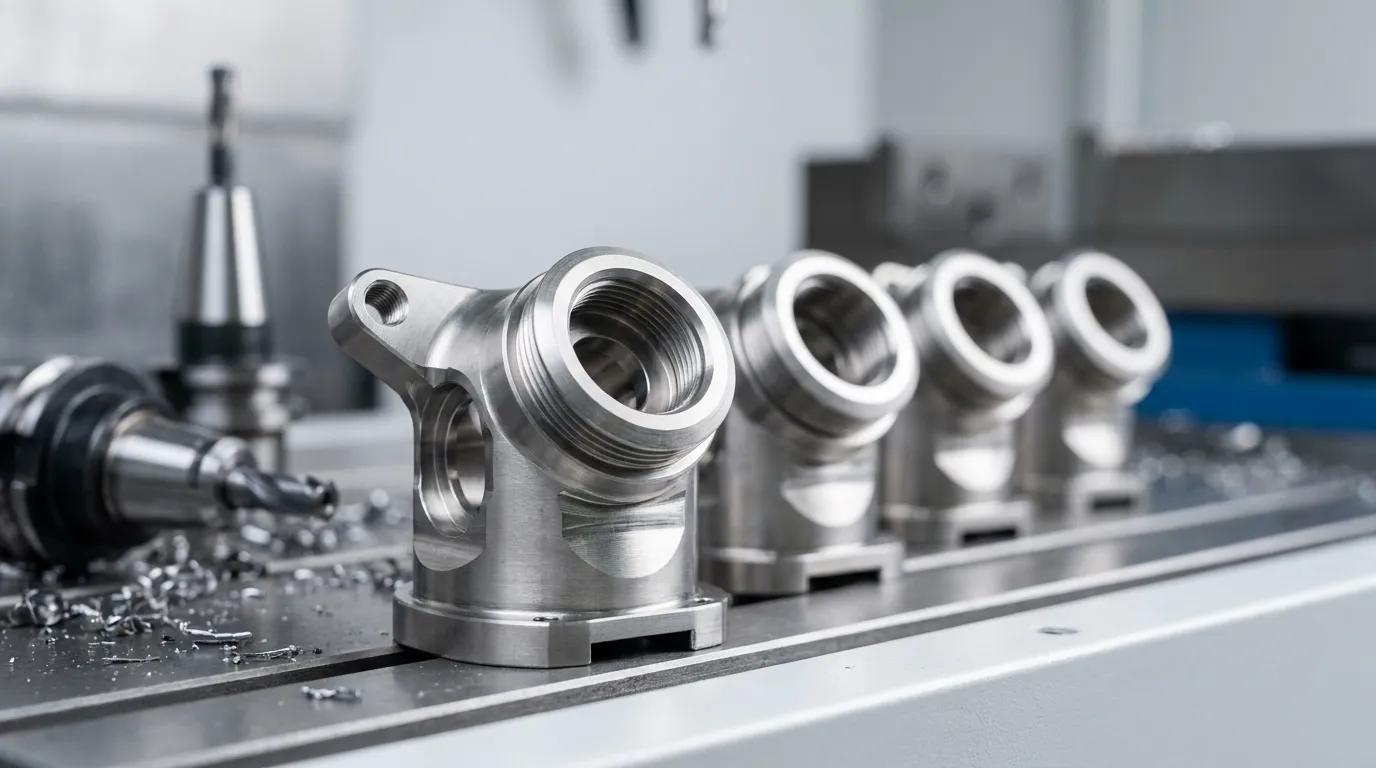
UAV motor mount CNC machining demands repeatable accuracy across every unit in a production run. Motor mounts transfer thrust loads directly to the airframe, so dimensional variation creates vibration, misalignment and premature fatigue. The same precision standard applies to drone frames, gimbal housings and structural brackets.
5-axis CNC for drone frames allows a cutting tool to approach a workpiece from five directions in a single setup. This approach reduces fixturing errors, eliminates re-chucking and maintains geometric consistency across complex contoured surfaces. Multi-axis milling and turning at Precision Advanced Manufacturing support these requirements for space, satellite, aerospace and UAV systems.
Precision sheet metal fabrication extends capability to structural skins, enclosures and brackets. Stamping, forming, bending and welding run under AS9100D and ISO 9001:2015 certified systems. Thermal-distortion-controlled welding using TIG, MIG and precision laser methods preserves structural integrity in lightweight assemblies where heat-induced warping disqualifies parts.
Quality and Compliance for ITAR-Controlled UAV Machining
ITAR-certified UAV machining serves as a baseline requirement for any program involving defense-related unmanned systems. The International Traffic in Arms Regulations restrict the manufacture, export and transfer of defense articles, and suppliers without ITAR registration expose programs to legal liability and contract termination. Precision Advanced Manufacturing maintains full ITAR registration.
AS9100D is the aerospace quality management standard that governs risk management, configuration control and product realization for flight-critical components. ISO 9001:2015 provides the underlying process discipline. Operating under both registrations means every production step at Precision Advanced Manufacturing follows defined quality checkpoints, inspection protocols and documentation requirements.
Full material and process traceability distinguishes certified domestic suppliers from generic or overseas providers. Traceability links each delivered part to its raw material certification, machining records and inspection data. This documentation reduces audit burden, supports first-article inspection packages and provides the evidence chain required when a component is investigated for a field anomaly.
Scalability from UAV Prototype to Production CNC
UAV prototype to production CNC describes the ability of a single supplier to execute both low-volume development builds and high-rate manufacturing runs using the same validated processes. Supplier changes between prototype and production phases introduce re-qualification risk, tolerance drift and schedule disruption.
Precision Advanced Manufacturing supports the full product lifecycle from project-specific prototype development through sustained, multi-shift production. In-house CNC programming and tooling development applied during prototyping carry forward directly into production. Process parameters validated on the first article govern every subsequent run, so quality remains consistent as volume increases.
Multi-shift capacity and disciplined scheduling allow programs to ramp without operational disruption. Engineering support remains available throughout the lifecycle to address design changes, tolerance refinements and material substitutions without restarting supplier qualification.
Integration Scope for Titanium UAV Components and Finishing
Beyond scalability, material capability determines whether a supplier can support advanced UAV designs. Titanium UAV components CNC machining addresses one of the most demanding material challenges in unmanned systems. Titanium offers a high strength-to-weight ratio and corrosion resistance suited to airframe and structural applications, but it requires specialized tooling, controlled cutting parameters and thermal management to machine without inducing residual stress or surface damage.
Precision Advanced Manufacturing expertise spans complex materials and advanced fabrication processes, including the exotic alloys and composites common in UAV programs. Beyond raw machining, the integration scope covers hardware installation, including PEM-style nuts, studs, standoffs and pins, along with brush finishing, laser marking and deburring. Secondary finishing treatments include anodizing, passivation, plating, sandblasting and ultrasonic cleaning.
Ready-to-integrate components remove secondary work at the customer facility. Assembly and testing timelines accelerate when parts arrive finished, marked and kitted rather than requiring additional processing before installation.
Request a detailed UAV machining plan that covers materials, tolerances, certifications and production strategy for a specific program.
Total Program Risk Reduction Across Four Dimensions
The four preceding dimensions work together to reduce total program risk by addressing specific failure modes. Technical capability reduces out-of-spec parts that trigger rework cycles and schedule slips. Certified quality and compliance reduce regulatory exposure that can halt production and increase audit frequency.
Scalability limits supplier-change disruptions that reset qualification timelines and introduce tolerance drift. Integration scope reduces handoffs and secondary processing delays that extend assembly schedules and complicate traceability. The consolidated approach described across technical capability, quality systems, scalability and integration also eliminates the scheduling dependencies and communication gaps that fragmented supply chains introduce.
Predictable performance protects program budgets and milestones. Rework, scrap and expedited orders act as primary drivers of cost overruns in precision component programs. Certified processes and rigorous in-process inspection reduce first-pass rejection rates and the downstream costs they generate.
Supplier Evaluation Checklist for UAV CNC Programs
- Technical capability: Confirm multi-axis CNC milling and turning, precision sheet metal fabrication and thermal-distortion-controlled welding are available in-house.
- Quality and compliance: Verify AS9100D and ISO 9001:2015 registrations and ITAR registration with current certificates on file.
- Traceability: Confirm full material and process traceability with inspection reports and material certifications delivered with each shipment.
- Scalability: Confirm the supplier supports prototype through full-rate production using the same validated processes and equipment.
- Integration scope: Confirm secondary finishing, hardware installation, laser marking, deburring and kitting are available without outsourcing.
- Engineering support: Confirm in-house CNC programming, tooling development and design-for-manufacturability review are available from program start.
- Domestic operations: Confirm U.S.-based facilities with no offshore manufacturing dependencies for ITAR-controlled work.
Frequently Asked Questions
Why is AS9100D certification necessary for UAV component suppliers?
AS9100D establishes the quality management requirements specific to aviation, space and defense manufacturing. It governs risk management, configuration control, first-article inspection and corrective action processes that general ISO 9001 certification does not fully address. For UAV programs, particularly those with defense applications, AS9100D certification signals that supplier processes match the failure-consequence environment of flight-critical components. Procurement and supplier quality teams use it as a baseline filter because it reduces the likelihood of receiving out-of-spec parts and simplifies supplier audits.
What challenges arise when scaling from UAV prototype to full-rate production?
The primary challenge is process continuity across phases. When a supplier validates a prototype using one set of fixturing, tooling and inspection methods, then hands off production to a different facility or team, tolerance drift and quality inconsistencies follow. A second challenge involves documentation transfer, because production runs require the same traceability records established during prototyping.
A third challenge relates to capacity, since suppliers focused on low-volume development work often lack the multi-shift scheduling and inventory management needed for sustained production. Selecting a supplier with an integrated prototype-to-production platform from the outset removes these transition risks.
How does ITAR registration affect supplier selection for defense UAV programs?
ITAR registration is a legal requirement for suppliers that manufacture, export or transfer defense articles defined under the U.S. Munitions List. UAV systems and their components frequently fall within ITAR jurisdiction, particularly for military and government programs. Using a non-registered supplier exposes the prime contractor and the program to regulatory violations, contract termination and potential criminal liability.
ITAR registration also signals that a supplier has established internal compliance controls, export authorization procedures and personnel training aligned with U.S. Department of State requirements.
What does full traceability mean in practice for UAV machined components?
Full traceability means every delivered part can be linked back to its raw material heat or lot certification, the specific machine and operator that produced it, the inspection records confirming dimensional compliance and any nonconformance reports generated and resolved during production. In practice, this documentation package accompanies each shipment and supports first-article inspection, receiving inspection and any downstream failure investigation. For supplier quality engineers, full traceability reduces the inspection burden at receiving and provides the evidence chain required during customer or regulatory audits.
Can a single supplier handle both complex geometries and secondary finishing for UAV programs?
A single supplier can manage both when it operates an integrated facility with multi-axis CNC machining, precision fabrication, welding and in-house finishing services. Distributing these operations across multiple vendors introduces scheduling dependencies, traceability gaps and communication failures that increase program risk. An integrated supplier applies the same quality management system across machining, hardware installation, surface finishing and kitting, and delivers parts that are ready to integrate without additional processing at the customer facility.
Conclusion: Choosing a UAV Precision CNC Machining Partner
UAV precision CNC machining performed under certified U.S. quality systems reduces total program risk across four dimensions: technical capability, quality and compliance, scalability and integration scope. Each dimension maps to a specific failure mode that procurement, program and supplier quality teams encounter when working with uncertified or fragmented suppliers.
Precision Advanced Manufacturing delivers across these dimensions as a single certified partner with facilities in California and Texas. From UAV motor mount CNC machining and 5-axis drone frame production through titanium component machining, secondary finishing and kitting, the integrated platform supports programs from first prototype through sustained full-rate production.
Engage a Precision Advanced Manufacturing specialist to launch a UAV precision CNC machining program built on certified quality and full traceability.