Last updated: July 9, 2026
Key Takeaways for Space CNC Machined Components
-
Space CNC machined components must meet strict requirements for vacuum compatibility, radiation resistance and thermal cycling that standard commercial parts cannot satisfy.
-
Procurement teams face significant program risk when sourcing from suppliers without proven space-grade capabilities, traceability and integrated manufacturing processes.
-
Material selection for space applications prioritizes aluminum alloys, titanium, nickel superalloys, precipitation-hardening stainless steels and low-outgassing polymers that meet ASTM E595 standards.
-
AS9100D, ISO 9001 and ITAR certifications, combined with full material traceability and first-article inspection documentation, are baseline expectations for space program suppliers in 2026.
-
Precision Advanced Manufacturing delivers certified, traceable space CNC machined components from prototype through production, supporting mission-critical programs with a U.S.-based supply chain.
Definition of Space CNC Machined Components
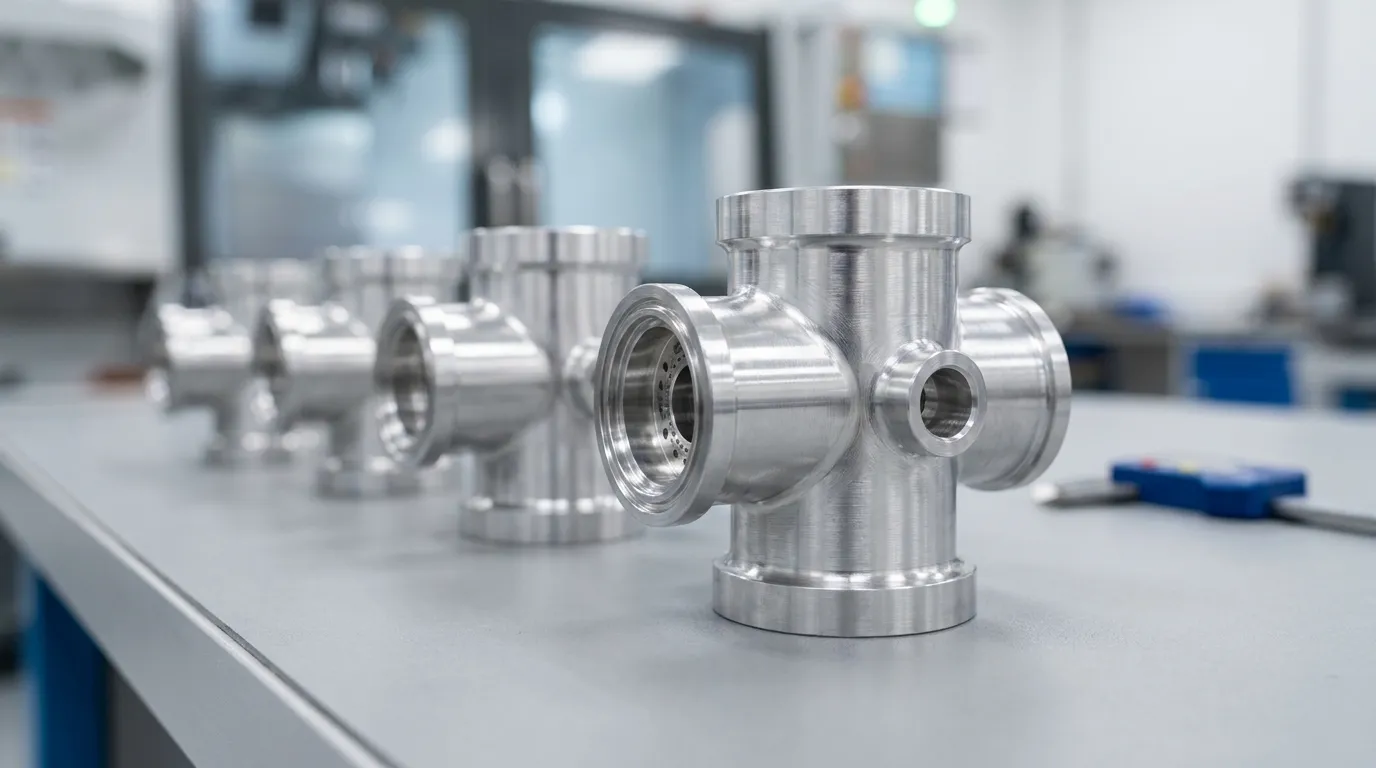
Space CNC machined components are precision metal and polymer parts produced with computer-controlled multi-axis machining for spacecraft, satellite and launch vehicle programs. These components must perform reliably across vacuum, radiation and thermal cycling conditions that degrade standard commercial parts.
Common space CNC machined components include:
-
Structural brackets and frames
-
Optical mounts and benches
-
Propulsion interfaces and manifolds
-
Satellite housings and enclosures
-
Thermal shields and heat management structures
-
Avionics housings
-
Fuel system and fluid handling components
-
Fasteners, standoffs and precision hardware
Program Risk from Unreliable Space CNC Suppliers
Program delays, compliance failures, scaling bottlenecks and out-of-spec parts create documented risk when teams source from suppliers without proven space-grade capabilities. These issues affect cost, schedule and qualification timelines across the program lifecycle.
For procurement and sourcing professionals, an unreliable supplier creates cascading schedule risk. A single out-of-spec delivery forces rework cycles, expedited orders and supplier qualification restarts, which compress program timelines and inflate costs.
Program managers encounter integration delays when parts arrive requiring secondary work. Components that are not fully finished and ready to integrate add unplanned labor and push assembly and testing milestones.
Supplier quality engineers carry the inspection burden when supplier documentation is incomplete or process controls are inconsistent. Incomplete material certifications, missing first-article reports and undocumented process deviations shift verification work onto the customer quality team.
These risks stem from fragmented supplier ecosystems where capabilities sit across multiple vendors. Integrated capabilities reduce these risks directly. When CNC machining, precision fabrication, specialty welding, secondary finishing and quality documentation operate under one roof, vendor handoffs disappear, traceability stays intact across every process step and the supplier owns the outcome from raw material to finished component.
Precision Advanced Manufacturing consolidates these capabilities under AS9100D, ISO 9001 and ITAR-compliant quality systems at facilities in California and Texas, supporting space and satellite programs from prototype through full-rate production.
Request a quote for space CNC machined components from a certified U.S.-based supplier.
Materials for Extreme Space Environments
Material selection for space CNC machined components is driven by five environmental and performance criteria: vacuum compatibility, thermal cycling performance, outgassing behavior, radiation resistance and structural requirements. Each material class addresses a different combination of these demands, which makes it suitable for specific component types in orbital and deep-space applications.
Aluminum alloys (6061 and 7075) remain the most widely specified materials for space structural components. Their high strength-to-weight ratio, machinability and stability across vacuum and thermal cycling environments make them a default choice for brackets, housings and structural frames. Aluminum dominated early spacecraft designs for these same reasons, though its performance limits at elevated temperatures require supplementing with higher-performance alloys for thermally demanding applications.
Titanium alloys, particularly Ti-6Al-4V, are specified for high-stress structural applications including frames, brackets and fasteners. Titanium delivers an exceptional strength-to-weight ratio and maintains mechanical performance at temperatures that exceed aluminum’s practical range. Its corrosion resistance also supports long-duration missions.
Nickel-based superalloys including Inconel 718 and 625 were developed for extreme thermal and mechanical environments. They are specified for propulsion systems, thermal structures and components exposed to intense heat where other alloys lose structural integrity. These alloys retain mechanical strength and resist oxidation at temperatures that exceed the capability of titanium or aluminum.
Precipitation-hardening stainless steels such as 15-5 PH and 17-4 PH provide strength, corrosion resistance and cryogenic performance for space systems that require environmental durability and cost-effective manufacturability.
Low-outgassing polymers including PEEK, PTFE and polyimides (Vespel) support applications where weight reduction, electrical insulation or low friction is required. These materials must meet strict vacuum compatibility requirements, specifically ASTM E595 standards for total mass loss and collected volatile condensable material, to prevent contamination of optics or sensors.
Precision Advanced Manufacturing’s expertise in complex aerospace materials supports space-grade alloys and specialty materials, with process controls aligned to the performance requirements of orbital and satellite applications.
Tolerance and Surface Finish for Satellite CNC Parts
Tolerance requirements for space CNC machined components vary by function, with tighter specifications applied where performance consequences carry greater risk. Structural brackets and frames typically require tolerances that meet aerospace standards. Propulsion and engine components demand tighter tolerances to support proper sealing and alignment under thermal stress. Fuel system and fluid handling components carry the tightest requirements because leakage or misalignment creates mission-critical failures.
Surface finish specifications follow the same functional logic, with finish quality tied directly to the component role. Standard structural surfaces are typically specified at industry-standard roughness values, while sealing interfaces, bearing seats and high-load contact surfaces require finer finishes. High-precision optical parts and sealing surfaces often need finishes achieved through polishing or grinding operations beyond standard CNC machining.
Optical benches, propulsion interfaces and precision mechanisms routinely carry true-position and flatness callouts that require advanced metrology, calibrated CMMs and full-form verification instead of manual inspection methods.
Multi-axis machining supports the complex geometries required in weight- and performance-focused aerospace parts. It provides tool path flexibility and cutter access needed to hold tight tolerances across compound angles and contoured surfaces. Multi-axis machining centers access a part from multiple angles in a single setup, which reduces repositioning and cumulative error and supports tight tolerances on complex geometries.
Precision Advanced Manufacturing advanced multi-axis CNC machining capabilities, combined with in-process and final inspection systems, deliver repeatable tight-tolerance performance across production runs for satellite and space programs.
Traceability and Documentation Requirements in 2026
Full material and process traceability represents a baseline expectation for space program suppliers in 2026. Procurement teams and supplier quality engineers require documentation that covers raw material certifications, in-process inspection records, dimensional reports and final inspection sign-off, all linked to specific lot and serial numbers.
Material certifications must trace back to the mill source and confirm compliance with the specified alloy, temper and applicable material standards. Process documentation must capture every operation performed on a component, including heat treatment, surface finishing and any special processes, with records retained and accessible for audit.
Traceability from raw material sourcing through final inspection defines AS9100D-certified suppliers. First-article inspection documentation and CMM verification reports provide the dimensional evidence that programs require before approving production runs.
Precision Advanced Manufacturing certified quality systems maintain complete traceability across materials and processes. The resulting documentation package simplifies customer audits and supports regulatory alignment while reducing verification workload for the buyer’s quality team.
Quality Certifications and Compliance for AS9100 Suppliers
AS9100D is the aerospace quality management standard that governs risk management, configuration control, first-article inspection and supplier oversight for space and aviation programs. ISO 9001:2015 provides the quality management foundation that AS9100D builds upon. ITAR registration is a legal requirement for suppliers that handle technical data, hardware or services related to defense articles and space launch systems covered under the U.S. Munitions List.
In 2026, space program procurement teams expect suppliers to hold current AS9100D and ISO 9001 registrations with documented scope that covers the specific processes being sourced. Aerospace OEMs mandate AS9100D certification and process capability requirements as conditions of supplier qualification, not optional differentiators.
First-article inspection per AS9102 and CMM-verified dimensional reports are standard deliverables for production approval. Suppliers without calibrated inspection equipment and documented FAI processes create noncompliance risk that falls on the program quality team to resolve.
Precision Advanced Manufacturing operates under AS9100D and ISO 9001:2015 registrations and is ITAR registered, with defined quality checkpoints, full traceability and complete documentation that address compliance failures before they reach the program level.
Request a quote and receive a detailed plan covering certifications, tolerances, materials and production strategy for space CNC machined components.
How Procurement Teams Evaluate Space CNC Suppliers
Supplier evaluation for space CNC machined components requires assessment of capability, compliance and scalability together. A supplier that machines to tolerance but cannot provide complete documentation, or one that handles prototypes but cannot scale to production rates, introduces program risk at different lifecycle stages.
The following checklist reflects criteria that procurement, program management and supplier quality teams apply when qualifying suppliers for space and satellite programs:
-
Current AS9100D and ISO 9001:2015 registrations with documented scope covering required processes
-
ITAR registration for programs involving controlled technical data or defense-related space hardware
-
Multi-axis CNC machining capability for complex geometries and tight-tolerance requirements
-
Integrated precision fabrication, specialty welding and secondary finishing under one roof
-
Full material traceability from mill certification through final inspection
-
Complete inspection reporting including CMM verification and first-article documentation
-
Demonstrated experience with space-grade materials including aluminum alloys, titanium, nickel superalloys and specialty stainless steels
-
Prototype-to-production scalability with multi-shift capacity and consistent quality across volume transitions
-
Engineering support for manufacturability review and design-for-production refinement
-
Documented process controls for special processes including welding, heat treatment and surface finishing
-
Supplier transition support including pilot builds and validation runs for mid-program changes
Precision Advanced Manufacturing meets each of these criteria with integrated capabilities, certified quality systems and a scalable production platform that supports space and satellite programs from initial prototype through sustained production.
Frequently Asked Questions
What materials does Precision Advanced Manufacturing work with for space CNC machined components?
Precision Advanced Manufacturing works with the full range of materials specified for space and satellite applications. This range includes aluminum alloys such as 6061 and 7075, titanium alloys including Ti-6Al-4V, nickel-based superalloys such as Inconel 718 and 625, precipitation-hardening stainless steels and specialty polymers and composites where vacuum compatibility and outgassing requirements apply. The company also works with stainless steel, carbon steel, exotic alloys and other materials required for aerospace and defense programs.
What certifications are required from a supplier of space CNC machined components?
Space program suppliers are expected to hold current AS9100D and ISO 9001:2015 registrations with scope that covers the processes being sourced. ITAR registration is required for programs involving hardware or technical data covered under the U.S. Munitions List, which includes most satellite and launch vehicle programs. First-article inspection capability per AS9102, CMM-verified dimensional reporting and full material and process traceability are standard documentation expectations. Precision Advanced Manufacturing holds AS9100D and ISO 9001:2015 registrations and is ITAR registered, with quality systems designed to support these requirements at every production stage.
How does multi-axis CNC machining reduce risk for satellite and space programs?
Multi-axis CNC machining reduces program risk by enabling complex geometries to be completed in fewer setups, which limits cumulative positioning error and improves dimensional repeatability. For space components with compound angles, contoured surfaces and tight true-position requirements, single-setup machining often provides the most reliable path to meeting specification. Multi-axis capability also supports thin-wall structures and intricate features that standard three-axis machining cannot access without repositioning. Precision Advanced Manufacturing multi-axis CNC equipment supports space and satellite components that require tight tolerance control and geometric complexity.
Can a supplier transition be managed mid-program without disrupting production?
Supplier transitions mid-program are manageable when the incoming supplier provides complete documentation, material traceability and engineering support from the start. Precision Advanced Manufacturing supports transitions through pilot builds and validation runs that confirm dimensional compliance and process alignment before full production transfer. Complete inspection documentation and material certifications are provided at each stage, which enables the customer quality team to verify conformance without rebuilding the qualification record from scratch. This approach limits schedule disruption and maintains the traceability chain required by space program quality systems.
How does Precision Advanced Manufacturing support prototype-to-production scaling for space programs?
Precision Advanced Manufacturing production platform scales from prototype through multi-shift, high-volume manufacturing without requiring a supplier change or process requalification. The same certified quality systems, inspection processes and material controls applied during prototyping carry forward into production, which preserves the quality baseline validated during development. Multi-shift capacity and disciplined scheduling support production ramp requirements, and engineering support remains available throughout the program lifecycle to address manufacturability questions as designs evolve.
Conclusion: Securing Reliable Space CNC Machined Components
Sourcing space CNC machined components without verified traceability, tight-tolerance capability and certified compliance creates program risk that compounds at every stage, from first article through full-rate production. Material failures, documentation gaps, out-of-spec parts and supplier scaling limitations are documented causes of program delays and cost overruns that procurement, program management and supplier quality teams work to prevent.
Precision Advanced Manufacturing consolidates advanced multi-axis CNC machining, precision fabrication, specialty welding, secondary finishing and AS9100D and ITAR-compliant quality systems under one roof. The result is a single U.S.-based partner that delivers traceable, certified, ready-to-integrate space CNC machined components from prototype through sustained production, with the process discipline and documentation that mission-critical programs require.
Request a quote to connect with Precision Advanced Manufacturing aerospace and space manufacturing specialists and receive a tailored production plan for space CNC machined components.