Last updated: August 24, 2026
Key Takeaways for Space Hardware Sourcing
- Space programs face recurring sourcing risks including schedule slippage, rework costs, audit failures and traceability gaps that can halt integration lines.
- Single-source U.S. partners with consolidated machining, fabrication and finishing capabilities under one quality system reduce hand-offs and documentation gaps.
- AS9100D and ITAR registration function as baseline requirements for flight-critical space components, and buyers should verify certificates directly with registrars.
- Multi-axis CNC machining, full lot traceability and rigorous in-process inspection under one roof minimize scrap, rework and downstream inspection burden.
- Precision Advanced Manufacturing supports the full product lifecycle from prototype to sustained production without supplier transitions or quality-system requalification. Request a quote to discuss precision machining space components requirements.
Risk Landscape in Sourcing Precision Machining Space Components
Procurement and program teams sourcing precision machining space components encounter four recurring risk categories.

Schedule risk. Specialty materials and space-grade components carry long lead times and extensive qualification requirements that create scheduling bottlenecks. Because these materials sit on the critical path, when a supplier cannot scale or misses a delivery, the delay cascades through integration and test with no buffer.
Rework and scrap cost. The cost of one outsourced quality escape in aerospace-related supply chains can be substantial, excluding subsequent inspection, expedited shipping and line-down charges. Hidden costs from low-quality suppliers, including scrap, rework cycles and audit failures, can outweigh initial per-part savings.
Compliance and audit failure. AS9100D is the baseline quality management system certification required by most commercial aerospace OEMs and Tier 1 primes for flight hardware, covering risk management, FOD control and configuration management. For programs involving U.S. Munitions List items, ITAR registration functions as a legal requirement, not a preference.
Traceability gaps. Primes and space agencies expect complete build records, configuration and calibration baselines, test reports, non-conformances and acceptance documents, assembled from immutable execution-level data, not reconstructed from fragmented logs.
Fragmented supply chains amplify every one of these risks. Each hand-off between a machining shop, a finishing vendor and a special-process house introduces a documentation gap, a scheduling dependency and a potential nonconformance.
Single-Source U.S. Partner Strategy for Space Components
A satellite propulsion bracket program illustrates how a single-source partner reduces risk. The program begins as a prototype requiring tight-tolerance titanium machining and passivation. The design team identifies a manufacturability concern, because a deep pocket geometry increases cycle time at production scale. With a single-source partner, that feedback loop closes during the prototype phase instead of during ramp.
The same engineering team, quality system and process documentation carry forward into low-volume bridge production and then full-rate manufacturing without requalification. A single CNC machine shop across the full lifecycle reduces production delays by enabling faster engineering feedback, preserving design continuity, eliminating communication gaps and lowering requalification risk.
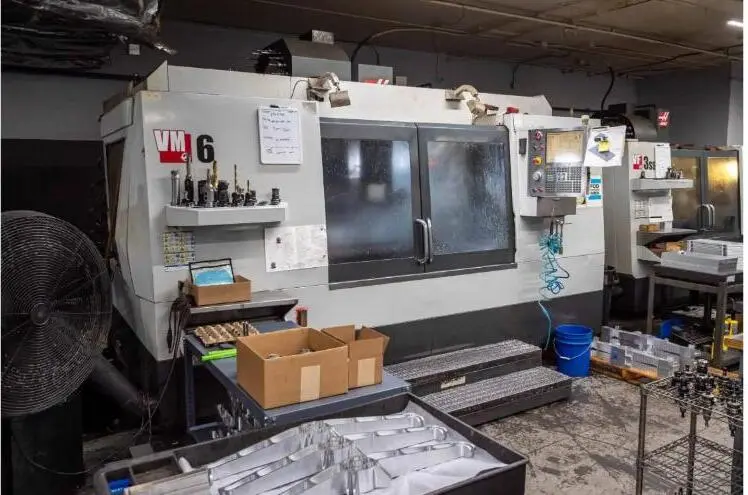
Precision Advanced Manufacturing consolidates multi-axis CNC machining, precision metal fabrication, specialty welding and secondary finishing under AS9100D and ITAR-compliant quality systems at two U.S. facilities. Programs move from prototype to sustained production without supplier transitions, documentation restarts or quality-system requalification.
Discuss program requirements with the Precision Advanced Manufacturing team.
Qualification Evidence to Request from Space Machining Suppliers
Before awarding work for precision machining space components, procurement and supplier quality teams should collect specific documentation from each candidate. These documents form a baseline qualification package that confirms capability, compliance and quality-system maturity.
- Current AS9100D certificate with revision level and defined scope, verified directly with the issuing registrar
- ISO 9001:2015 certificate confirming the broader quality management system
- ITAR registration confirmation, verifiable through the DDTC database for programs involving USML-controlled technical data
- On-time delivery metrics from comparable aerospace or space programs
- First Article Inspection packages compliant with AS9102, covering 100 percent of drawing dimensions
- Material certification workflows demonstrating heat-lot traceability to applicable AMS or MIL specifications
- Documented nonconformance and corrective action procedures
- CMM calibration records with NIST-traceable measurement history
- FOD control program documentation
Most OEM aerospace customers require AS9100 Rev D certification as a baseline qualification criterion, not a competitive differentiator. Because this certification functions as a minimum entry requirement, suppliers that cannot produce these documents on request introduce immediate audit risk that often disqualifies them before technical evaluation.
Once baseline certifications are verified, the next qualification step involves confirming technical capability to hold the tight tolerances that space components demand.
Holding Tight Tolerances on Complex Space Geometries
Space components demand tolerances that standard job shops cannot reliably hold. Propulsion brackets and valve mounts require tight tolerances on valve interfaces, machined from titanium Ti-6Al-4V or stainless 316L. Optical payload housings require bore concentricity and face flatness tolerances on optical alignment features that leave no margin for setup error.
Heat-resistant superalloys such as Inconel 718 and titanium Ti-6Al-4V require specialized high-torque, high-rigidity machining centers with high-pressure coolant. These materials cause rapid tool failure through work-hardening and extreme heat generation, and general CNC shops typically lack the stability and thermal management required for flight-critical hardware.
Multi-axis CNC centers reduce the number of setups required for complex parts, which lowers tolerance stack-up risk and shortens cycle times compared with sequential 3-axis operations. Five-axis machining for propulsion components enables continuous contour machining in a single setup, maintaining optimal tool engagement and geometric accuracy across the full part surface.
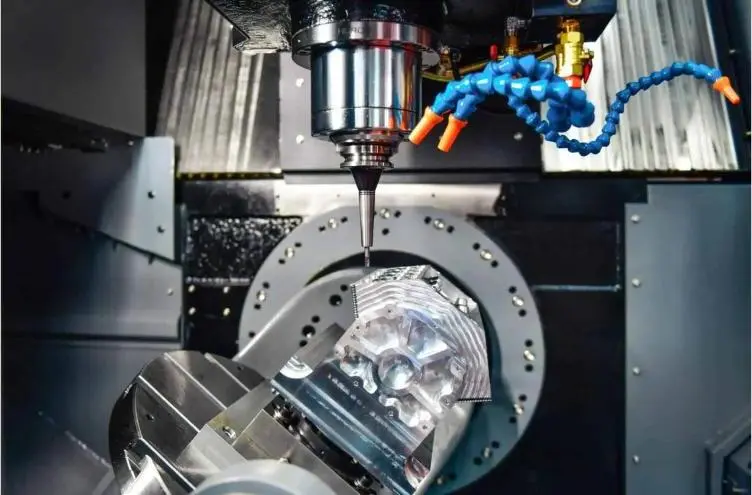
Buyers evaluating multi-axis capability should confirm documented process capability studies on representative materials, CMM verification on first articles and a defined tool-wear monitoring and compensation protocol.
Meeting AS9100D and ITAR Traceability Requirements
Lot traceability links a specific production lot of components or materials to the finished assemblies they support. This linkage enables containment of nonconforming material, structured failure investigation, counterfeit detection and recalls scoped only to affected lots.
For space programs, the traceability requirements outlined earlier extend beyond a certificate of conformance to include progress reports per part number across flight units. Aerospace material traceability requires every billet or bar stock to include a mill certificate traceable to the specific heat lot number and governed by the applicable AMS specification.
Precision Advanced Manufacturing operates under certified quality management systems with full lot traceability across materials and processes. Every project includes defined quality checkpoints and complete documentation aligned with aerospace quality standards. Buyers should request a sample traveler, a representative FAI package and evidence of calibration records before awarding production work.
Reducing Scrap, Rework and Downstream Inspection Load
Every weld repaired, component rejected, drawing revised after installation or test repeated consumes skilled labor and facility time twice, once for the initial work and again for the correction. In a labor-constrained industrial base where skilled workers form the limiting resource, this double consumption turns rework into negative capacity that reduces output of new parts. That dynamic makes first-pass quality a production-rate issue, not only a compliance issue.
Quality risk costs include extra inspection and sorting labor, production-schedule disruption while awaiting replacements, return or scrap expenses and downstream warranty claims or emergency field repairs if out-of-spec parts reach the customer.
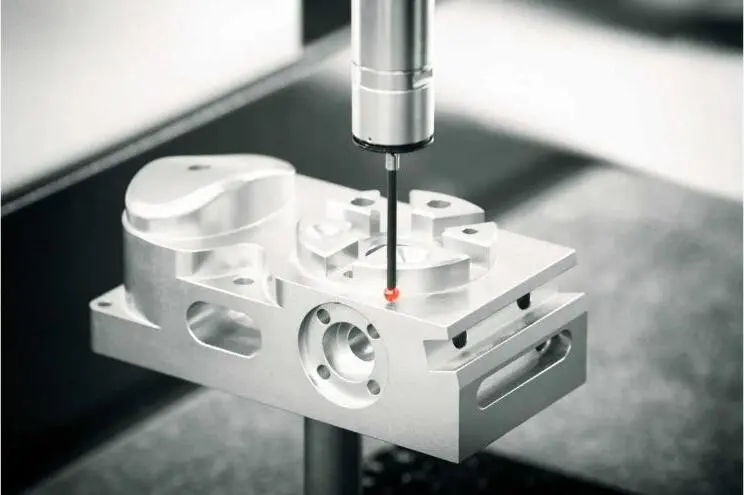
Integrating in-process and final inspection under one roof removes hand-off points where nonconformances remain undetected until downstream assembly. Precision Advanced Manufacturing implements rigorous in-process and final inspections and delivers validated parts with complete quality documentation. This approach reduces the inspection burden on customer quality teams and prevents rework cycles that erode program budgets.
Evaluation criteria include defect and nonconformance rate data from comparable programs, defined in-process inspection checkpoints in the quality plan and CMM reports accompanying first articles.
Scaling from Prototype to Sustained Production
Common reasons CNC prototypes fail during production ramp-up include design complexity that increases cycle time at scale, material substitutions that affect machinability and tolerance stack-up across multiple parts. Unoptimized toolpaths, inadequate fixturing for repeatability and supplier transition gaps that cause loss of process knowledge also contribute.
The New Space paradigm of large satellite constellations demands higher production rates and greater customization than traditional programs. Meeting both requirements, building more units faster while accommodating design variations, requires a shift from low-volume sequential processes toward adaptive production ecosystems that reconfigure quickly without sacrificing quality. These ecosystems must address lead-time and defect-rate pressures that intensify as production scales.
Precision Advanced Manufacturing supports the full product lifecycle from project-specific prototype development to sustained, multi-shift production without supplier changes or quality-system requalification. The same processes validated during prototyping carry forward into full-rate manufacturing. Buyers should confirm that a candidate supplier uses the same equipment, tooling and quality checkpoints at production volumes as during prototype validation.
Managing Total Program Cost with Integrated Capabilities
Total cost of ownership for sourced components includes acquisition costs, inventory costs, quality and nonconformance costs such as inspection, testing, sorting, rework, scrap and downtime, and logistics costs including expediting fees.
A procurement manager stated, “A supplier who delivers on time, even at 10 percent higher price, is more cost-effective than a cheaper supplier who delivers late.” Space-grade components can have lead times 6–18 months longer and qualification costs 5–15 times higher than commercial equivalents, which increases total cost of ownership and supply-chain disruption risk. Domestic sourcing often lowers total landed cost versus overseas sourcing by eliminating tariffs, ocean freight, customs delays and related risks, although the advantage depends on annual volume and design stability.
Integrating machining, fabrication, welding and finishing under one roof removes third-party hand-off risks, reduces scheduling dependencies and produces fully finished, ready-to-integrate components. In-house surface treatments and finishing services also extend component operational lifecycle and reduce downstream maintenance costs.
Evaluate total program cost with Precision Advanced Manufacturing.
Neutral Comparison of Space Machining Sourcing Options
Understanding how different supplier categories address cost, capability and compliance requirements helps procurement teams make informed sourcing decisions.
General job shops offer flexibility and competitive pricing for non-critical commercial work. They typically hold ISO 9001 certification but lack AS9100D registration and ITAR compliance, which makes them unsuitable for flight-critical space components without significant qualification investment. Engineering support remains limited, and documentation packages rarely meet aerospace prime requirements.
Specialized aerospace and space-certified manufacturers combine AS9100D quality systems, ITAR registration, multi-axis machining capability and engineering support under one quality framework. Compliance rigor is built into every production step. Responsiveness to engineering changes and prototype-to-production transitions functions as a core operational competency. This category carries higher baseline qualification requirements but substantially lower program risk.
Large-scale global suppliers offer volume capacity and broad material coverage. However, domestic sourcing of custom components often lowers total landed cost versus overseas sourcing by eliminating tariffs, ocean freight, customs delays and related risks, though the advantage depends on annual volume and design stability. Beyond cost, regulatory constraints further limit offshore options, because ITAR-controlled programs face legal and compliance barriers that can halt a program entirely. Material availability adds a third layer of risk, since China controls a significant share of rare earth processing capacity, and germanium and gallium used in space-grade solar cells are subject to Chinese export controls, which adds geopolitical supply risk to cost considerations.
Due-Diligence Framework for Space Machining Supplier Qualification
A structured qualification process for precision machining space components suppliers should include specific stages. This framework validates supplier capability before production commitment and reduces the risk of mid-program failures and costly requalification.
- Certification audit. Verify AS9100D and ISO 9001:2015 certificates directly with the issuing registrar. Confirm ITAR registration through the DDTC database. Review scope statements to confirm machining and special processes are covered.
- Process capability study. Request documented Cpk data on representative part features using the same materials specified for the program. Confirm CMM calibration records are NIST-traceable.
- Pilot-run validation. Award a prototype or bridge-production run before committing to full-rate production. Evaluate first-article inspection packages against AS9102 requirements and review the traveler for operator sign-off at each operation.
- Site visit. Assess equipment capability, FOD control practices, material storage and segregation and the physical quality lab. Confirm multi-axis CNC equipment is present and calibrated.
- Financial and operational stability check. Review capacity utilization, multi-shift capability and the supplier track record on comparable programs. Assess whether the supplier can absorb production ramp while maintaining quality.
Frequently Asked Questions
What certifications should a precision machining space components supplier hold?
At minimum, suppliers should hold a current AS9100D registration with a scope that covers the machining and fabrication processes required for the program. ISO 9001:2015 certification confirms the broader quality management system. For programs involving items on the U.S. Munitions List, ITAR registration functions as a legal requirement. Buyers should verify all certificates directly with the issuing registrar and confirm that the certificate scope matches the work being awarded. Precision Advanced Manufacturing holds the certifications described earlier in this article.
How does a single-source manufacturer reduce program risk compared with a fragmented supply chain?
As discussed earlier, fragmented supply chains create documentation gaps and scheduling dependencies at every hand-off. A single-source partner maintains one quality system, one set of process records and one point of accountability from raw material receipt through final inspection. Engineering changes propagate faster, traceability packages remain complete and prototype-to-production transitions do not require supplier requalification. As noted above, Precision Advanced Manufacturing consolidates these capabilities under one roof at two U.S. facilities.
What materials and geometries are typical for satellite and launch-vehicle precision machining?
Satellite structures commonly use aluminum alloys for bus panels and brackets, titanium Ti-6Al-4V for propulsion brackets and optical payload housings, stainless steel for valve mounts and Invar for alignment-critical structures where thermal stability is essential. Launch-vehicle components often use Inconel alloys for high-temperature propulsion applications. Complex geometries such as thin walls, deep pockets, tight-tolerance bores and multi-feature interfaces require multi-axis CNC machining to achieve required tolerances in a single setup and avoid cumulative error from multiple fixturings. Precision Advanced Manufacturing works with a broad range of aerospace-grade metals and alloys suited to these applications.
How does a supplier transition mid-program without disrupting schedules?
Supplier transitions mid-program carry real risk because process knowledge can be lost, documentation must be reconstructed and requalification consumes schedule. A structured transition begins with a pilot build or validation run using the new supplier equipment and quality system, with full first-article inspection before production quantities are released. Complete material traceability and engineering documentation from the outgoing supplier must transfer to the incoming partner. Precision Advanced Manufacturing supports mid-program transitions by providing complete documentation, material traceability and engineering support to maintain continuity, beginning with pilot builds to minimize risk.
What does a complete documentation package for a precision-machined space component include?
A complete package includes raw material certifications with heat-lot numbers traceable to the applicable AMS or MIL specification, a first article inspection report covering all drawing dimensions per AS9102, process certifications for any special processes such as anodizing or passivation, a certificate of conformance signed by a responsible quality representative and a traveler tracking the part through every operation with operator sign-off at each step. For space programs, primes may also require configuration control records, calibration evidence and an End Item Data Package assembled from execution-level data.
Decision Checklist for Space Machining Supplier Selection
Procurement, program and supplier quality teams can apply the following checklist when evaluating candidates for precision machining space components. This consolidated list combines evidence signals, capability requirements and operational factors into a single go or no-go tool.
- AS9100D certificate verified directly with the issuing registrar, with scope covering required processes
- ISO 9001:2015 certificate current and in scope
- ITAR registration confirmed through DDTC for USML-controlled programs
- Multi-axis CNC machining capability demonstrated on representative materials and geometries
- Documented process capability data on critical features
- AS9102-compliant first article inspection capability with ballooned inspection reports
- Full lot traceability from raw material receipt through final inspection
- NIST-traceable CMM calibration records
- Documented FOD control program
- Nonconformance and corrective action procedures with closure metrics
- In-house finishing and special-process capability or documented Nadcap-accredited subcontractor relationships
- Scalable production platform supporting prototype through multi-shift full-rate manufacturing
- Engineering support for design for manufacturability during prototype phase
- On-time delivery performance data from comparable aerospace or space programs
- U.S.-based operations for ITAR compliance and supply-chain resilience
Conclusion: Lowering Space Program Risk with Integrated U.S. Partners
Sourcing precision machining space components from non-certified or fragmented suppliers creates measurable program risk across schedule, compliance, traceability and total cost. U.S.-based, AS9100D- and ITAR-registered manufacturers that combine multi-axis CNC machining, fabrication and finishing under one quality system reduce hand-offs, maintain a single documentation chain and protect launch windows.
Precision Advanced Manufacturing delivers high-precision, tight-tolerance components for satellite, launch-vehicle and space-adjacent programs with the certifications and integrated capabilities discussed throughout this article. Programs scale from prototype to full-rate production without supplier transitions or quality-system requalification.