Key Takeaways for UAV CNC Machining Programs
-
Precision CNC machining for UAV components relies on multi-axis capabilities, in-house programming, and material expertise to meet tight tolerances and flight requirements.
-
AS9100D certification with ITAR registration and full material traceability forms a baseline that protects compliance and reduces audit exposure for defense UAV programs.
-
Selecting a supplier with scalable, multi-shift capacity from the start reduces requalification cycles and protects timelines from prototype through full-rate production.
-
Supplier fragmentation and traceability gaps create cascading risks, including out-of-spec parts, compliance exposure and integration delays that can derail mission-critical UAV programs.
-
Precision Advanced Manufacturing consolidates 5-axis CNC machining, certified quality systems and full traceability under one roof, connecting programs with specialists who support UAV platforms from prototype through production.
Precision CNC Machining Requirements for UAV Components
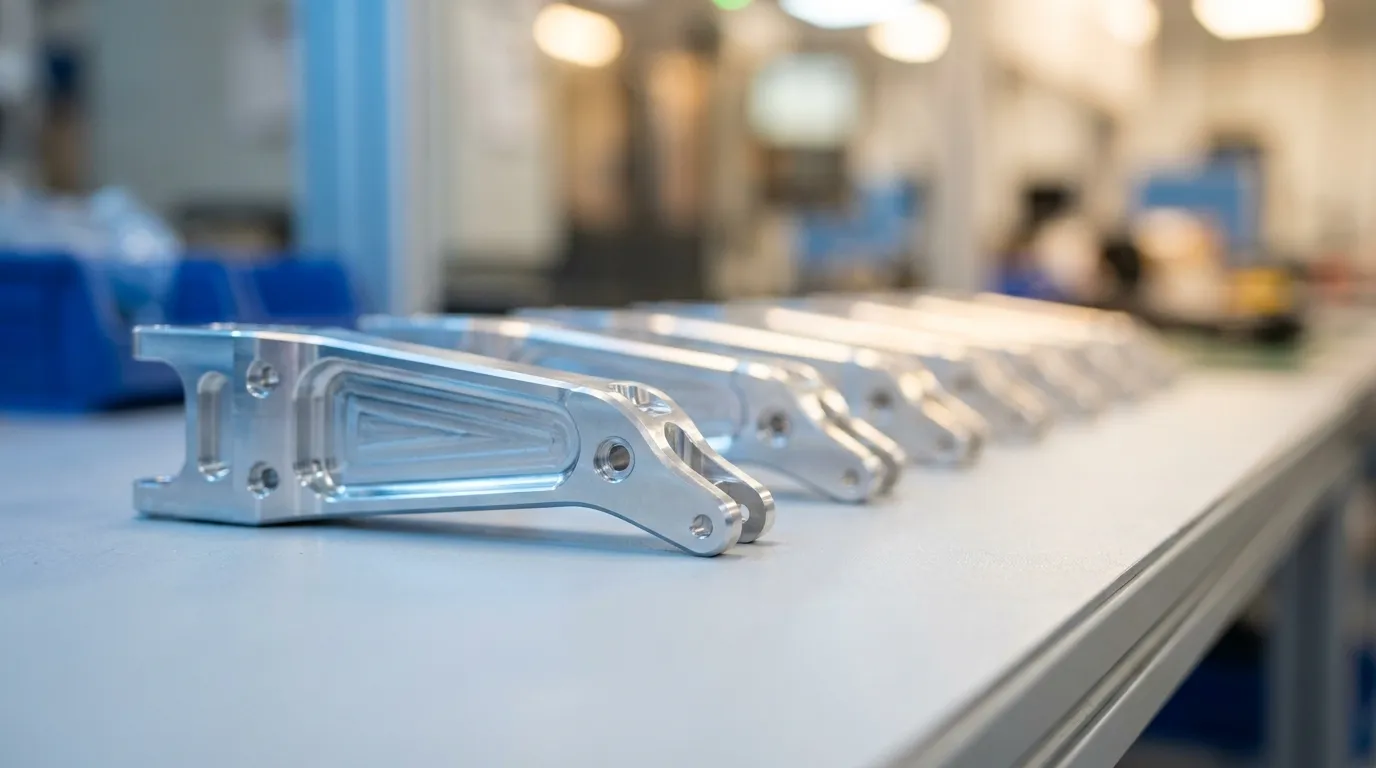
Precision CNC machining uses programmable software to execute complex cuts on metal stock with high repeatability. For UAV applications, this process produces structural frames, motor mounts, brackets, sensor housings and propulsion interfaces that must meet aerospace-grade dimensional requirements. UAV frames increasingly demand the same tolerances as manned aircraft structural components, including ribs, spars and bulkheads. A part that fails dimensional requirements can ground a program, trigger costly rework or compromise mission-critical flight performance.
Evaluating Multi-Axis Capabilities for Tight UAV Tolerances
Multi-axis CNC machining forms the foundation of UAV component production. Three-axis equipment handles simpler geometries, but UAV airframes, propulsion housings and sensor brackets often require complex contoured surfaces and intersecting features that need more capable platforms. Five-axis CNC machining centers cut multiple faces in a single setup, which eliminates repositioning errors and maintains tight tolerances across complex geometries with repeatability across production batches.
These multi-axis capabilities directly support the tight tolerances that UAV propulsion and structural components require. Motor mount flatness and hole position in propulsion components must hold tight tolerances to prevent vibration and asymmetric thrust. Frame geometry symmetry on multirotor UAVs depends on precise arm-length tolerances that prevent yaw tendency and asymmetric power consumption. Without consistent multi-axis performance, these functional prerequisites for stable flight cannot be maintained across production runs.
In-house CNC programming and tooling development matter as much as the equipment. Suppliers that manage programming internally can refine toolpaths, tighten tolerances and resolve manufacturability issues before cutting begins. This approach shortens iteration cycles and protects program schedules.
Material selection also plays a central role. 7075-T6 aluminum alloy offers tensile strength approaching certain steels with a strong strength-to-weight ratio, which makes it a preferred choice for load-bearing UAV structures such as arm booms, landing gear and motor mounts. 6061-T6 aluminum provides balanced mechanical performance, corrosion resistance after anodizing and ductility, which suits electronic housings and non-load-bearing covers. Titanium and nickel superalloys such as Inconel 718 support UAV propulsion systems that share metallurgical requirements with rocket engine components. A qualified supplier demonstrates fluency across this full material range.
Certified Quality Systems for UAV CNC Machining Programs
AS9100D is the mandatory quality standard for flight-ready and flight-adjacent components. It extends ISO 9001 with aerospace-specific requirements for risk management, configuration control and traceability. For UAV programs, this certification functions as a baseline requirement. Suppliers operating without it introduce compliance risk that procurement and supplier quality teams cannot accept.
ITAR registration is equally nonnegotiable for defense UAV programs. Executive orders are accelerating the push for U.S.-made drone systems, which increases demand for domestic ITAR-registered manufacturing partners that secure sensitive supply lines. Defense and government UAS programs operate within a complex regulatory landscape that includes ITAR/EAR, NDAA §889, MIL-STD-810 and CMMC 2.0. A supplier without ITAR registration cannot legally participate in these programs.
First Article Inspection per AS9102 is a required process before series production. Aerospace aluminum machined parts require FAI before series production, along with material certifications tracing every part to its raw material heat lot per AMS standards. CMM validation confirms dimensional compliance on critical features. Primary quality documentation for mission-critical UAV parts includes dimensional inspection records, CMM reports for critical features, material certificates with full heat-lot traceability from the mill and certificates of conformance for every delivery batch.
Full material traceability closes the loop. Every part must be traceable from the finished component back to the raw material heat lot. Suppliers that cannot provide this documentation create audit exposure and compliance risk for the programs they support.
Scaling from Prototype to Production Without Disruption
Scalable capacity protects program timelines during the shift from prototype to production. Supplier transitions mid-program rank among the most common sources of schedule disruption. When a prototype supplier lacks capacity or process discipline for full-rate production, programs face requalification cycles, new FAI requirements and integration delays. Selecting a supplier with established processes and capacity for the full product lifecycle from the outset reduces these risks.
Multi-shift operations provide a practical indicator of production readiness because they signal capacity to absorb surge requirements and respond to compressed timelines. This capacity is no longer optional as federal initiatives expand demand for domestic UAV production. Domestic manufacturing partners must scale from prototypes to high-volume production while maintaining consistent quality. Suppliers that validate quality during prototyping and maintain that same quality at production volume reduce the requalification risk that derails programs when capacity falls behind demand.
Precision Advanced Manufacturing supports the full product lifecycle from prototype development to sustained, multi-shift production. Programs move from initial design to full-rate manufacturing without changing suppliers or repeating qualification steps, which protects both compliance and schedules.
Managing Risks from Out-of-Spec Parts and Fragmented Suppliers
Out-of-spec parts generate cascading program costs. Rework, scrap, expedited reorders and integration delays compound quickly on mission-critical timelines. A single rejected part in high-value materials can cost thousands of dollars in material and rework, and that figure does not include schedule impact.
Traceability gaps create compliance exposure. When material certifications are incomplete or CMM records are unavailable, supplier quality engineers carry the burden of verification. Centralizing fabrication and inspection within an ITAR-registered U.S. facility simplifies export compliance, strengthens traceability and reduces schedule risk during audits.
Supplier fragmentation multiplies handoff risk. When machining, finishing, inspection and documentation are split across multiple vendors, each transition becomes an opportunity for error, delay or lost traceability. An integrated U.S. facility that combines multi-axis CNC machining, precision fabrication, finishing and engineering support under one roof reduces these handoffs. Trade conditions, global risks and federal policies are driving supply chain resiliency strategies among OEM clients, and domestic contract manufacturers with integrated capabilities are positioned to benefit.
Precision Advanced Manufacturing consolidates these capabilities under the certified quality systems described above at facilities in California and Texas. Programs receive finished, ready-to-integrate components with full documentation, which reduces the inspection burden on customer quality teams and protects program milestones.
Connecting with an Aerospace Manufacturing Specialist
Procurement and program management teams sourcing precision CNC machining for UAV components gain value from early engagement with a manufacturing specialist who understands aerospace tolerances, compliance requirements and production scaling. Connecting before RFQ submission allows suppliers to identify manufacturability issues, confirm material availability and align documentation scope to program requirements.
Requesting a Tailored Quote for ITAR-Registered UAV Machining
A tailored quote for ITAR-registered UAV machining should address capabilities, tolerances, materials, certifications and production strategy. Suppliers that provide a detailed, customized plan at the quote stage demonstrate the process discipline required for mission-critical programs. Documentation scope, including FAI level, CMM reporting requirements and material traceability, should be confirmed during the RFQ stage to meet regulatory and customer-specific data flow-downs.
Precision Advanced Manufacturing delivers a detailed quote that covers these elements. The process begins with a conversation about program requirements and concludes with a production strategy aligned to mission timelines.
Conclusion: Shortlisting Certified U.S. Partners for 5-Axis CNC UAV Frames
Evaluating precision CNC machining suppliers for UAV components benefits from a structured framework. Technical capabilities, including 5-axis CNC for UAV frames, multi-axis turning, in-house programming and expertise in aerospace-grade aluminum, titanium and exotic alloys, establish the foundation. Certified quality systems with FAI, CMM validation and full material traceability protect compliance. Scalability from prototype to multi-shift production reduces supplier transition risk. The integrated approach described above removes the handoff failures that create out-of-spec parts, traceability gaps and program delays.
Precision Advanced Manufacturing meets these criteria from facilities in California and Texas. Programs receive certified quality, full traceability and scalable production support under one roof.
Begin production with a certified U.S. partner built for mission-critical UAV programs.
Frequently Asked Questions
What certifications does Precision Advanced Manufacturing hold for UAV machining programs?
Precision Advanced Manufacturing operates under AS9100D and ISO 9001:2015 registered quality management systems and is ITAR registered. These certifications cover risk management, configuration control, traceability and documentation requirements for flight-critical and defense UAV components. Every project includes defined quality checkpoints and full documentation aligned with aerospace quality standards.
What quality documentation is provided with UAV machined parts?
Standard documentation includes material certificates with full heat-lot traceability, certificates of conformance and dimensional inspection records. First Article Inspection reports aligned with AS9102 and CMM reports for critical features are available to support qualification requirements. Documentation scope is confirmed during the quote stage to align with program-specific data flow-down requirements.
What materials does Precision Advanced Manufacturing machine for UAV components?
Precision Advanced Manufacturing works with aerospace-grade aluminum alloys, titanium, stainless steel and exotic alloys including nickel superalloys. Material selection is driven by the structural, thermal and weight requirements of each UAV application. The team provides engineering support to help programs select and qualify the right material for each component.
Can Precision Advanced Manufacturing support a mid-program supplier transition?
Precision Advanced Manufacturing supports supplier transitions by providing complete documentation, material traceability and engineering support to maintain continuity. The team can begin with pilot builds or validation runs to reduce risk while integrating into existing supply chains. This approach protects program schedules and avoids the requalification delays that typically accompany supplier changes.
How does Precision Advanced Manufacturing scale from prototype to full-rate production?
Precision Advanced Manufacturing supports the full product lifecycle from prototype development through sustained, multi-shift production. Established processes and capacity allow programs to move from initial builds to full-rate manufacturing without changing suppliers or repeating qualification steps. The same quality validated during prototyping is maintained at production volume, which protects both compliance and program timelines.