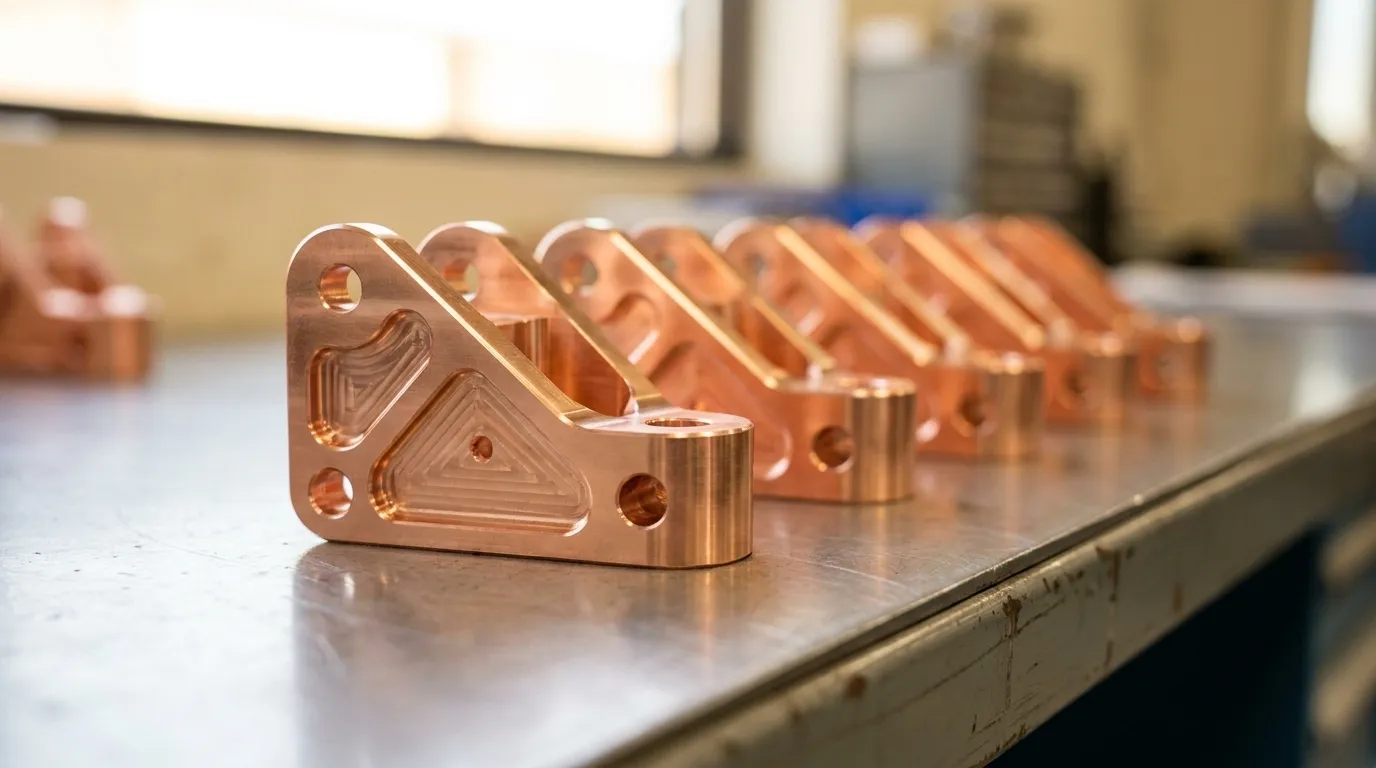
Key Takeaways for Copper CNC Machining
- Precision CNC machining copper introduces gumming, burrs, thermal distortion and traceability gaps that increase risk for aerospace programs.
- Alloy selection, tooling geometry, cutting parameters and coolant strategy determine tolerance control and conductivity on copper components.
- AS9100D, ISO 9001:2015 and ITAR credentials, combined with full material traceability and in-house metrology, form the baseline for aerospace suppliers.
- A single scalable U.S. manufacturer removes requalification risk when copper parts move from prototype through full-rate production.
- Precision Advanced Manufacturing delivers certified domestic copper machining backed by integrated engineering, multi-axis capacity and complete documentation, and start your program evaluation with the team.
How Copper Machining Creates Program Risk
Copper alloys introduce machining challenges that differ from aluminum or steel. High ductility causes the material to deform plastically instead of shearing cleanly, which produces a gummy chip that smears across the cutting edge. This smearing accelerates tool wear, degrades surface finish and increases the probability of out-of-tolerance dimensions on critical features.
Thermal conductivity compounds this problem. Copper moves heat rapidly into the workpiece and fixturing instead of through the chip. That behavior can cause localized thermal distortion on thin-walled sections or precision bores. For heat sink components and electrical bus parts where flatness and conductivity are both specified, even minor distortion creates a nonconformance.
Burr formation also drives downstream cost. Copper’s ductility produces stubborn burrs at exit edges, cross-holes and threaded features. Removing these burrs without altering part geometry requires controlled deburring processes, which add time and inspection burden when not planned into the production workflow from the start.
Beyond these manufacturing challenges, aerospace and defense procurement teams face a compounding risk around traceability. Suppliers without certified quality systems often cannot provide material certifications, first-article inspection reports or in-process records that satisfy AS9100D audit requirements. A single documentation gap can place an entire lot on hold, delay integration and trigger corrective action cycles that consume program schedule.
Process Choices That Stabilize Copper Machining
Alloy selection sets the foundation for stable machining. C110 electrolytic tough pitch copper offers high electrical conductivity and supports bus bars and electrical contacts, but its ductility makes it the most challenging to machine cleanly. C145 tellurium copper adds a small tellurium content that improves machinability while retaining acceptable conductivity. C101 oxygen-free copper supports maximum conductivity and purity for waveguide and RF components and requires a controlled cutting environment that prevents contamination and surface smearing.
Tooling geometry then drives chip control. Sharp, polished cutting edges with high positive rake angles reduce cutting forces and limit smearing. Uncoated carbide or diamond-like carbon coated tools often perform best on copper because standard TiN or TiAlN coatings can increase built-up edge on ductile materials. Polished flutes promote chip evacuation and reduce friction that contributes to gumming.
Cutting parameters must balance speed, finish and stability. Higher surface speeds often improve finish on copper. Feed rates must still produce a chip that clears the cutting zone instead of re-cutting. Shallow depths of cut on finishing passes limit heat input and help preserve dimensional stability on tight-tolerance features.
Coolant strategy affects both tool life and part cleanliness. Flood coolant with a low-concentration water-soluble oil supports most copper alloy operations. For components with conductivity specifications, coolant residue must be removed completely. Ultrasonic cleaning provides a reliable post-machining step that Precision Advanced Manufacturing integrates into its finishing workflow.
Workholding on copper also requires controlled clamping force. Excessive clamping distorts thin walls and bores. Soft jaws, collet chucks and fixtures that distribute load evenly across the part surface help maintain geometry through the full cutting cycle.
Compliance, Traceability and Documentation for Aerospace Copper
Aerospace and defense programs require documentation that extends well beyond dimensional inspection. AS9100D mandates a risk-based quality management system with defined process controls, nonconformance management and records retention. ISO 9001:2015 establishes the baseline quality framework. ITAR registration applies to any supplier handling defense-related technical data or hardware, including copper components used in military platforms, satellites and UAV systems.
Material traceability begins at receiving inspection. Each lot of copper alloy must arrive with a material test report that confirms alloy designation, heat number, mechanical properties and chemical composition. That traceability chain must remain intact through every production step, from raw stock to finished part, so that any nonconformance can be isolated to a specific lot without quarantining unaffected inventory.
First-article inspection reports, in-process inspection records and final dimensional reports form standard deliverables for aerospace programs. Suppliers without in-house metrology capability introduce a gap. Parts leave the machine and enter a separate inspection queue at an outside lab, which breaks the traceability chain and adds schedule risk.
Precision Advanced Manufacturing operates under these registered quality systems and maintains ITAR credentials. Every copper component moves through defined quality checkpoints with full documentation. Procurement and supplier quality teams receive inspection records and material certifications that satisfy audit requirements without additional supplier coordination.
Scaling Copper Parts from Prototype to Production
Program teams face added risk when copper components move from prototype to full-rate production through different suppliers. A prototype machined on one platform with one fixturing approach may not replicate on a different machine or at a different facility without a formal requalification effort. That effort adds cost and schedule impact that many programs do not plan into early budgets.
A single scalable manufacturing partner reduces this exposure. When the same CNC programs, tooling setups, inspection plans and quality records carry from prototype through production, dimensional repeatability improves without a new qualification cycle. Engineering changes during development enter a controlled document system that follows the part into production.
Precision Advanced Manufacturing supports the full product lifecycle from prototype development through sustained multi-shift production. The same engineering team that refines a copper heat sink or electrical contact during prototyping applies those validated parameters to production runs. That continuity preserves tolerance control and documentation consistency across the program lifecycle.
Discuss your prototype and production requirements with Precision Advanced Manufacturing’s engineering team.
Supplier Evaluation Criteria for U.S. Copper Machining Partners
Procurement and supplier quality teams benefit from a structured framework when evaluating precision CNC copper machining suppliers for aerospace programs. The following criteria distinguish certified domestic partners from generic or offshore alternatives.
Certifications: Start by confirming active AS9100D and ISO 9001:2015 registrations with current certificates, since these define the baseline quality framework. Defense and space programs add a second requirement, which is verified ITAR registration. In all cases, ensure certifications are scope-specific to machining and fabrication, not limited to a parent organization that does not cover shop-floor processes.
Material scope and traceability: Once certifications are verified, review how the supplier manages material control. The supplier must demonstrate the ability to procure certified copper alloy stock, maintain heat traceability through production and deliver material test reports with each shipment. Request a sample traceability package from a prior program to confirm depth and clarity.
Engineering involvement: In-house CNC programming, tooling development and design-for-manufacturability support shorten iteration cycles that drive prototype cost and schedule. Engineering involvement at the quote stage often signals a mature process and a focus on long-term program support.
Inspection systems: In-house metrology, including CMM capability for complex geometries, forms a baseline requirement for aerospace copper components. Confirm that first-article inspection reports and in-process records are generated internally rather than outsourced, since internal control supports faster feedback and stronger traceability.
Multi-axis CNC capacity: Complex copper components with cross-holes, precision bores and contoured surfaces require multi-axis milling and turning. Confirm that the supplier’s equipment list and workholding strategies match the geometric complexity of the program’s parts.
Production scalability: The supplier should demonstrate a clear path from prototype quantities to full-rate production on the same platform. Multi-shift capacity and documented scheduling processes signal scalable operations that can respond to ramp schedules and surge demand.
Domestic operations: U.S.-based manufacturing reduces export control complications, shortens supply chain lead time and simplifies audit access for supplier quality teams. For ITAR-controlled programs, domestic sourcing often appears as a defined program requirement.
Frequently Asked Questions
What copper alloys does Precision Advanced Manufacturing machine?
Precision Advanced Manufacturing works with a range of copper alloys including C110, C145 tellurium copper and C101 oxygen-free copper, along with other red metals. Alloy selection is evaluated against conductivity requirements, machinability and the dimensional and surface finish specifications of each program.
What certifications apply to copper components produced for aerospace and defense programs?
Precision Advanced Manufacturing operates under these registered quality systems and maintains ITAR credentials. These certifications apply to all production, including copper alloy components, and are supported by full documentation, inspection reporting and material traceability.
How does Precision Advanced Manufacturing maintain traceability for copper alloy stock?
The traceability process described in the compliance section applies to all copper stock. Documentation that begins at receiving inspection travels with each lot and appears in the finished part package.
Can Precision Advanced Manufacturing support a mid-program supplier transition for copper components?
Precision Advanced Manufacturing supports supplier transitions by providing complete documentation, material traceability and engineering review of existing part data. Pilot builds or validation runs can be structured to minimize risk while integrating into an existing supply chain.
How does Precision Advanced Manufacturing control burr formation and surface finish on copper parts?
Burr control relies on tooling selection, tuned cutting parameters and controlled deburring processes integrated into the production workflow. In-house deburring and finishing capabilities, including ultrasonic cleaning, help ensure parts meet surface finish and cleanliness specifications before final inspection.
Conclusion and Copper Supplier Checklist
Precision CNC machining copper for aerospace and defense programs requires more than capable equipment. Success depends on alloy-specific process knowledge, certified quality systems, full material traceability and a scalable production platform that maintains documentation continuity from prototype through production. Certified domestic partners with integrated engineering and in-house inspection systems reduce program risk at every stage.
Use the following checklist when evaluating precision CNC copper machining suppliers:
- Active AS9100D and ISO 9001:2015 registrations with scope covering machining and fabrication
- ITAR registration confirmed for defense and space programs
- Documented copper alloy material traceability from receiving through shipment
- In-house metrology and first-article inspection capability
- Multi-axis CNC milling and turning for complex geometries
- In-house engineering support for CNC programming and design-for-manufacturability
- Demonstrated prototype-to-production scalability on a single platform
- U.S.-based operations with audit access for supplier quality teams
- Integrated deburring, finishing and cleaning processes aligned to aerospace standards
Precision Advanced Manufacturing meets each criterion across its California and Texas facilities and provides aerospace, defense and advanced industrial programs with a certified domestic source for precision copper components.
Begin your program evaluation with Precision Advanced Manufacturing’s aerospace machining team.