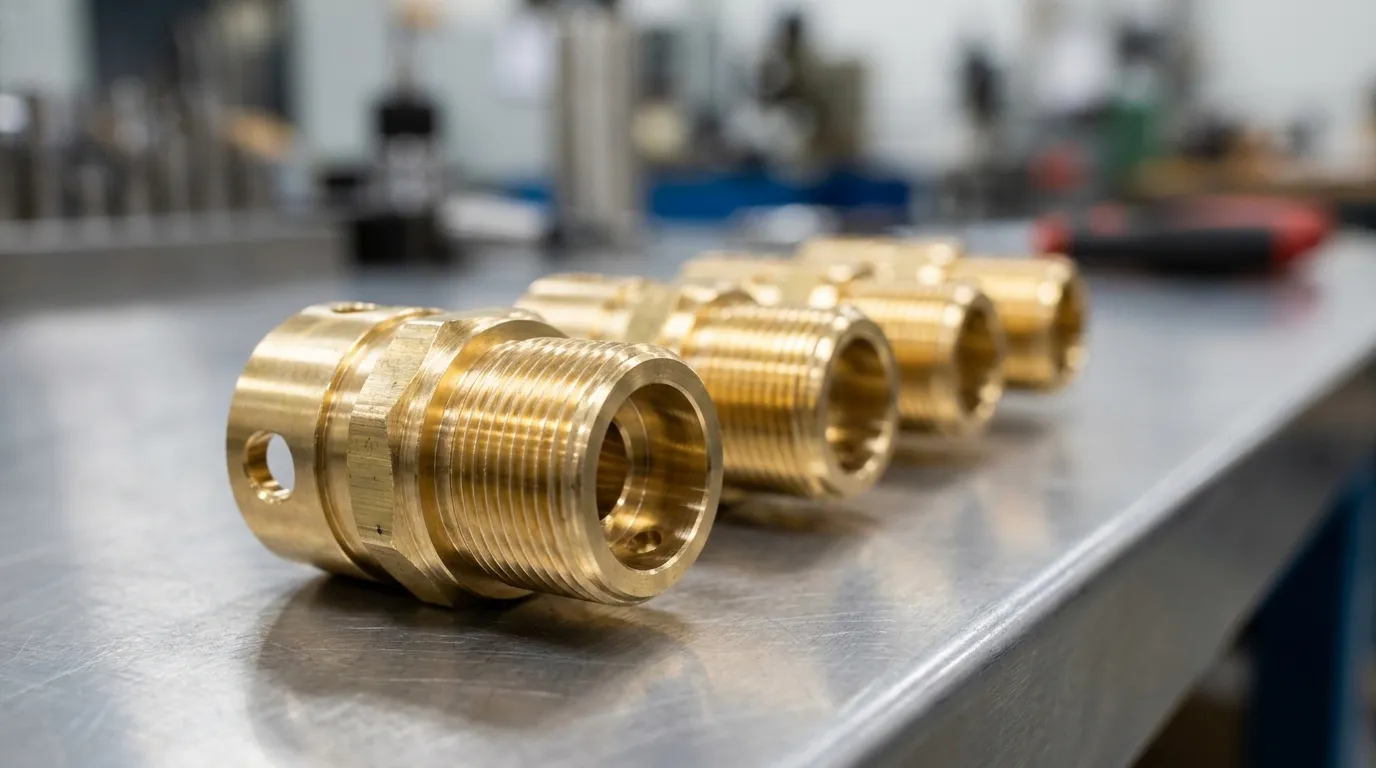
Last updated: July 12, 2026
Key Requirements for Aerospace-Grade Brass Machining
- Precision CNC machining of brass for aerospace and defense relies on certified quality systems, full material traceability and repeatable accuracy at any volume.
- Brass alloys differ in machinability. C36000 offers the highest rating, while lead-free options like C48500 and C69300 need adjusted cutting parameters to maintain quality.
- Tight tolerances on brass parts depend on controlled CNC settings, rigid fixturing, thermal stability and single-setup finishing that removes re-clamping error.
- Aerospace and defense programs require AS9100D, ISO 9001:2015 and ITAR compliance with complete documentation and traceability for every production order.
- Precision Advanced Manufacturing provides certified multi-axis CNC capacity and scalable production from prototype through full-rate manufacturing. Share project details for a brass machining proposal.
Brass CNC Settings for Aerospace-Grade Parts
Correct CNC parameters for brass keep parts in tolerance and prevent costly rework. The selected alloy guides each parameter choice.
C36000 free-cutting brass typically runs at 300 to 500 SFM with carbide or coated HSS tooling. Its lead content promotes clean chip formation, reduces tool wear and supports dimensional stability during long production runs. For lead-free grades such as C485, cutting speeds shift to roughly 250 to 400 SFM, and tooling strategies change to preserve surface quality.
Beyond alloy-specific speeds and feeds, maintaining dimensional accuracy on brass requires focused process controls:
- Sharp cutting edges that limit burrs on threads, holes and sealing surfaces
- Rigid workholding that prevents chatter on small or thin features
- Stable chip evacuation that supports consistent cycle times
- Coolant temperature control that reduces thermal drift during long runs
- Single-setup finishing on critical tight-tolerance surfaces that removes re-clamping error
RFQs for brass machined parts list the exact alloy, critical dimensions, thread standards, sealing features, surface finish and quantity so process planning can lock in stable settings before production.
Machinability of Brass Alloys in Production
Brass ranks among the most machinable engineering metals used in aerospace and defense. C36000 free-cutting brass holds a 100% machinability rating, which forms the baseline for other engineering metals. That rating reflects low cutting forces, predictable chips and strong surface finish potential at production speeds.
Different brass alloys trade machinability for strength, corrosion resistance or regulatory compliance. Common grades and relative machinability include:
- C36000 with a 100% machinability rating, tensile strength of 48,000 to 55,000 psi and suitability for high-volume precision work
- C48500 lead-free brass at roughly 85 to 90% of C360 machinability, tensile strength of 50,000 to 58,000 psi and compliance with RoHS, REACH and potable-water rules
- C69300 Eco Brass at about 95% of C360 machinability through bismuth and selenium additions, with lower tool wear than C485 for high-speed lead-free work
- C46400 naval brass at about 30% of C360 machinability, tensile strength of 58,000 to 75,000 psi and selection for saltwater corrosion resistance over machining speed
Brass and copper provide strong machining stability due to low cutting forces and predictable chips. Dimensional variation often stays lower than stainless steel or titanium, which supports consistent results on connectors, fasteners, valve bodies and threaded components.
C360 Brass Machining Tolerances and Stability
Typical tolerance capability for brass depends on machine condition, fixturing, thermal control and disciplined inspection practices.
Achieving tight specifications at production volumes requires process controls beyond standard machining. Critical factors include spindle runout, machine warm-up cycles, consistent coolant temperature and real-time tool-wear monitoring. To preserve the stability created by these controls, tight-tolerance surfaces on brass parts usually run in a single setup that removes re-clamping error. Even with these measures, tolerances tighter than standard ranges remain challenging and call for specialized equipment and secondary finishing.
Compliance and Traceability in Brass Machining
Aerospace and defense OEMs expect documented compliance at every supply-chain tier. Certified brass machining partners reduce audit exposure, close traceability gaps and lower program risk.
Required certifications for aerospace suppliers include an AS9100-certified quality management system, an ISO 9001-certified quality management system and ITAR registration. Precision Advanced Manufacturing holds AS9100D and ISO 9001:2015 registrations and maintains ITAR registration across commercial aerospace, military and defense, space and satellite and UAV programs.
Compliance at Precision Advanced Manufacturing integrates directly into production workflows. Every project includes:
- Defined quality checkpoints aligned with AS9100D requirements
- Material certifications and lot traceability from incoming stock through final shipment
- First article inspection and in-process measurement with micrometers, calipers and CMM verification
- Complete inspection and documentation packages delivered with each order
- ITAR-compliant handling for controlled technical data and defense-related components
This documentation structure lightens the inspection load on customer quality teams and simplifies supplier audits. Aerospace and defense manufacturing depends on quality, traceability and regulatory compliance supported by rigorous process controls, documented procedures and comprehensive inspection protocols.
Multi-Axis CNC Milling and Turning for Brass Components
Precision Advanced Manufacturing runs advanced multi-axis CNC milling and turning equipment across two specialized facilities in California and Texas. This equipment produces complex, high-tolerance brass components with repeatable accuracy from prototype through production.
Integrated capabilities in each facility include:
- Multi-axis CNC milling and turning for complex geometries and tight-tolerance features
- In-process inspection at defined checkpoints to catch dimensional drift early
- Final CMM inspection and documentation for critical features such as concentricity, position and thread form
- Secondary finishing services such as deburring, brush finishing, laser marking and hardware installation
- Treatments including anodizing, passivation, plating and ultrasonic cleaning aligned with aerospace standards
Consolidated machining, finishing and inspection in one facility removes supplier handoffs that add dimensional risk, schedule uncertainty and traceability gaps. Components ship as ready-to-integrate parts with full documentation, which supports smoother assembly and program launches.
Discuss multi-axis brass machining and receive a capability-based quotation.
Scaling Brass Machining from Prototype to Production
Program risk stays lower when a single supplier sustains quality from prototype through full-rate production. Precision Advanced Manufacturing supports the full product lifecycle using the same certified processes and quality systems at each stage.
Quality control for tight-tolerance brass parts follows a structured workflow of incoming material check, first article inspection, in-process measurement, CMM verification and final inspection. This workflow applies at prototype quantities and scales directly as production volumes grow.
For programs shifting from an existing supplier, Precision Advanced Manufacturing provides documentation transfer, material traceability and engineering support to maintain continuity. Pilot builds or validation runs help manage risk during integration into current supply chains. Reshoring and supply chain localization trends in North America continue to drive new metalworking investments, and a single certified U.S. partner with scalable capacity reduces fragmentation across the program lifecycle.
Frequently Asked Questions
What brass alloy fits aerospace and defense CNC machining?
C36000 free-cutting brass serves as the most common alloy for precision CNC machining in aerospace and defense. It carries the highest machinability rating among brass alloys, supports complex geometries and tight tolerances and maintains consistent surface finish in high-volume work. When programs require lead-free compliance for regulatory or environmental reasons, C48500 or C69300 Eco Brass often enter evaluation. C46400 naval brass supports components exposed to saltwater or corrosive marine environments where corrosion resistance outweighs machining speed.
What tolerances are typical on CNC machined brass parts?
Standard CNC machining of brass often achieves plus or minus 0.005 in on most linear dimensions. Precision machining under controlled conditions can reach plus or minus 0.001 in on critical features such as turned diameters, milled surfaces and precision holes. Achieving these tighter limits requires stable, well-maintained CNC equipment, rigid fixturing, thermal management, real-time tool-wear monitoring and CMM verification. Tolerances tighter than plus or minus 0.001 in remain possible on selected features but require specialized equipment and secondary finishing. Precision Advanced Manufacturing applies these controls to meet aerospace and defense dimensional requirements.
What certifications should a brass machining supplier hold?
As outlined in the compliance section, AS9100D, ISO 9001:2015 and ITAR form the baseline certifications for aerospace and defense machining. AS9100D defines quality management requirements specific to aviation, space and defense. ISO 9001:2015 establishes the core quality framework. ITAR registration covers components, technical data and processes subject to U.S. export control rules. Beyond holding these credentials, qualified suppliers demonstrate active use of their systems through documented procedures, internal audits and traceability that withstands customer review.
How does a supplier maintain traceability for brass components?
Full traceability for machined brass components relies on documented control from incoming material through final shipment. That control includes material certifications tied to lot numbers, in-process inspection records at defined checkpoints, first article inspection documentation, CMM reports for critical features and a final inspection package released with each shipment. Precision Advanced Manufacturing maintains this structure under its AS9100D and ISO 9001:2015 systems, which supports audits, configuration management and downstream assembly verification.
Next Steps for Mission-Critical Brass Components
Programs that specify tight-tolerance brass components under AS9100D, ISO 9001:2015 and ITAR benefit from a supplier with certified processes, full traceability and scalable capacity. Precision Advanced Manufacturing delivers these capabilities from two U.S. facilities, supporting prototype through full-rate production without supplier changes or documentation gaps. An aerospace manufacturing specialist can review part specifications, compliance needs and production timelines to define a clear path forward.