Key Takeaways
-
Precision CNC machining produces tight-tolerance aerospace components using multi-axis milling for complex geometries in UAVs and space systems.
-
Aerospace programs rely on CMM-verified tolerances and materials like Ti-6Al-4V titanium, Inconel 718, and 7075 aluminum that demand specialized tooling and cooling.
-
Core certifications include AS9100D for aerospace quality management and ITAR for defense compliance, supporting traceability and risk control.
-
The machining workflow covers CAD programming, multi-axis operations, AS9102 inspection, and integrated finishing to support smooth prototype-to-production scaling.
-
Partner with Precision Advanced Manufacturing, an ITAR-registered, AS9100D-certified provider, for compliant, scalable aerospace CNC machining.
How Precision CNC Machining Supports Aerospace Components
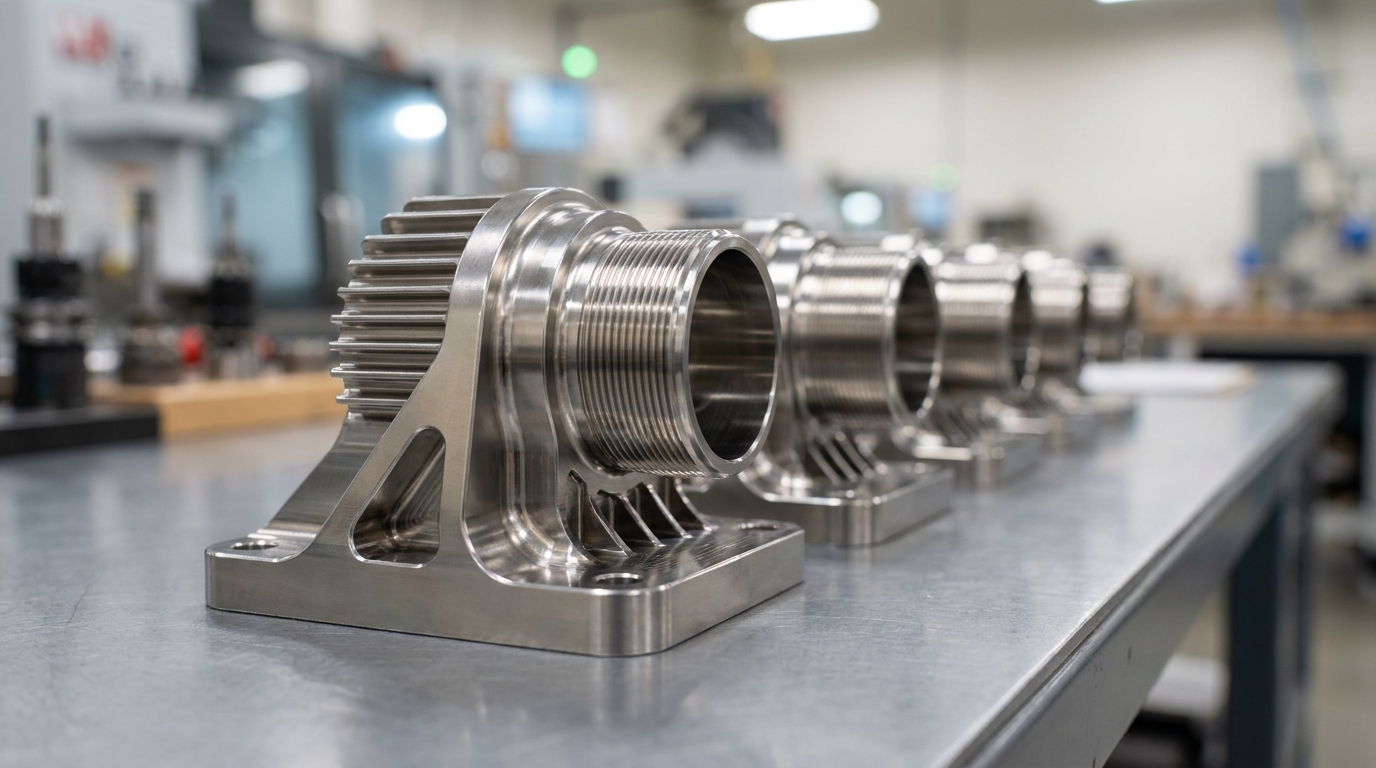
Precision CNC machining for aerospace components uses advanced multi-axis milling and turning to produce complex, tight-tolerance parts for flight-critical systems. 5-axis CNC milling centers machine complex aerospace parts from multiple angles without repositioning, which minimizes tolerance stack-ups.
Aerospace programs require components that withstand extreme environments, from the vacuum of space to high-altitude UAV operations. This expanding application range drives strong market growth, with the global military drone market projected to reach $98.24 billion by 2033 at 8.9% CAGR and commercial drones expected to account for 70% of the global UAV market by 2026. These trends increase demand for lightweight, durable components with intricate geometries and exceptional precision. Precision Advanced Manufacturing’s multi-axis expertise supports the complex machining requirements of next-generation aerospace platforms.
Tolerances and Material Choices in Aerospace CNC Machining
Aerospace CNC machining achieves tolerances significantly tighter than conventional manufacturing. Precision CNC machining holds tight tolerances consistently. Standard CNC milling operations maintain these tolerances with verification through Coordinate Measuring Machines (CMMs) and adherence to ASME Y14.5 geometric dimensioning and tolerancing standards. These verification methods confirm that production parts match design intent across multiple runs.
Achieving these tight tolerances depends heavily on material selection, because aerospace alloys respond differently during machining. Titanium alloys like Ti-6Al-4V and Inconel 718 introduce significant machining challenges. These materials have lower machinability than aluminum alloys and demand specialized cutting strategies. Inconel 718 work-hardens almost instantly when cutting tools contact the material and generates extreme heat during machining, which requires high-pressure coolant systems and dedicated tooling approaches.
While superalloys like Inconel support high-temperature environments, aluminum alloys remain the workhorse for many aerospace structures. Aluminum 7075 provides excellent strength-to-weight ratios for airframe components. However, aluminum 7075-T6 still requires tailored machining strategies to control distortion and maintain dimensional accuracy.
Precision Advanced Manufacturing’s experience with titanium, Inconel, and aerospace-grade aluminum supports consistent repeatability for critical aerospace components. The team applies advanced cooling systems, optimized toolpaths, and specialized tooling to manage heat, tool wear, and dimensional stability.
Certifications and Compliance Requirements for Aerospace CNC Shops
AS9100D certification sets the benchmark for aerospace quality management systems. AS9100D builds on ISO 9001:2015 with additional requirements for risk management, traceability, and product safety. These aerospace-specific additions include operational risk management, configuration management, product safety processes, and counterfeit parts prevention controls. Together, these requirements help suppliers meet the demanding expectations of aerospace manufacturers.
ITAR registration plays a central role in defense and export-controlled aerospace projects. ITAR compliance is mandatory for these programs and requires strict security controls to avoid multimillion-dollar fines and removal from the supply chain. These certifications reduce rework risk, support consistent quality, and maintain regulatory compliance across the aerospace supply base.
Precision Advanced Manufacturing maintains AS9100D, ITAR, and ISO 9001 compliance. This combination positions the company as a strong partner for U.S. defense and space programs that require rigorous quality assurance and secure handling of sensitive data.
The Five-Step CNC Machining Workflow for Aerospace Parts
Aerospace CNC machining follows a structured five-step workflow that supports quality control and traceability at every stage. This structure helps teams maintain precision while meeting aerospace documentation and inspection requirements.
1. Design and CAD Programming: Engineers translate aerospace specifications into detailed CAD models and CNC programs, including geometric dimensioning and tolerancing requirements.
2. CNC Programming and Setup: Advanced CAM software generates toolpaths for multi-axis machining, which reduces setup changes and supports consistent precision.
3. Multi-Axis Machining: 5-axis CNC machining improves accuracy by reducing multiple setups and enabling continuous machining from different angles, which lowers misalignment risk.
4. Inspection and Validation: AS9102 First Article Inspection provides digital traceability for aerospace parts by linking each component to its material lot. CMM verification confirms dimensional accuracy across all critical features.
5. Finishing and Integration: Secondary operations such as welding, surface treatments, and kitting prepare components for assembly and system integration.
Integrated finishing capabilities reduce delays between separate vendors and simplify program management. Precision Advanced Manufacturing’s one-roof model, which combines CNC machining, fabrication, welding, and kitting, shortens lead times while preserving quality control from raw material through shipment.
Scaling Aerospace CNC from Prototype to Production
Scaling aerospace CNC work from prototype to production requires a structured plan that protects quality and schedule. Leading manufacturers achieve cost reductions while maintaining consistent quality as volumes increase. Effective scaling depends on stable processes, standardized tooling, and integrated quality systems.
Statistical Process Control (SPC) becomes a key tool during this transition. First Article Inspection focuses on high process capability for critical characteristics. This statistical foundation supports predictable performance as production ramps.
Common scaling pitfalls include unplanned tooling changes, incomplete process documentation, and gaps between prototype and production quality systems. Many shops excel at prototypes but lack production-scale equipment such as HMCs and automation cells, which creates process discontinuities.
Precision Advanced Manufacturing’s scalable platform supports smooth transitions from prototype through multi-shift production while holding aerospace tolerance and documentation requirements. Request a quote to review your scaling strategy, volume targets, and schedule.
Addressing Common Challenges in Precision Aerospace Machining
Aerospace CNC machining encounters distinct technical and supply chain challenges that require targeted solutions. Material behavior often drives the most complex issues, with titanium’s poor thermal conductivity causing rapid tool wear and spring-back that affects dimensional accuracy. Superalloys add further complexity, as Inconel 718 work-hardens quickly and needs specialized carbide or ceramic tooling with high-pressure coolant.
Supply chain reliability also affects program outcomes through rework, non-compliance, and late deliveries. Quality gaps between prototype and production phases can disrupt entire aerospace programs, which makes supplier selection a strategic decision.
Precision Advanced Manufacturing addresses these risks through integrated services that combine advanced CNC capabilities, engineering support, specialized tooling knowledge, and robust quality systems. This model reduces supplier fragmentation and supports the precision and compliance levels aerospace customers expect.
Checklist for Vetting Aerospace CNC Machining Partners
Evaluating aerospace CNC partners works best with a structured checklist that covers certifications, capabilities, and location. Essential certifications include AS9100D for aerospace quality, ITAR registration for defense work, and ISO 9001 for baseline quality systems. High-volume CNC suppliers should hold ISO 9001 at minimum, with AS9100 required for aerospace programs.
Technical capabilities should include multi-axis CNC machining, precision fabrication, and the ability to support both prototypes and production volumes. Teams should confirm experience with titanium alloys, Inconel superalloys, and aerospace-grade aluminum. Quality systems need to show active statistical process control and full traceability from raw material through finished parts.
Geographic factors often favor U.S.-based suppliers for ITAR compliance and supply chain security. Integrated capabilities reduce handoffs, while in-house engineering support improves manufacturability early in the design cycle.
Precision Advanced Manufacturing satisfies these vetting criteria with AS9100D and ITAR compliance, integrated one-roof services, and proven aerospace program experience. U.S.-based operations support secure, reliable supply while delivering the precision and consistency aerospace customers require.
Frequently Asked Questions
What certifications are essential for aerospace CNC machining suppliers?
AS9100D certification is mandatory for aerospace CNC suppliers and provides quality management systems tailored to aviation, space, and defense. ITAR registration is required for defense and export-controlled work, supporting secure handling of sensitive designs and data. ISO 9001 supplies the foundational quality framework that underpins these aerospace-specific standards. Together, these certifications support traceability, risk management, and consistent quality for critical aerospace components.
What tolerances can precision CNC machining achieve for aerospace components?
Precision CNC machining routinely holds tight tolerances for aerospace components, while processes such as wire EDM and precision grinding achieve even tighter limits when required. Standard CNC operations maintain these tolerances reliably across production runs. Aerospace applications depend on this precision for component fit, performance, and safety. Coordinate measuring machines and ASME Y14.5 standards provide the verification framework for dimensional accuracy.
Can CNC machining suppliers scale from prototype to full production?
Experienced aerospace CNC suppliers can scale from prototype development to full production while maintaining quality and compliance. Successful scaling relies on stable processes, standardized tooling, SPC implementation, and access to production-scale equipment. The most effective partners combine integrated capabilities, documented scaling experience, and quality systems that support both prototype agility and production efficiency without relaxing aerospace tolerance requirements.
What materials are commonly used in aerospace CNC machining?
Aerospace CNC machining frequently uses titanium alloys like Ti-6Al-4V for high strength-to-weight applications, Inconel superalloys for high-temperature components, and aluminum alloys such as 6061 and 7075 for structural parts. Each material introduces distinct machining challenges that demand specialized tooling, cooling, and process strategies. The main materials section above provides deeper detail on how these alloys affect machining and tolerance control.
Why is ITAR compliance important for aerospace CNC machining?
ITAR compliance is mandatory for aerospace CNC suppliers that support defense and export-controlled projects. It establishes security controls over design files, machining processes, and documentation to protect sensitive aerospace technologies. Non-compliance can trigger severe fines, removal from approved supplier lists, and legal exposure. U.S.-based ITAR-registered suppliers provide the security and regulatory framework defense aerospace programs require.
What trends are driving aerospace CNC machining demand in 2026?
The aerospace CNC machining market continues to grow with expanding UAV and space activity. Fixed-wing VTOL UAVs are growing at 11.7% CAGR, and the civil UAS market is projected to reach $22.4 billion by 2034. Military drone markets are also expanding, while commercial drone adoption accelerates across defense, surveillance, inspection, and logistics. These trends increase demand for lightweight, precision-machined components that withstand harsh environments and meet strict aerospace quality and compliance standards.
Conclusion: Applying This Framework to Your Aerospace CNC Sourcing
This framework gives procurement managers and program leads a practical guide for low-risk aerospace CNC sourcing. The sections on tolerances, materials, certifications, and scaling help teams evaluate suppliers against real program requirements. Program success depends on partners with integrated capabilities, strong compliance records, and scalable production platforms that maintain precision from prototype through full-rate production. Request a quote from Precision Advanced Manufacturing to review your aerospace CNC machining needs, tolerance targets, and delivery expectations.