Last updated: July 10, 2026
Key Takeaways for 2026 ITAR CNC Programs
- ITAR CNC machining lead times in 2026 depend on part complexity, material sourcing, documentation, and integration scope, not machine speed alone.
- Suppliers with AS9100D, ISO 9001:2015, and ITAR registrations plus in-house multi-axis CNC, engineering support, and traceability systems cut compliance overhead and schedule risk.
- Integrating finishing, welding, kitting, and laser marking under one roof removes handoffs and improves production control for defense and aerospace programs.
- Evaluating partners across technical capability, quality systems, scalability, integration scope, and total cost of ownership creates a repeatable comparison framework.
- Precision Advanced Manufacturing supports defense, aerospace, space, UAV, and advanced industrial programs from two U.S. facilities; request a quote to accelerate the next ITAR CNC machining program.
Regulatory Landscape Shaping ITAR CNC Lead Times
U.S. precision machining for regulated sectors now demands tighter tolerances, stricter traceability, and more complex documentation packages. Suppliers that serve defense and aerospace programs must manage overlapping regulatory frameworks on every order.
ITAR registration controls the export of defense-related technical data and hardware. DFARS 252.225-7009 flowdown contracts require domestically melted specialty metals with documented heat-lot origin, which adds material acquisition time that generic suppliers rarely include in schedules. NADCAP accreditation governs special processes such as heat treatment, NDT, and plating, often routing those operations to qualified subcontractors. AS9102 First Article Inspection documentation formalizes dimensional and material verification before production release. Each requirement introduces coordination overhead, documentation cycles, and potential schedule delays.
Suppliers that hold relevant registrations and manage these requirements in-house reduce coordination burden for customers by eliminating many handoffs. Suppliers without this structure introduce documentation gaps and schedule risk at each process boundary.
Technical Capability for Complex Defense Components
Part complexity is the first variable that separates capable ITAR suppliers from marginal ones. Multi-axis CNC machining supports complex geometries, tight tolerances, and difficult materials that simpler equipment cannot produce reliably. Suppliers without multi-axis capability require extra setups, which add time and increase tolerance stack-up risk.
Engineering support at the quoting stage influences schedule as much as machine capability. Design-for-manufacturability review highlights features that drive cost and lead time before production begins. Suppliers with in-house CNC programming and tooling development refine tool paths and shorten cycle times without forcing design changes from the customer.
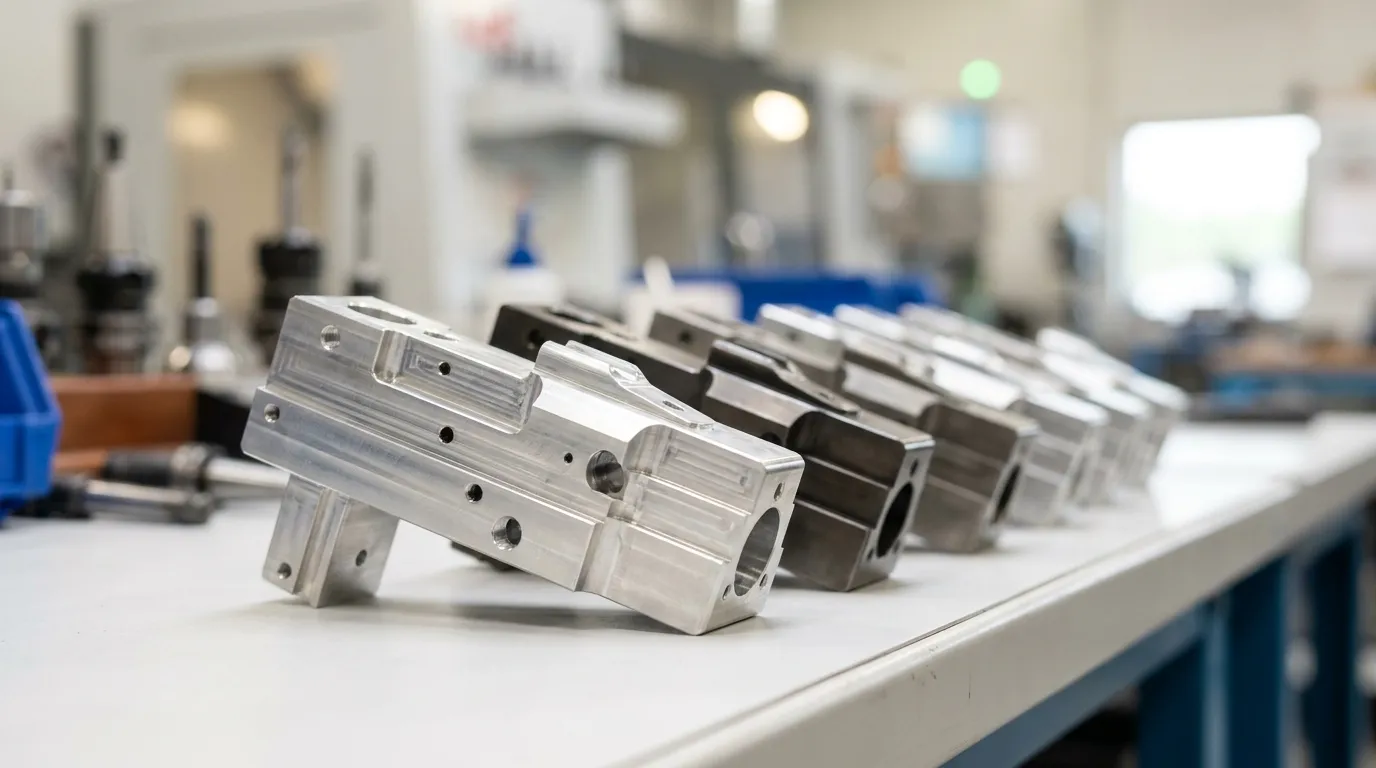
Precision Advanced Manufacturing applies multi-axis milling and turning with in-house engineering and CNC programming. This combination supports complex, high-tolerance components for space, satellite, aerospace, and UAV applications while preserving repeatability across production runs.
Quality, Compliance, and Traceability Controls
AS9100D certification establishes the quality management baseline for aerospace and defense manufacturing. ITAR registration controls access to regulated technical data and hardware. Together, they define the minimum compliance floor for serious defense and aerospace suppliers.
A full AS9102 Rev C First Article Inspection, including bubble drawing, Form 1/2/3 completion, CMM measurement on every characteristic, and Form 2 evidence collation of MTRs, welder qualification records, and special-process certificates, requires a meaningful number of business days for a typical defense component. Customer supplemental requirements such as Cpk analysis or MSA studies extend that cycle further.
Traceability supports both compliance and schedule. Every material, process, and inspection record must link to the finished part. Suppliers that rely on manual or fragmented systems create audit risk and documentation delays that affect delivery.
Precision Advanced Manufacturing operates defined quality checkpoints, full traceability, and complete documentation aligned with AS9100D and ITAR requirements. Each project includes inspection reporting and material certifications that reduce the verification burden on customer quality teams.
Scalability and Production Planning Across Program Phases
Prototype programs and full-rate production runs follow different scheduling profiles. Prototypes require setup, programming, and FAI documentation before any parts ship. Production runs spread those fixed costs across volume but introduce capacity planning requirements that low-volume suppliers cannot satisfy.
Suppliers with multi-shift capacity and disciplined scheduling absorb volume ramps without disrupting active programs. Suppliers that cannot scale force program managers to qualify additional vendors mid-program, which resets documentation and validation cycles.
Precision Advanced Manufacturing supports the full product lifecycle from prototype development through sustained, multi-shift production. Programs move from initial design to full-rate manufacturing without supplier changes or quality revalidation.
Integrated Secondary Processes and Lead Time Control
Special process operations such as heat treatment, NDT, or plating routed to qualified subcontractors add shipping, processing, and documentation collation time per operation, and multiple operations can absorb substantial calendar time outside the primary fabricator. Each handoff introduces schedule risk and potential documentation gaps.
Suppliers that integrate secondary processes such as finishing, welding, kitting, hardware installation, laser marking, and deburring under one roof remove many of those handoffs. Parts arrive ready to integrate rather than requiring additional processing at the customer facility or a third-party vendor.
Precision Advanced Manufacturing consolidates multi-axis CNC machining, precision sheet metal fabrication, specialty welding, secondary finishing (anodizing, passivation, plating, sandblasting, ultrasonic cleaning), kitting, hardware installation, brush finishing, laser marking, and deburring in one facility. This scope reduces supplier fragmentation and improves production control for mission-critical applications.
Total Cost of Ownership and Schedule Risk
Initial quote price represents one input into total program cost. Rework, scrap, expedited shipping, re-inspection, and schedule recovery from a delayed supplier rarely appear in a quote but consistently appear in program budgets.
Fragmented supply chains multiply these hidden costs. Each supplier boundary introduces a potential delay, a documentation gap, and a quality handoff. Programs that rely on multiple uncoordinated vendors for machining, finishing, and inspection absorb coordination overhead that integrated suppliers avoid.
Certified quality systems, in-process inspection, and full traceability reduce first-pass rejection rates. Parts produced right the first time do not generate rework costs, expedite fees, or schedule recovery actions. That performance protects program budgets more reliably than a low initial quote from a supplier without robust systems.
Strategic Trade-offs Affecting ITAR CNC Lead Times
Part complexity, material availability, documentation requirements, volume ramp, and supplier consolidation interact to shape program schedules. A complex part in a DFARS-restricted material with NADCAP-required finishing and a first-article documentation package carries greater schedule risk than a simple part in a standard alloy.
The DFARS material acquisition time discussed earlier can dominate program schedules, particularly for specialty alloys like titanium. Procurement officers reduce that exposure by authorizing material commitment at quote acceptance or engaging the mill before purchase order issuance.
The secondary operation delays described earlier compound when multiple processes require external routing. Suppliers that perform those operations in-house or manage qualified subcontractors directly reduce that exposure.
Volume ramp decisions influence both schedule and quality. Transitioning from prototype to production with the same supplier preserves validated processes and documentation. Switching suppliers at production release resets qualification cycles and introduces risk at the most sensitive program phase.
Best Practices for Consistent Quality and Predictable Schedules
The following practices reduce schedule variance and improve first-pass yield across ITAR CNC machining programs. They also create a shared planning baseline between program teams and suppliers.
- Engage the supplier engineering team during design review to identify manufacturability issues before production release.
- Authorize material commitment at quote acceptance to shorten DFARS material acquisition time.
- Define FAI documentation requirements, including any supplemental customer requirements, before program kickoff.
- Require in-process inspection checkpoints instead of relying only on final inspection.
- Maintain full material traceability from mill certification through finished part delivery.
- Plan secondary process routing before production begins to avoid schedule surprises from subcontractor availability.
- Use a single integrated supplier for machining, finishing, and kitting where program scope allows.
- Establish a production planning cadence with the supplier to align capacity with program milestones.
Readiness Checklist for ITAR CNC Sourcing
This checklist supports internal program readiness and supplier evaluation across the five framework dimensions.
- Technical capability: Part drawings released with GD&T and tolerance callouts. Multi-axis CNC capability confirmed for part geometry.
- Quality and compliance: AS9102 FAI requirements defined and communicated. AS9100D and ITAR registration current and verifiable.
- Scalability: Production volume and ramp schedule documented. Multi-shift capacity and prototype-to-production transition process confirmed.
- Integration scope: Secondary process requirements identified, including finishing, kitting, and marking. In-house or managed secondary process capability confirmed.
- Total cost of ownership: Program risk tolerance and rework cost thresholds defined. Traceability, documentation, and first-pass yield history reviewed.
Request a quote and bring completed checklist inputs to accelerate the quoting process.
Common Sourcing Pitfalls and How to Avoid Them
The following pitfalls consistently extend ITAR CNC machining lead times and increase program risk. Addressing them early improves schedule confidence.
- Fragmented vendor base: Using separate suppliers for machining, finishing, and inspection multiplies handoffs and documentation gaps. Consolidate to an integrated supplier where scope allows.
- Unclear specifications at RFQ: Incomplete drawings, undefined FAI requirements, or missing material callouts delay quoting and force clarification cycles. Release complete packages before soliciting quotes.
- Underestimating compliance overhead: DFARS material verification, AS9102 FAI documentation, and NADCAP special-process routing each add time that generic lead-time estimates ignore. Build these cycles into program schedules explicitly.
- Late material commitment: Waiting for purchase order issuance before engaging the mill extends DFARS material acquisition time. Authorize material commitment earlier in the program cycle.
- Supplier qualification at production release: Qualifying a new supplier at the transition from prototype to production resets documentation and validation cycles. Qualify the production supplier during the prototype phase.
FAQ: ITAR, AS9100D, and Integrated Capability
What does ITAR registration mean for a CNC machining supplier, and why does it matter for defense programs?
ITAR registration means the supplier is registered with the U.S. Department of State Directorate of Defense Trade Controls and is authorized to manufacture, handle, and discuss defense articles and technical data covered by the U.S. Munitions List. For defense programs, this registration serves as a baseline requirement. Suppliers without it cannot legally receive controlled drawings, specifications, or hardware. Working with an unregistered supplier on a controlled program creates export control liability for the customer and can halt program execution. ITAR registration also signals that the supplier maintains internal controls for access, data handling, and personnel screening consistent with federal requirements.
How does AS9100D certification affect lead times and documentation requirements?
AS9100D certification establishes a quality management system designed for aviation, space, and defense manufacturing. Certified suppliers operate defined quality checkpoints, in-process inspection protocols, and documentation systems that produce the records defense and aerospace customers require. This structure reduces the back-and-forth that occurs when a supplier without a formal quality system attempts to produce documentation after the fact. For FAI packages, AS9100D-certified suppliers follow established processes for generating Form 1, Form 2, and Form 3 documentation, material traceability records, and inspection reports. That preparation shortens the documentation cycle compared with suppliers that build these packages from scratch for each program.
What documentation is typically required for an AS9102 First Article Inspection on a defense component?
As discussed in the Quality and Compliance Systems section, AS9102 Rev C FAI documentation includes Forms 1, 2, and 3 with complete characteristic accountability. Beyond these baseline requirements, customer-specific supplemental requirements such as Cpk analysis, measurement system analysis studies, or multi-sample submissions add to that package. The time required to complete a full FAI package depends on part complexity, the number of characteristics, and the availability of special-process certifications from in-house or subcontracted operations. Programs that define FAI requirements before production begins avoid scope surprises that extend the documentation cycle.
What integrated capabilities should a defense or aerospace program look for in an ITAR CNC machining partner?
Programs benefit most from suppliers that combine machining, fabrication, finishing, and kitting under one quality system. Ideal capability sets include multi-axis CNC milling and turning, precision sheet metal fabrication, specialty welding with thermal distortion control, and secondary finishing aligned to aerospace standards such as anodizing, passivation, plating, sandblasting, and ultrasonic cleaning. Hardware installation, laser marking, deburring, and kitting further support ready-to-integrate components. In-house engineering support and CNC programming allow the supplier to refine designs for manufacturability before production begins. When these capabilities operate under one AS9100D and ITAR-compliant quality system, programs receive finished components that move directly into assembly.
Conclusion and Next Steps for ITAR CNC Programs
ITAR CNC machining lead times in 2026 depend on material sourcing requirements, documentation obligations, secondary process routing, and supplier integration scope, not machine speed alone. Programs that evaluate suppliers only on initial quote price or stated lead times encounter schedule and compliance risk that those metrics do not capture.
The five-dimension framework of technical capability, quality and compliance systems, scalability, integration scope, and total cost of ownership provides a repeatable structure for comparing ITAR-registered partners on the factors that determine program outcomes.
- Complete an internal needs assessment using the readiness checklist, including part complexity, material requirements, FAI documentation scope, and production volume targets.
- Shortlist suppliers that hold current AS9100D and ITAR registrations and can demonstrate integrated capability across the required process scope.
- Engage certified partners early in the program cycle to authorize material commitment, align FAI requirements, and establish production planning cadence before schedule pressure builds.
Precision Advanced Manufacturing supports defense, aerospace, space, UAV, and advanced industrial programs from two U.S. facilities under AS9100D, ISO 9001:2015, and ITAR-compliant quality systems. The integrated platform covers multi-axis CNC machining, precision fabrication, specialty welding, secondary finishing, kitting, and engineering support under one roof.
Request a quote to begin the program evaluation process with Precision Advanced Manufacturing aerospace and defense manufacturing specialists.