
Last updated: August 3, 2026
Key Takeaways for Defense Supplier Selection
-
ITAR-compliant CNC machining for U.S. defense programs requires DDTC-registered suppliers with documented U.S.-person access controls, AS9100D quality systems and a CMMC/NIST SP 800-171 cybersecurity posture.
-
Active DDTC registration must be verified annually through the DDTC database and cross-checked against the supplier’s CAGE code in SAM.gov to avoid compliance gaps and penalties exceeding $1 million per violation.
-
Defense programs demand documented U.S.-person workforce controls, physical access logs and visitor management records that are auditable during DDTC reviews.
-
AS9100D certification, NIST SP 800-171 System Security Plans and complete AS9102 First Article Inspection packages with full material traceability support supplier qualification and risk reduction.
-
Precision Advanced Manufacturing meets all five compliance dimensions under one roof and supports structured supplier qualification for defense programs.
DDTC Registration Verification for CNC Machining Suppliers
Any U.S. person that manufactures, exports, temporarily imports or brokers defense articles, defense services or technical data on the U.S. Munitions List must register with the Directorate of Defense Trade Controls. Registration is not limited to exporters. For CNC machining suppliers producing components that appear on the USML, active DDTC registration is a baseline legal requirement before any controlled drawing is received.
DDTC registration is annual and must be renewed 30 to 60 days before expiration. A lapsed registration creates an immediate compliance gap that can halt program deliveries and trigger enforcement action. Civil penalties for ITAR violations reach up to $1,271,078 per violation, and criminal penalties include fines up to $1,000,000 per violation and up to 20 years imprisonment.
Supplier quality teams verify registration status directly through the DDTC registration database and confirm the supplier’s CAGE code matches the registered entity. Precision Advanced Manufacturing maintains ITAR compliance, and its CAGE code is verifiable through SAM.gov, which supports named-supplier accountability for defense programs.
Confirm Precision Advanced Manufacturing’s registration status and CAGE code verification as the first step in the supplier qualification process.
U.S. Person Workforce Controls for ITAR Programs
DDTC registration establishes legal authority to handle defense articles, but registration alone does not ensure compliance. ITAR’s deemed export rule treats providing a foreign national access to ITAR-controlled technical data inside the United States as legally equivalent to exporting it to that person’s country of origin, which triggers the same licensing requirements.
For a CNC machining shop, every employee, contractor or visitor who can view a controlled drawing, access a CAD or PDM system or enter a production area where ITAR parts are processed must be a U.S. person or covered by an approved export license. In 2026, DDTC has intensified scrutiny on technical control plan implementation, digital environments and voluntary disclosure practices. Physical security controls including visitor management, access badging and facility access logs now function as auditable artifacts during DDTC reviews.
Procurement managers request documentation of a supplier’s U.S.-person screening procedures, physical access controls and visitor management logs. Precision Advanced Manufacturing maintains documented workforce controls that restrict access to ITAR-controlled technical data and production areas to authorized U.S. persons, with records available for prime contractor review during supplier qualification audits.
AS9100D Quality and CMMC/NIST Cybersecurity Alignment
ITAR technical data under a Department of Defense contract is typically treated as controlled unclassified information specified. That status requires both NIST SP 800-171 cybersecurity controls and ITAR U.S.-person access restrictions that CMMC alone does not enforce. The two regimes remain distinct but overlap for most ITAR-registered CNC machining suppliers that handle controlled drawings or process specifications.
CMMC Level 2 security requirements match the 110 controls in NIST SP 800-171 Revision 2. The DFARS final rule implementing CMMC 2.0 took effect Nov. 10, 2025. The CMMC Phase 2 requirements, originally scheduled to begin Nov. 10, 2026 and make Level 2 C3PAO third-party certification mandatory for applicable new CUI-handling contracts, have been suspended pending review.
Supplier quality engineers evaluating a CNC machining partner verify several specific items that connect quality, cybersecurity and contract flow-down requirements.
-
AS9100D certification from an accredited registrar, with a current certificate scope covering the machining operations relevant to the program
-
A current NIST SP 800-171 Revision 2 System Security Plan and a SPRS score on file, verifiable through the Supplier Performance Risk System
-
A Plan of Action and Milestones for any unmet controls, with an assessment score at or above the threshold required for conditional CMMC Level 2 status
-
DFARS clauses 252.204-7012, -7019, -7020 and -7021 flow-down compliance for any subcontract involving CUI
Precision Advanced Manufacturing operates under AS9100D and ISO 9001:2015 registered quality management systems, which align quality controls with cybersecurity and contract requirements.
AS9102 FAI Packages and Material Traceability
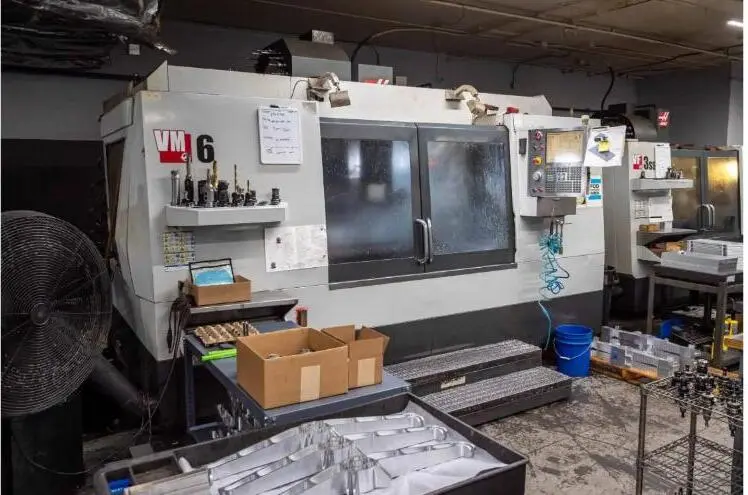
AS9100 certification mandates formal risk management, configuration management, First Article Inspection per AS9102, identification of key characteristics and supplier control for aerospace programs. For defense programs, a complete AS9102 FAI package serves as the primary mechanism by which a prime contractor confirms that a supplier’s production process can consistently produce conforming parts before full-rate production begins.
Material traceability in aerospace machining requires every part to be traceable to its raw material heat number, with all process records retained for the life of the program. This traceability is maintained through documentation that links raw material certification, incoming inspection, production traveler, process records, inspection results and non-conformance dispositions. The complete chain enables fleet-level defect analysis when a failure occurs in service.

Buyers request a sample AS9102 FAI package and confirm it includes several specific document types.
-
Material certifications with heat number and chemical and mechanical property data
-
Dimensional inspection results tied to the drawing revision used for the FAI
-
Process records for any special processes, including heat treatment or surface finishing
-
Certificate of conformance referencing the applicable drawing, revision and purchase order
-
Non-conformance disposition records, if applicable
Precision Advanced Manufacturing supports AS9102 FAI packages and material and process traceability. Documentation is available for prime contractor review and supports a seamless transition from first article to full-rate production under the same CAGE code.
Defense programs with active traceability requirements can receive a documentation package overview and sample AS9102 FAI materials during the qualification process.
Tolerance and Material Capabilities for Defense Components
Many defense machined components require tolerances within ±0.001 inches or tighter, depending on material selection, geometry complexity, assembly requirements and application criticality. Defense applications commonly use materials such as titanium, Inconel, stainless steel alloys, aluminum aerospace grades and hardened tool steels.
Defense precision machining operations commonly use coordinate measuring machines, optical inspection systems, surface finish testing, in-process verification tools and calibration-controlled gauges. Buyers confirm that a supplier’s inspection equipment is calibrated to a traceable standard and that inspection records are retained as part of the production traveler.
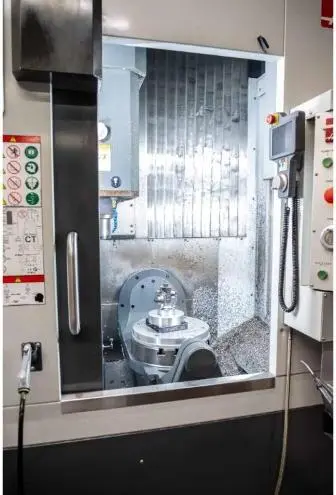
Precision Advanced Manufacturing operates advanced multi-axis CNC milling and turning equipment capable of producing complex, tight-tolerance components in the materials and alloys required for military and defense applications. In-house inspection capabilities support 100 percent dimensional verification on critical characteristics, and all inspection equipment is maintained under a calibration program aligned to AS9100D requirements.
Eight-Question RFQ Checklist for ITAR CNC Suppliers
The following checklist consolidates the five evaluation dimensions into actionable questions for use before issuing an RFQ to any ITAR-registered CNC machining supplier.
-
DDTC Registration: The supplier’s DDTC registration is active, and the CAGE code in SAM.gov matches the entity that will receive controlled drawings and produce parts.
-
Registration Currency: The supplier has renewed its DDTC registration within the required annual cycle and can provide the registration expiration date.
-
U.S.-Person Controls: The supplier maintains documented U.S.-person screening procedures, physical access controls and visitor management logs that are available for prime contractor review.
-
AS9100D Certification: The supplier holds a current AS9100D certificate from an accredited registrar with a scope that covers the machining operations required by the program.
-
CMMC/NIST Posture: The supplier has a current NIST SP 800-171 Revision 2 System Security Plan, a SPRS score on file and a POA&M for any open controls.
-
AS9102 FAI Capability: The supplier can produce a complete AS9102 First Article Inspection package, including material certifications, dimensional results, process records and a certificate of conformance.
-
Material and Process Traceability: The supplier maintains full traceability from raw material heat number through final inspection for every production lot.
-
Scalability: The supplier can transition from prototype to full-rate production under the same CAGE code, quality system and documented processes without a re-qualification event.
Conclusion: Applying the Five Compliance Dimensions
Qualifying an ITAR-compliant CNC machining partner for a U.S. defense program requires verification across five dimensions: DDTC registration currency, U.S.-person workforce controls, AS9100D and CMMC or NIST cybersecurity posture, AS9102 FAI and traceability documentation and demonstrated tolerance and material capabilities. Each dimension maps directly to a category of program risk, including audit findings, security violations, delivery failures, non-conformance and integration delays.
Precision Advanced Manufacturing satisfies every dimension under one roof, with two U.S. facilities, a single CAGE code, AS9100D and ISO 9001:2015 registrations, active ITAR registration and a scalable production platform that supports programs from prototype through full-rate manufacturing. Supply chain managers and supplier quality engineers can use the eight-question checklist above to structure evaluation and confirm compliance posture before issuing a controlled RFQ.
Begin supplier qualification to receive a tailored capability and compliance overview for a defense program.
Frequently Asked Questions
What is the difference between ITAR registration and CMMC certification, and does a CNC machining supplier need both?
ITAR registration and CMMC certification are separate compliance regimes with different triggers, agencies and penalties. ITAR registration is required by the State Department’s Directorate of Defense Trade Controls for any U.S. person that manufactures, exports or brokers defense articles or technical data on the U.S. Munitions List. CMMC certification is required by the Department of Defense for contractors and subcontractors whose systems process, store or transmit federal contract information or controlled unclassified information under a DoD contract.
A CNC machining supplier can be ITAR-registered without a CMMC obligation if it holds no DoD contract involving CUI. Most defense machining programs involve controlled drawings and process specifications that qualify as CUI, which means both regimes apply simultaneously. The FAQ builds on the earlier discussion by emphasizing contract language. Buyers review the specific DFARS clauses in their contract to determine the exact CMMC level required and confirm the supplier’s posture in the Supplier Performance Risk System before issuing an RFQ.
What documentation should a defense prime request from an ITAR-registered CNC machining supplier during qualification?
A thorough supplier qualification package for an ITAR-registered CNC machining partner includes several categories of documentation. On the compliance side, buyers request the supplier’s current DDTC registration confirmation, CAGE code verification through SAM.gov, AS9100D certificate with registrar name and scope and SPRS score or NIST SP 800-171 System Security Plan summary.
On the quality and traceability side, buyers request a sample AS9102 First Article Inspection package, material certifications with heat number traceability, a sample certificate of conformance and inspection records that show dimensional verification against drawing requirements. For workforce controls, buyers request written U.S.-person screening procedures, physical access control documentation and visitor management logs. Precision Advanced Manufacturing provides this documentation as part of its standard qualification process, which reduces the administrative burden on prime contractor supplier quality teams.
How does a CNC machining supplier demonstrate scalability from prototype to full-rate production without re-qualification?
Scalability without re-qualification depends on three factors. A single CAGE code must cover both prototype and production operations. A quality management system must validate the production process during the First Article Inspection phase. Documented manufacturing processes must be locked at FAI approval and carried forward unchanged into full-rate production.
When a supplier uses the same facility, equipment, personnel and documented processes for both prototype and production runs, the AS9102 FAI conducted during the prototype phase remains valid for subsequent production lots, provided no engineering changes are introduced. Suppliers that route prototype work through one facility and production work through another require re-qualification at each transition point, which adds program risk and schedule exposure. Precision Advanced Manufacturing supports the full product lifecycle from prototype development through multi-shift, sustained production under one roof, which allows programs to transition without supplier changes or re-qualification events.
What are the consequences of selecting a CNC machining supplier with a lapsed or unverified ITAR registration?
Selecting a supplier with a lapsed DDTC registration creates immediate legal exposure for both the supplier and the prime contractor. Providing ITAR-controlled technical data to a supplier whose registration has lapsed constitutes an unauthorized export under the Arms Export Control Act. The penalties detailed earlier represent only part of the impact.
Beyond direct penalties, a compliance failure at the supplier level can trigger a program audit, halt deliveries and result in debarment from future defense contracts. Prime contractors remain responsible for verifying subcontractor compliance posture, and DDTC examiners treat the absence of documented supplier verification as an aggravating factor in enforcement actions. Verifying DDTC registration status through the DDTC database and cross-referencing the supplier’s CAGE code in SAM.gov before issuing any controlled drawing represents the minimum verification step required.
Can Precision Advanced Manufacturing support a mid-program supplier transition for an active defense contract?
Precision Advanced Manufacturing supports mid-program supplier transitions by providing complete documentation, material traceability and engineering support to maintain production continuity. The transition process typically begins with a pilot build or validation run using the customer’s existing drawings and specifications. That run allows the quality team to confirm dimensional conformance and documentation completeness before full production transfer.
Because Precision Advanced Manufacturing operates under AS9100D and ITAR-compliant quality systems with full traceability from raw material to finished part, the documentation package produced during the transition run satisfies prime contractor incoming inspection requirements and supports any required re-qualification under the new supplier’s CAGE code. Engineering support remains available throughout the transition to address manufacturability questions, tolerance stack-up concerns or material substitution requirements that may arise when moving from a previous supplier’s process.