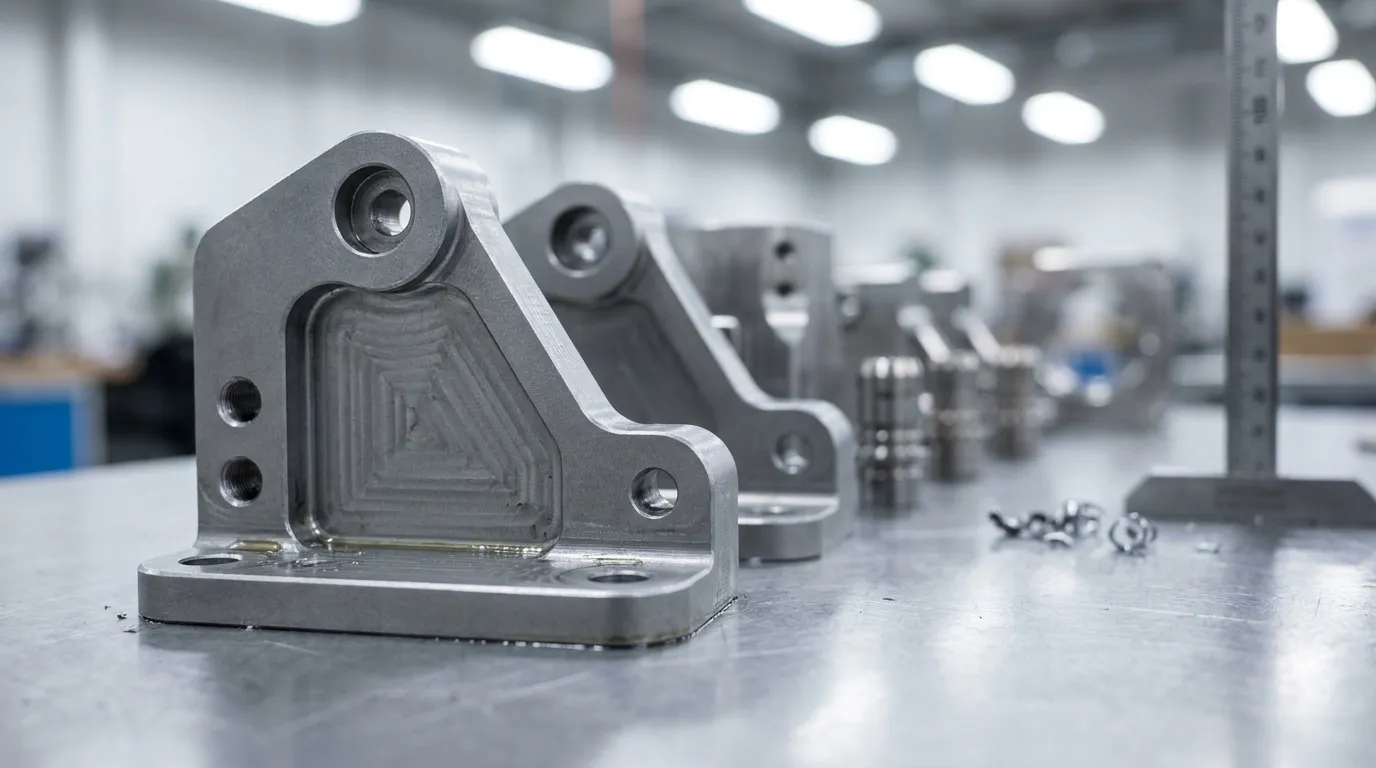
Defense CNC Milling Risk Snapshot
- ITAR registration, AS9100D certification, CMMC 2.0 readiness, DFARS flow-down compliance and full material traceability form the baseline for defense CNC suppliers.
- Fragmented supply chains and non-compliant suppliers drive audit failures, program delays and cost overruns that threaten timelines and contract standing.
- Precision Advanced Manufacturing consolidates multi-axis CNC milling, sheet-metal fabrication, welding, finishing and engineering support under one ITAR-registered and AS9100D-certified roof, which reduces handoffs and documentation gaps.
- End-to-end traceability from mill test report through final shipment, combined with AS9102 FAI documentation, prevents non-conformances and reduces False Claims Act exposure.
- Request a quote to connect with Precision Advanced Manufacturing’s defense manufacturing specialists and reduce compliance and scalability risk on the next program.
Core Compliance Requirements for Defense CNC Milling Suppliers
Procurement and supplier quality teams benefit from confirming several compliance elements before awarding work to any CNC milling supplier for defense components.
ITAR registration establishes the legal foundation. It requires active DDTC registration and U.S.-person-only access to controlled technical data. Missing registration creates export-control violations and contract termination risk.
ITAR governs technical data access, while AS9100D certification governs the manufacturing quality system. Suppliers need a current certificate from an accredited registrar with scope that covers CNC milling. Missing certification creates non-conformances, audit failure and rework costs.
Cybersecurity controls now sit beside quality controls. CMMC 2.0 Level 2 readiness requires a self-assessment on file in SPRS and NIST SP 800-171 Rev 2 controls implemented. Missing readiness creates contract ineligibility and False Claims Act exposure.
DFARS 252.204-7012 flow-down extends cybersecurity expectations. It requires CUI safeguarding, FedRAMP Moderate cloud and cyber incident reporting to DC3. Missing flow-down compliance creates progress payment withholding and contract termination.
Full material traceability and AS9102 FAI complete the baseline. They require mill test reports, heat-lot segregation, Positive Material Identification and FAI Forms 1-3. Missing traceability creates non-conformances, retrofit costs and False Claims Act risk.
ITAR CNC Milling Requirements for Defense Components
The compliance requirements above form the baseline for supplier qualification. Three areas, including ITAR registration, material traceability and production scalability, deserve closer examination because they represent common failure points in defense supply chains.
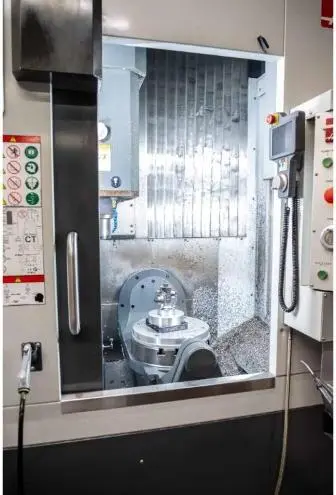
Problem: Suppliers without active ITAR registration or proper data-handling controls expose prime contractors and programs to export-control violations. ITAR mandates that controlled technical data remain under U.S. jurisdiction, be handled only by U.S. persons and reside on U.S. soil. These requirements extend beyond standard cybersecurity frameworks. Foreign nationals, including outsourced IT personnel, cannot access ITAR-controlled data without export authorizations.
Solution: Precision Advanced Manufacturing maintains active ITAR registration with U.S.-person-only access controls across all production and engineering functions. A mature ITAR compliance program includes a designated Empowered Official, documented Technology Control Plans, risk assessments and retention of controlled-data transaction records. Precision Advanced Manufacturing aligns quality and security systems with NIST SP 800-171 to satisfy the cybersecurity controls that DFARS 252.204-7012 requires of suppliers handling Covered Defense Information.
ITAR imposes stricter controls than CMMC or CUI requirements, so ITAR registration functions as a threshold qualification rather than a differentiator for CNC milling suppliers serving defense programs.
The Cost of Traceability Gaps in Defense Programs
Problem: Missing material certifications or broken lot tracking frequently trigger non-conformances in defense manufacturing. Fragile supply chains remain significant drivers of cost increases and schedule overruns in DoD programs; when materials become unavailable or suppliers disappear, programs must redesign components and requalify vendors, delaying testing, fielding and sustainment. Inaccurate compliance certifications create additional legal exposure. A December 2025 False Claims Act settlement required Illinois precision-machining subcontractor Swiss Automation Inc. to pay $421,234 for failing to provide adequate cybersecurity for defense technical drawings supplied to DoD prime contractors.
Solution: Precision Advanced Manufacturing maintains end-to-end traceability from mill test report through in-process inspection and final shipment. AS9102 First Article Inspection documentation ties material certificates and heat codes directly to the manufactured part through Form 2, while Form 3 creates a searchable map linking each ballooned dimension or GD&T callout to actual measurements and inspection instrument IDs. Positive Material Identification provides non-destructive chemical verification at receiving, which prevents separation of Material Test Reports from physical stock. AS9100D Clause 8.5.2 requires material certifications, special process records and production sequence documentation, while Clause 8.7 requires nonconforming product to be identified and controlled via traceability to isolate affected parts.

Scaling Prototype to Production Defense Parts Without Supplier Changes
Problem: Prototype shops that cannot scale force programs into requalification cycles during production ramp. The cost of losing a critical specialized supplier to compliance attrition, including qualification of a replacement and schedule impact, can be significant. Addressing certification shortfalls during integration often costs more than incorporating requirements from the start.
Solution: Precision Advanced Manufacturing’s multi-shift, multi-axis CNC capacity supports the full product lifecycle from prototype through sustained production, which reduces the requalification cycles that occur when programs move from prototype shops to separate production facilities. This continuity gains strength from integrated sheet-metal fabrication, welding, kitting, secondary finishing and engineering support under one roof, preserving validated processes and documentation across every production phase. The platform is structured to meet the demands of aerospace and defense production ramps, including accuracy, repeatability and uptime on challenging materials such as titanium and high-nickel alloys, without requiring a supplier change between program phases.
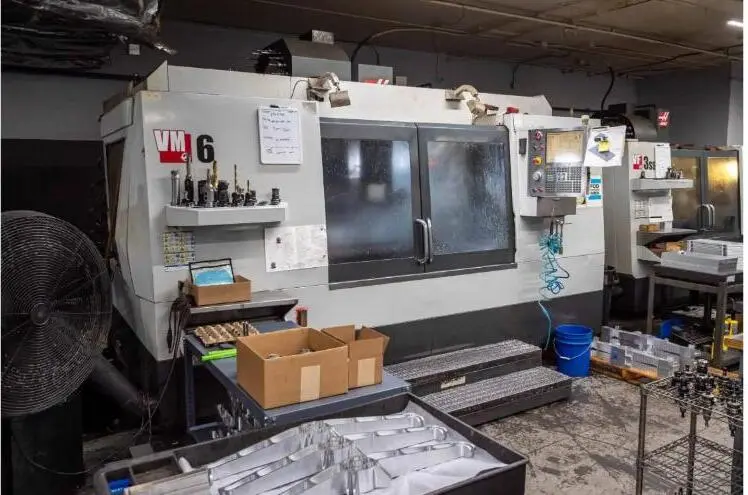
Request a quote to discuss prototype-to-production scaling for defense components.
Managing Mid-Program Supplier Transitions
Problem: Mid-program supplier transitions introduce documentation handoff failures and validation gaps that increase audit risk and schedule exposure. Supplier-level CMMC Level 2 compliance costs create financial pressure that can trigger unplanned transitions and downstream program disruption. When a transition becomes unavoidable, the incoming supplier must absorb existing documentation and maintain AS9102 FAI continuity without interrupting delivery schedules.
Solution: Precision Advanced Manufacturing supports mid-program transitions with a structured onboarding process that treats documentation continuity as a primary deliverable.

- Request a complete traceability package from the outgoing supplier, including mill test reports, heat-lot records, FAI Forms 1–3 and inspection reports, so the new team starts with a full history.
- Confirm that the incoming supplier’s ITAR registration, AS9100D certification and CMMC self-assessment remain current and in scope for the component type, which prevents compliance regressions.
- Execute a pilot build or validation run under the incoming supplier’s quality system before transitioning full production volume to validate processes and documentation.
- Verify AS9102 FAI continuity, since the new supplier must complete a fresh FAI when any process, material or equipment changes occur.
- Confirm that all documentation generated by the incoming supplier uses the same revision-controlled drawings and specifications as the outgoing supplier, which maintains configuration control.
Precision Advanced Manufacturing provides engineering and quality documentation support throughout this process and reduces the risk of gaps between outgoing and incoming supplier records.
Due-Diligence Checklist for Selecting a Defense CNC Milling Partner
This checklist outlines core verification steps for procurement, program management and supplier quality teams evaluating a CNC milling partner for defense components.
- Verify active ITAR registration with the DDTC and confirm U.S.-person-only access to controlled technical data.
- Confirm AS9100D certification from an accredited registrar with a scope that explicitly covers CNC milling and fabrication.
- Review the supplier’s CMMC self-assessment status in SPRS and confirm NIST SP 800-171 Rev 2 implementation documentation is current.
- Assess the supplier’s traceability workflow and request a sample traceability package that reflects the documentation outlined in the compliance section.
- Evaluate multi-axis CNC capacity and confirm the supplier can support both prototype and multi-shift production volumes without a facility or process change.
- Confirm integrated secondary capabilities such as finishing, welding, fabrication and kitting to reduce handoffs and documentation gaps.
- Review the supplier’s cyber incident reporting procedures and cloud service compliance with FedRAMP Moderate or equivalent standards.
- Request evidence of Positive Material Identification procedures at receiving to prevent MTR separation from physical stock.
- Confirm the supplier’s quality system includes mock recall capability and regular internal traceability audits.
Frequently Asked Questions
What materials are commonly CNC-milled for defense components and what tolerances are typical?
Defense CNC milling programs commonly use aluminum alloys, alloy steels, stainless steels, titanium alloys such as Ti-6Al-4V and nickel superalloys such as Inconel 718. Copper alloys appear in electrical and connector applications. Material selection depends on the structural, thermal and weight requirements of each component.
Tolerances vary by geometry and application. Five-axis milling of complex housings and structural components can achieve tolerances of a few thousandths of an inch on primary datums. Tighter capability on qualifying features becomes possible when process controls, rigid fixturing and appropriate tooling are applied. Titanium and superalloys require specialized toolpaths and high-pressure coolant to manage tool wear and maintain dimensional stability across production lots.
How do CMMC 2.0 and DFARS requirements affect CNC milling suppliers in 2026?
The CMMC Final Rule became effective Nov. 10, 2025, and Phase 1, which covers Level 1 and Level 2 self-assessments, remains active through Nov. 9, 2026. The Department of War suspended Phase 2 third-party certification requirements pending a 60-day reform review. DFARS 252.204-7012 remains fully in effect and requires suppliers handling Covered Defense Information to implement NIST SP 800-171 Rev 2 controls.
DFARS 252.204-7021 flows CMMC requirements down to subcontractors, so prime contractors now vet supply chains for current self-assessment status, SPRS scores and cyber incident reporting procedures. Non-compliance can result in progress payment withholding, contract termination or False Claims Act exposure. CNC milling suppliers that process defense technical data remain subject to these requirements regardless of the Phase 2 suspension.
What documentation must a supplier provide to demonstrate full material traceability?
A complete material traceability package for defense CNC milling includes mill test reports linked to specific heat and lot numbers, receiving inspection records, Positive Material Identification results, work order allocation records, in-process inspection data, AS9102 First Article Inspection Forms 1 through 3, special process certifications such as heat treatment or anodizing records and final inspection reports with shipment documentation. AS9100D Clause 8.5.2 requires that this chain remain maintained and auditable.
The practical test of a traceability system is the ability to trace any incoming material lot forward to every finished product and customer shipment within a defined timeframe. Suppliers should demonstrate this capability on request, and procurement teams benefit from reviewing a sample traceability package during supplier qualification.
Can a single supplier handle both prototype and full-rate production while maintaining ITAR compliance?
A single supplier can manage both phases when the facility has multi-axis CNC capacity, multi-shift scheduling capability and integrated secondary services that operate under a single, continuously maintained ITAR registration and AS9100D quality system. This structure allows validated processes, toolpaths, fixturing and documentation to carry forward from prototype to production without requalification.
The ITAR requirements described earlier apply equally to prototype and production work, so U.S.-person-only access, compliant data storage and controlled technical data handling remain constant across phases. Precision Advanced Manufacturing structures operations to support this continuity across the full program lifecycle.
Conclusion: Certified, Integrated Manufacturing Reduces Program Risk
Selecting an ITAR-registered and AS9100D-certified CNC milling partner with integrated fabrication, finishing and engineering capabilities functions as a direct risk-mitigation decision for defense programs. Compliance shortfalls, traceability gaps and supplier transitions each carry measurable cost and schedule consequences. Those consequences compound when they occur simultaneously or late in a program.
Precision Advanced Manufacturing delivers the certifications, documentation systems and production capacity that defense procurement, program management and supplier quality teams require. Multi-axis CNC milling, precision fabrication, welding, kitting and secondary finishing operate under one certified roof and reduce the handoffs and fragmentation that create audit exposure and program delays.
Request a quote to begin the conversation with Precision Advanced Manufacturing’s defense manufacturing team.