Last updated: July 15, 2026
Key Takeaways for Texas Space CNC Sourcing
- Space-grade CNC machining demands tight tolerances, full material traceability, and aerospace-specific quality certifications.
- Texas buyers face schedule, compliance, traceability, and scaling risks when sourcing from unqualified or fragmented suppliers.
- Certified integrated manufacturers consolidate machining, fabrication and finishing under one AS9100D and ITAR-compliant system to remove handoffs and documentation gaps.
- Precision Advanced Manufacturing’s Texas facility delivers multi-axis CNC capabilities on titanium and Inconel with complete traceability and prototype-to-production continuity.
- Ready to secure a certified partner, request a quote from Precision Advanced Manufacturing today.
The Problem: Compounding Risks in Texas Space CNC Sourcing
Procurement, program and supplier quality teams sourcing space components in Texas face four connected risks. Schedule risk emerges when suppliers miss tolerances or lack capacity to ramp production. These schedule failures often stem from compliance gaps when certifications are incomplete, documentation is inconsistent or ITAR flowdowns are not met. Compliance failures create traceability gaps when material heat numbers cannot be linked to finished parts, which triggers nonconformance investigations. These issues compound during scaling when a shop that performed well on prototypes cannot sustain the same quality and documentation rigor at production rates.
Common causes of late hardware in defense and aerospace programs include special process houses losing accreditation, overseas vendors becoming nonviable under ITAR flowdowns and qualified shops failing to repeat first-article capability at rate production. These risks consume schedule margin and drive cost overruns on mission-critical programs.
How Certified Integrated Aerospace Manufacturers Solve These Risks
To address schedule, compliance, traceability and scaling risks, buyers benefit from suppliers that remove the root causes of variability. Certified integrated aerospace manufacturers consolidate multi-axis CNC machining, precision fabrication and finishing under one AS9100D, ISO 9001 and ITAR-compliant roof. This structure removes handoffs between separate vendors that introduce schedule variability, documentation gaps and configuration control failures. Precision Advanced Manufacturing operates two specialized facilities, including a Texas location, under AS9100D and ISO 9001:2015 registrations with full ITAR compliance. These facilities support prototype and full-rate production programs for space, satellite, commercial aerospace, defense and UAV customers.
Teams that need a certified partner for space-grade components can request a quote from Precision Advanced Manufacturing.
Managing Tight Tolerances and Complex Geometries
Aerospace CNC machining on well-maintained equipment reliably achieves tolerances of plus or minus 0.0002 to 0.0005 in. on critical features. Reaching those tolerances on titanium and Inconel requires more than capable machines. Titanium concentrates heat at the cutting edge and galls tools, while Inconel 718 work-hardens rapidly and causes notch wear. Both materials require high-pressure coolant, specialized tooling strategies and rigid 5-axis workholding to prevent deflection and chatter on thin-wall structures.
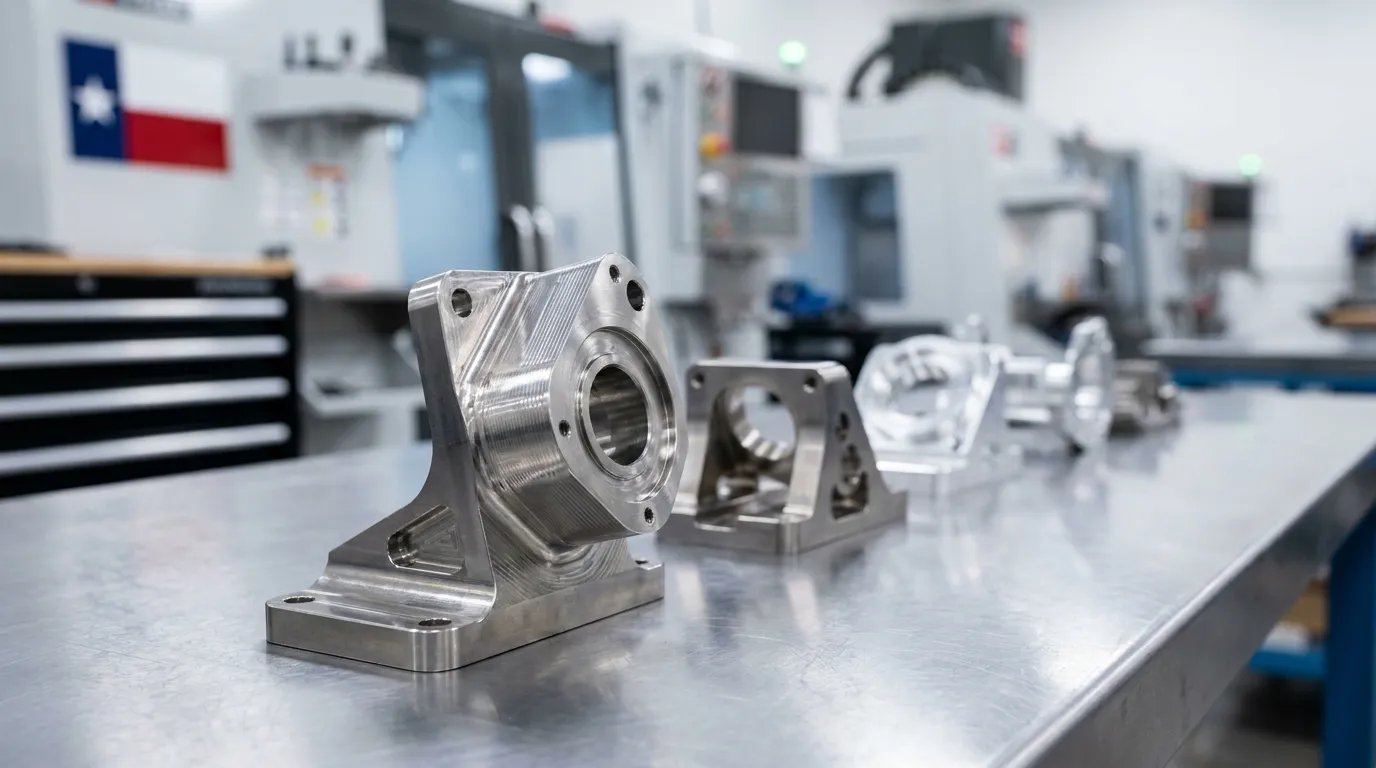
5-axis simultaneous machining reaches compound angles, deep pockets and contoured surfaces without repositioning the part. This method reduces setup-induced error and improves geometric consistency. Precision Advanced Manufacturing’s Texas facility applies multi-axis milling and turning to complex, high-tolerance space components. In-house CNC programming and tooling development improve manufacturability before the first chip is cut.
Building Reliable Documentation and Traceability Workflows
AS9100D-certified operations record the material certificate heat number on the job traveler for every production lot. This practice enables finished parts to be traced back to the original raw material batch. Full traceability requires documented raw material chemistry and mechanical test results, complete processing history, inspection results, personnel IDs for critical operations and calibration status of all measurement equipment.
Precision Advanced Manufacturing operates under AS9100D and ITAR-compliant quality systems that produce complete inspection records, material certifications and job travelers for every project. This documentation package simplifies customer audits and satisfies regulatory requirements for space and satellite programs without additional burden on the buyer’s quality team.
Reducing Rework and Inspection Burden
Rework rates at unqualified shops are often higher than at qualified suppliers, which adds cost and schedule risk before downstream impacts are counted. In high-volume aerospace production, Statistical Process Control using in-process probing and scheduled CMM inspections monitors dimensional trends. These controls allow machinists to adjust offsets before parts fall out of tolerance.
Precision Advanced Manufacturing uses rigorous in-process and final inspections to deliver validated parts with complete quality documentation. This approach reduces the incoming inspection burden on customer quality teams and prevents nonconforming material from reaching assembly.
Maintaining Prototype-to-Production Continuity
Transferring a project from a specialized prototyping house to a separate high-volume production facility introduces risks including lost tribal knowledge, duplicated tooling costs and a second, time-consuming First Article Inspection. Suppliers with robust version control on CNC programs, fixture drawings and tooling assemblies can reproduce original production conditions across a program’s service life.
Precision Advanced Manufacturing supports the full product lifecycle from prototype development through sustained multi-shift production on the same equipment, under the same quality system and with the same engineering team. Programs move from initial design to full-rate manufacturing without supplier changes or operational disruption.
Improving Schedule Adherence Through Integration
Vertically integrated aerospace manufacturers that consolidate multiple processes under one roof reduce lead times by removing shipping and handoff time between separate vendors. Each handoff between a machinist, a welder and a finishing house introduces a scheduling dependency that can cascade into program delays.
Precision Advanced Manufacturing combines multi-axis CNC machining, precision fabrication, specialty welding and secondary finishing at its Texas facility. Consolidated operations reduce handoffs, improve production control and support predictable delivery performance for mission-critical space programs.
Comparing Texas Aerospace CNC Sourcing Options
General job shops offer flexibility and competitive pricing for standard geometries but typically lack AS9100D registration, ITAR compliance and the documentation systems required for space programs. These shops may perform well on low-complexity prototype work but introduce compliance and traceability risk at production scale.
Specialized certified manufacturers such as Precision Advanced Manufacturing, Primus Aerospace and Acutec Precision Aerospace operate under aerospace quality management systems with full traceability, engineering support and process discipline to sustain quality across production ramps. They carry higher baseline costs than general job shops but reduce total cost of ownership by removing rework, compliance failures and schedule disruptions.
Large-scale global suppliers offer high capacity but introduce ITAR exposure, international logistics dependencies and communication overhead that create risk on tight-schedule programs. Industry best practice is to qualify and maintain two to three approved suppliers per critical component, with a domestic certified manufacturer as the primary or backup source to remove international logistics risk on critical-path parts.
Due Diligence Steps for Evaluating Texas CNC Partners
A structured evaluation process reduces sourcing risk before production begins. Procurement professionals verify that the supplier holds current AS9100D certification and can provide the certificate and validation letter from the issuing registrar. Effective evaluations also cover documentation quality, process maturity and pilot-run performance.
- Verify AS9100D and ISO 9001:2015 certificates with issuing registrar confirmation and confirm ITAR registration status.
- Request sample documentation including a job traveler, material certification and CMM inspection report from a recent aerospace order.
- Confirm 5-axis machining capability and experience with titanium and Inconel, including tooling strategy and coolant systems.
- Assess process maturity through documented work instructions, version-controlled CNC programs and fixture drawings.
- Conduct a pilot run of representative parts with full First Article Inspection per AS9102 before production release.
- Review on-time delivery performance over the prior 12 months as a leading indicator of schedule reliability.
- Evaluate engineering support depth, including DFM feedback during quoting and dedicated program management during production.
- Confirm scalability by reviewing multi-shift capacity and the supplier’s process for transitioning from prototype to production volumes.
Why Texas Attracts Space Manufacturing Investment
Texas has built one of the most concentrated aerospace and defense ecosystems in the United States. The Texas aerospace and defense industry employs about 170,000 workers, with employment having grown 18 percent since 1990 while the national industry lost 2.5 percent of jobs over the same period. The state hosts SpaceX’s Starbase launch facility near Boca Chica, NASA’s Johnson Space Center in Houston, Firefly Aerospace’s headquarters in Cedar Park and Lockheed Martin’s F-35 final assembly plant in Fort Worth.
SpaceX has invested an estimated $3 billion at Starbase, generating over $13 billion in economic output in South Texas. Blue Origin plans to establish a manufacturing and logistics center near Austin, and Firefly Aerospace is expanding its Cedar Park operations. U.S. launch activity has increased nearly tenfold in six years, and Texas-based programs are driving localized demand for precision aerospace components at every tier of the supply chain.
The Role of CNC in Modern Aerospace Programs
CNC machining uses programmable software to execute complex cuts with high precision and repeatability. This capability makes CNC the primary manufacturing method for tight-tolerance space components. Aerospace components such as spacecraft elements and jet engine parts commonly require tolerances of plus or minus 0.0005 in. or tighter for weight reduction, performance and regulatory compliance.
Multi-axis CNC machining of titanium and Inconel enables production of structural brackets, propulsion hardware, satellite bus structures and other flight-critical components that conventional 3-axis methods cannot produce. Complex contoured aerospace components require simultaneous 5-axis milling because 3-axis or 4-axis machines cannot reach undercuts and multi-angle surfaces in a single setup without introducing refixturing errors.
Certifications Required by Major Space Employers
AS9100D certification is the minimum quality standard requirement for aerospace supply chain participation and is required by OEMs such as Boeing, Lockheed Martin and SpaceX’s supply chain partners. AS9100D extends ISO 9001 with aerospace-specific requirements for risk management, configuration control, First Article Inspection per AS9102 and full material and process traceability.
ITAR registration is required for suppliers that handle defense-related or export-controlled parts, including components destined for national security space programs. NADCAP accreditation supplements AS9100D by independently verifying specific special processes such as welding, heat treatment, NDT, plating and chemical processing that are frequently required for space and satellite hardware. Many Tier-1 OEMs do not issue purchase orders without both AS9100D and applicable NADCAP accreditations in place.
Checklist for Selecting a Space CNC Machining AS9100 Partner
This checklist supports consistent evaluation of CNC partners for space and satellite programs.
- Certification verification: Confirm active AS9100D and ISO 9001:2015 registrations with issuing registrar documentation and verify ITAR registration.
- Scope alignment: Confirm the AS9100D scope explicitly covers the processes being sourced, including machining, fabrication and any special processes.
- Material and process capability: Verify demonstrated experience with titanium, Inconel and other exotic alloys using 5-axis CNC equipment with high-pressure coolant systems.
- Documentation review: Request a sample job traveler, material certification, CMM report and FAI package from a comparable aerospace order.
- Traceability system: Confirm that material heat numbers are recorded on job travelers and that finished parts can be traced to original mill certifications.
- Inspection infrastructure: Verify in-house CMM capability, calibration records and in-process SPC practices for critical dimensions.
- Scalability assessment: Confirm multi-shift capacity, fixture and tooling documentation and a defined process for transitioning from prototype to production volumes.
- Pilot-run validation: Require a trial order with full AS9102 FAI documentation before committing to production release.
- Engineering support: Evaluate DFM feedback quality during quoting and confirm access to in-house CNC programming and manufacturing engineering resources.
- Schedule reliability: Request on-time delivery data and confirm that consolidated operations reduce external handoffs on the critical path.
Teams ready to evaluate Precision Advanced Manufacturing against this checklist can request a quote and connect with the team.
Conclusion: Securing Reliable Texas Space CNC Capacity
Sourcing space-grade CNC components in Texas carries schedule, compliance and scaling risks. Skilled labor shortages, material lead-time variability and OEM production schedule inconsistency compound those risks across the supply chain. Certified integrated aerospace manufacturers that combine multi-axis CNC machining, fabrication and finishing under one AS910D and ITAR-compliant roof address these pain points directly through tighter process control, complete documentation, reduced handoffs and seamless prototype-to-production continuity.
Precision Advanced Manufacturing’s Texas operations deliver high-precision, traceable space components backed by AS9100D, ISO 9001:2015 and ITAR-compliant quality systems. Programs ranging from initial prototypes to sustained production runs benefit from integrated capabilities and engineering support designed for mission-critical applications. Teams can request a quote to discuss program requirements with the Precision Advanced Manufacturing team.
Frequently Asked Questions
What certifications should a CNC machining supplier hold to serve space and satellite programs
The minimum requirement for aerospace supply chain participation is AS9100D registration, which extends ISO 9001 with aerospace-specific controls for configuration management, risk management, First Article Inspection and full material traceability. Suppliers that handle defense-related or export-controlled hardware must also maintain ITAR registration. For special processes such as welding, heat treatment and chemical processing, NADCAP accreditation is required by many Tier-1 OEMs. Precision Advanced Manufacturing holds AS9100D and ISO 9001:2015 registrations and is ITAR registered, which supports programs with the full documentation and compliance infrastructure these standards require.
How does an integrated manufacturer reduce sourcing risk compared to using multiple specialized vendors
When machining, fabrication, welding and finishing are distributed across separate vendors, each handoff introduces a scheduling dependency, a documentation gap and a potential configuration control failure. An integrated manufacturer consolidates these operations under one quality management system, one set of job travelers and one program management team. This structure removes inter-vendor shipping time, reduces the risk of traceability breaks between processes and provides a single point of accountability for schedule and quality performance. Precision Advanced Manufacturing combines multi-axis CNC machining, precision fabrication, specialty welding and secondary finishing at its Texas facility under a single AS9100D-compliant quality system.
What is the risk of switching CNC suppliers mid-program, and how can it be managed
Switching suppliers mid-program introduces the risk of lost configuration knowledge, duplicated tooling costs and the requirement for a new First Article Inspection before production can resume. If the original supplier retains ownership of fixtures, CNC programs and tooling assemblies, the transfer becomes significantly more difficult. The risk is managed by treating manufacturing data as controlled, portable configuration items from the start of the program. Teams also require the new supplier to conduct a pilot run with full FAI documentation before production release and select a supplier with documented version control on programs and fixtures. Precision Advanced Manufacturing supports supplier transitions with complete documentation, material traceability and engineering support to maintain continuity.
Why does Texas attract space and aerospace manufacturing investment
Texas combines a large skilled manufacturing workforce, favorable tax and incentive structures and proximity to major space program operators including SpaceX’s Starbase in South Texas, NASA’s Johnson Space Center in Houston, Firefly Aerospace in Cedar Park and Lockheed Martin’s Fort Worth facility. The Texas Legislature restarted the Texas Space Commission in 2023 with significant grant funding for space exploration and research. The state’s aerospace and defense employment has grown substantially since 1990 while national industry employment declined over the same period. This concentration of programs, infrastructure and workforce creates strong demand for qualified local suppliers that meet AS9100D and ITAR requirements.
How does Precision Advanced Manufacturing support scaling from prototype to full-rate production
Precision Advanced Manufacturing supports the full product lifecycle on the same equipment, under the same quality system and with the same engineering team. Prototype and production parts are machined using documented, version-controlled CNC programs, fixture drawings and tooling assemblies that preserve the conditions validated during First Article Inspection. Multi-shift capacity supports production ramps without supplier changes or requalification. This continuity protects programs from the schedule and cost risks associated with transferring work to a separate production facility after prototype validation is complete.