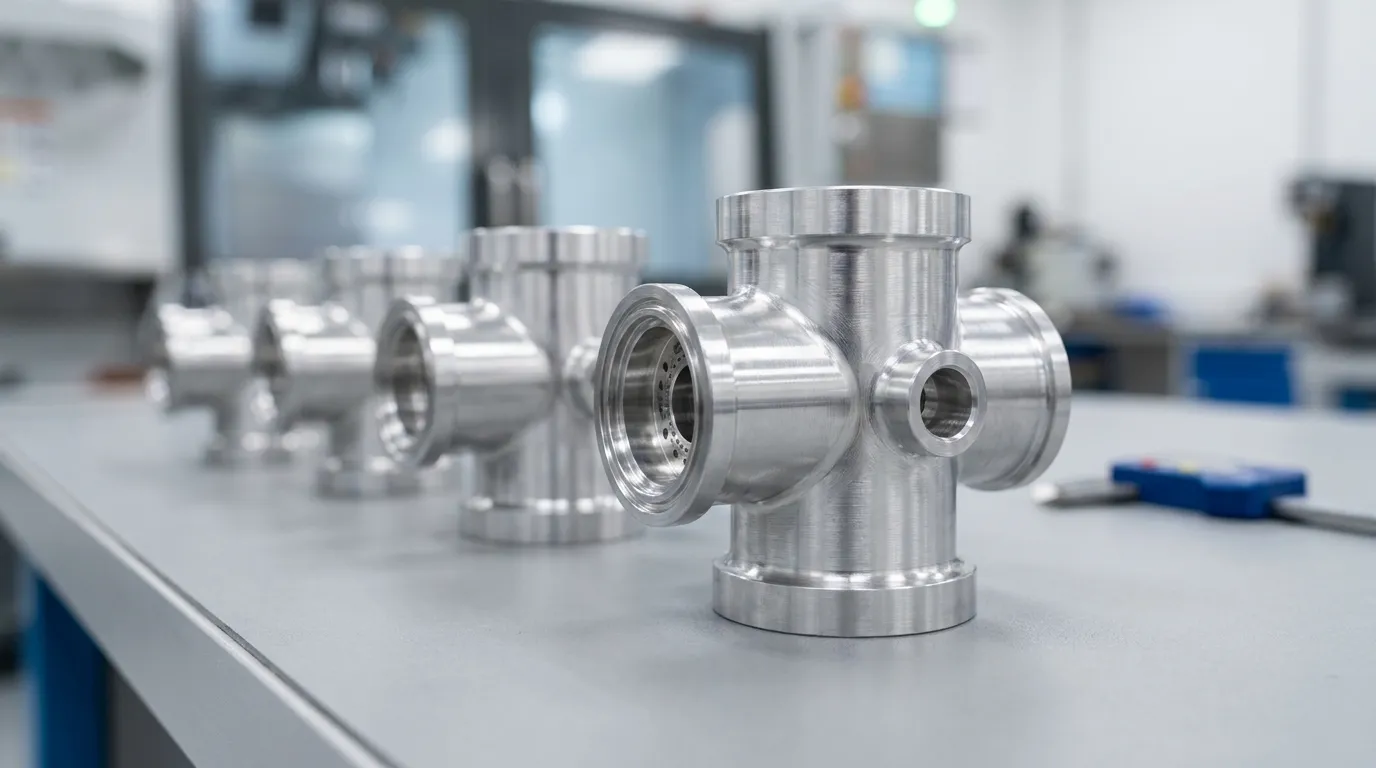
Key Takeaways for Space CNC Sourcing
- Space programs face significant risk when sourcing CNC machined components from unvetted or fragmented suppliers, including delays, compliance gaps and costly rework.
- U.S.-based, ITAR-registered manufacturers with AS9100D and ISO 9001 certifications reduce risk through traceable, ready-to-integrate parts and complete documentation.
- Integrated capabilities under one roof remove supplier handoffs, cut contamination risk and maintain process control from prototype through full-rate production.
- Advanced multi-axis CNC machining, rigorous in-process inspection and full material traceability support tight tolerances and reliable performance for propulsion and satellite hardware.
- Precision Advanced Manufacturing delivers certified, ITAR-compliant manufacturing solutions for space programs; connect with their aerospace specialists to review program needs.
The Problem: Sourcing Risks for Space CNC Machined Components
General job shops and fragmented supply chains create compounding risks for space programs. Many suppliers appear capable on paper but fail on complex geometries, tight tolerances or exotic materials such as titanium and Inconel once production begins. The impact extends well beyond a single rejected part.
Late discovery of defects drives severe schedule impacts because rejected parts cause missed launch windows with no possibility of recovery, forcing programs to wait for orbital mechanics to realign. Beyond schedule delays, the cost of resolving a contamination issue escalates with each stage, from fabrication through payload integration to after launch, so prevention remains far cheaper than late detection.
Moving components between multiple vendors increases delays, security vulnerabilities and documentation complexity through separate documentation systems, coordination overhead and freight time between facilities. Each handoff also multiplies contamination risk. Each transfer introduces new contamination vectors from packaging materials, vibration, impact and exposure to uncontrolled environments outside cleanrooms.
Certifications such as AS9100D and NADCAP, along with material sourcing and traceability requirements, add significant timeline pressure that delays procurement and production when suppliers lack mature quality systems.
Shifting to certified U.S. manufacturers with integrated capabilities addresses these risks at the source. Consolidated operations, documented quality systems and in-house engineering support eliminate the handoffs and gaps that generate program risk. One such manufacturer shows how this integrated approach functions in practice.
Precision Advanced Manufacturing: Integrated U.S. Space CNC Partner
Precision Advanced Manufacturing is a U.S.-based, ITAR-registered precision machining and fabrication provider operating under AS9100D and ISO 9001:2015 certified quality management systems. The company combines multi-axis CNC machining, precision metal fabrication, specialty welding, secondary finishing and engineering support under one roof at facilities in California and Texas.
This integrated model removes supplier fragmentation, reduces handoffs and maintains process control from raw material receipt through final inspection. Programs ranging from single prototypes to sustained multi-shift production runs operate within the same certified environment, so validated processes remain intact as volume scales.
Discuss your program requirements with Precision Advanced Manufacturing’s aerospace and space manufacturing specialists.
Machining Tight Tolerances for Propulsion and Satellite Hardware
Aerospace and space components regularly require tight tolerances for structural parts, engine components and fuel and hydraulic systems, along with surface finishes in the 2–8 µm Ra range. At these levels, process discipline determines whether parts integrate successfully or generate rework.
Holding tolerances at the tightest levels requires thermal stability, developed tooling compensation and frequent inspection. Requirements beyond standard ranges may also need advanced manufacturing equipment, calibrated digital measuring instruments and controlled operating speeds.
Dimensional stack-up errors in large-scale assemblies mean that a consistent 1-micron deviation across 50 mating surfaces creates a cumulative 50-micron error that prevents proper integration of flight hardware. Precision Advanced Manufacturing applies advanced multi-axis CNC milling and turning with in-house programming and tooling expertise to maintain repeatable accuracy across production runs for satellite CNC components and propulsion hardware.
Compliance, Traceability and Documentation Requirements
Aerospace CNC machining requires complete material traceability to mill sources and heat-treatment lots, supported by mill test certificates, heat-lot traceability records, chemical composition and mechanical test data and conformance to AMS, ASTM or MIL specifications.
Every aerospace part must be supported by First Article Inspection per AS9102, dimensional inspection reports, material certification, process validation records and non-conformance documentation when applicable. Precision Advanced Manufacturing operates quality systems that generate and retain this documentation at every production step, which supports customer audits and regulatory alignment without extra burden on the program team.
ITAR registration restricts technical data and controlled hardware to U.S. persons, with physical and electronic access controls supporting compliance across all production activities. This structure protects programs involving export-controlled space hardware from the outset.
Reducing Rework, Scrap and Inspection Burden
Repeatability across production runs depends on controlled programming, repeatable workholding, stable tools, documented offsets, trained operators, inspection frequency and corrective action. Strong process controls using first-article inspection, in-process measurement and tool wear monitoring reduce scrap, rework and late deliveries.
Precision Advanced Manufacturing implements rigorous in-process and final inspections that deliver validated parts with complete quality documentation. This approach reduces the inspection workload on customer quality teams and limits the out-of-spec parts that create rework costs and schedule disruption.
Scaling from Prototype to Full-Rate Production
Tighter tolerances for defense and space CNC components increase machining time, require more frequent tool changes and raise costs, which can constrain scale-up from prototype to full-rate production when suppliers lack the capacity or process maturity to manage the transition.
Precision Advanced Manufacturing’s scalable multi-shift platform supports the full product lifecycle. Programs move from prototype development to sustained production within the same certified facility, so validated processes and quality records remain consistent without a supplier change. This continuity removes the requalification overhead and schedule risk that accompany mid-program supplier transitions.
Protecting Program Schedules and Launch Windows
Vertically integrated manufacturing partners eliminate compounding schedule risks by keeping parts within a single secure facility, avoiding multiple security verifications, reconciling documentation across systems and freight delays between vendors.
Consolidated operations at Precision Advanced Manufacturing support disciplined scheduling and predictable delivery performance. Finished, ready-to-integrate components leave the facility with complete documentation, which removes secondary work at the customer site and protects launch and integration windows.
Materials and Applications for Space Environments
Space-grade components require materials that perform in vacuum, thermal cycling and sustained mechanical stress. Advanced materials including titanium alloys, Inconel superalloys and high-performance polymers require specialized machining expertise for aerospace applications.
Titanium alloys offer a favorable strength-to-weight ratio suited to structural components operating in vacuum environments where mass reduction directly affects launch cost and mission performance. For components exposed to extreme heat, Inconel and other nickel superalloys maintain mechanical properties at elevated temperatures, which supports propulsion hardware in combustion environments. Where electrical insulation is the primary requirement, high-performance polymers such as PEEK provide that capability along with chemical resistance at low weight, supporting satellite and avionics assemblies.
Aluminum alloys remain common for structural brackets and housings where weight and machinability matter most. Stainless steel serves applications that require corrosion resistance and dimensional stability across thermal cycles.
Tolerances, Finishes and Long-Term Reliability
Micron-level accuracy at the component level determines whether assemblies integrate on schedule and perform reliably over mission life. Micro-deviations that allow initial assembly generate long-term failure risks through accelerated wear, stress concentrations and metal fatigue under constant vibration in the vacuum of space where there is no atmospheric pressure to dampen effects.
Surface finish requirements for space components tie directly to sealing performance, optical function and adhesive bond strength. Precision Advanced Manufacturing integrates secondary finishing processes including anodizing, passivation, plating and ultrasonic cleaning aligned to aerospace standards. These capabilities deliver components ready for assembly without extra processing at the customer facility.
Compliance and Traceability Documentation Flows
The documentation package described earlier, including material certifications, FAI reports and inspection records, must remain consistent across every production lot. First Article Inspection performed per AS9102 validates dimensional conformity with specifications, process capability, material compliance and manufacturing repeatability for aerospace components.
Precision Advanced Manufacturing maintains these records across every production lot, which provides the transparency required for customer audits, regulatory submissions and supply chain reviews. Material certifications remain on file for every lot, supporting full visibility into material sourcing and composition throughout the program lifecycle.
Comparing Sourcing Options for Space CNC Components
General job shops often offer flexibility and short-run capacity but may lack the certified quality systems, material traceability infrastructure and documentation discipline required for space applications. These shops can perform adequately on commercial tolerances yet struggle to maintain consistency on the tighter requirements common to satellite CNC components and propulsion hardware.
Specialized certified manufacturers such as Precision Advanced Manufacturing combine AS9100D quality systems, ITAR registration, multi-axis CNC capability and integrated finishing under one roof. This structure supports compliance, traceability and schedule performance across the full program lifecycle without the fragmentation risk of multi-vendor supply chains.
Large-scale global suppliers may provide broad capacity but introduce ITAR compliance complexity, longer coordination cycles and documentation reconciliation challenges that add risk to programs with controlled hardware or sensitive technical data. Defense and space manufacturing partners without mature compliance processes often experience lead time increases for governed work compared to commercial projects due to secure file handling, controlled access and documentation requirements.
For mission-critical space programs, the combination of certification maturity, integrated capabilities and domestic ITAR compliance positions specialized U.S. manufacturers as a low-risk sourcing option across flexibility, engineering support, compliance rigor and scalable capacity.
Due-Diligence Checklist for Supplier Evaluation
Structured evaluation of a supplier for space CNC machined components reduces sourcing risk. The following checklist supports that review.
Certifications: Confirm active AS9100D and ISO 9001 registrations. Verify ITAR registration status with the Directorate of Defense Trade Controls. Assess whether NADCAP accreditation applies to required special processes.
Documentation samples: Request sample First Article Inspection reports, material certifications with mill traceability, dimensional inspection records and a representative Certificate of Conformance. Evaluate completeness and format against program requirements.
Process maturity: Assess in-process inspection frequency, tool wear monitoring practices, workholding repeatability controls and corrective action processes. Confirm that Statistical Process Control or equivalent methods are in use.
Pilot run capability: Confirm the supplier can execute a controlled pilot build or validation run before full-rate production. Assess how process records from the pilot carry forward into production.
Integrated capabilities: Determine whether machining, fabrication, finishing and engineering support operate within a single facility. Multi-vendor supply chains for a single part introduce handoff risk and documentation complexity.
Scalability: Confirm multi-shift capacity and the supplier’s process for transitioning programs from prototype to full-rate production without quality system changes or requalification.
Financial and operational stability: Review operational history, customer references in aerospace or space programs and evidence of sustained delivery performance on mission-critical work.
Begin supplier evaluation with Precision Advanced Manufacturing for space and satellite CNC components.
Frequently Asked Questions
What certifications should a supplier hold for space CNC machined components?
At minimum, suppliers should hold active AS9100D and ISO 9001 registrations and maintain ITAR registration for programs involving export-controlled hardware. As noted earlier, AS9100D and ISO 9001 form baseline quality requirements, while ITAR registration restricts access to controlled technical data and hardware to U.S. persons. Some special processes, including heat treatment, coatings and non-destructive testing, may also require NADCAP accreditation. Precision Advanced Manufacturing holds AS9100D and ISO 9001:2015 registrations and is ITAR registered.
How does a certified manufacturer support manufacturability during design?
Certified manufacturers with in-house engineering and CNC programming capabilities can review designs before production to identify features that drive unnecessary cost or risk. This support includes tolerance rationalization, material selection input, toolpath refinement and workholding strategy. Early manufacturability collaboration reduces the likelihood of design changes after first article, which is one of the most common sources of schedule delay on space programs. Precision Advanced Manufacturing provides engineering support at the outset to strengthen production efficiency and reduce downstream risk.
What is involved in transitioning from an existing supplier mid-program?
Supplier transitions mid-program require careful management of documentation continuity, process revalidation and material traceability. A qualified replacement supplier should receive existing design packages, review prior inspection records and execute a controlled pilot build before assuming full production responsibility. Precision Advanced Manufacturing supports transitions by providing complete documentation, material traceability and engineering support to maintain continuity. Pilot builds or validation runs help minimize risk while integrating into existing supply chains.
Can a single supplier support both prototype and full-rate production for space components?
Suppliers with scalable multi-shift platforms and established quality systems can support the full program lifecycle without a supplier change at production ramp. This continuity holds operational significance because it preserves validated processes, quality records and material traceability across the transition. Requalifying a new supplier at full-rate production introduces schedule risk and compliance overhead that certified integrated manufacturers remove. Precision Advanced Manufacturing’s production platform scales from prototype through sustained high-volume manufacturing within the same certified environment.
What documentation should accompany delivered space CNC machined components?
A complete delivery package for space CNC machined components includes the items covered earlier, such as the Certificate of Conformance, material certifications, FAI reports and inspection records. This package supports customer audits, regulatory submissions and incoming inspection. Suppliers operating under AS9100D quality systems generate and retain these records as a standard output of the production process, which reduces the documentation workload on the customer’s quality team.
Conclusion: Decision Framework for Space CNC Machined Components
The sourcing risks for space CNC machined components include program delays from unreliable suppliers, compliance failures from inadequate quality systems, rework and scrap costs from out-of-spec parts and scalability bottlenecks when production ramps. Demand for certified aerospace and defense precision manufacturing continues to grow, with comparable segments posting multi-year EBITDA growth and record backlogs as of early 2026, which reflects the sustained need for qualified suppliers across space and defense programs.
U.S.-based, ITAR-registered manufacturers operating under AS9100D and ISO 9001 with integrated multi-axis CNC machining, fabrication, finishing and engineering support address these risks through certified processes, complete traceability and scalable production platforms. Precision Advanced Manufacturing delivers this combination from two domestic facilities, supporting space and satellite programs from prototype through full-rate production with the documentation discipline and process maturity that mission-critical applications require.
Evaluate program fit with Precision Advanced Manufacturing for space CNC machined components, satellite hardware or propulsion system parts.