Key Aerospace Traceability Takeaways
- Aerospace traceability requirements create a documented chain that links every machined metal component from raw material through final delivery. Any break in that chain triggers nonconformance reports and program delays.
- AS9100D Clause 8.5.2 and related standards mandate unique part identification, material heat or lot linkage, inspection records and certificate of conformance retention that survive every production step.
- Material and process certification chains, including mill certificates, Nadcap special-process approvals and ITAR handling records, must be complete and flow down to every sub-tier supplier without gaps.
- Bidirectional requirements traceability for DO-178C and DO-254 programs, combined with rigorous sub-tier flow-down language, protects primes and Tier 1 suppliers from audit findings and contract penalties.
- Precision Advanced Manufacturing delivers end-to-end aerospace traceability compliance under AS9100D, ISO 9001 and ITAR; get a quote for machined metal components with built-in documentation from day one.
AS9100D Clause 8.5.2 Requirements for Physical Part Identification
AS9100D Clause 8.5.2 establishes the baseline for identification and traceability of physical parts throughout production and delivery. The clause requires organizations to control part identity by suitable means and to retain documented information that enables traceability when required. For machined metal components, effective implementation covers these steps:
- Assign a unique part identifier, including part number, revision level and serial or lot number, at the point of material receipt.
- Mark or tag each piece of stock and each in-process component so identity stays intact through every machining operation.
- Link the part identifier to the applicable drawing revision, work order and router at job creation.
- Record each inspection checkpoint against the specific part identifier in the inspection traveler.
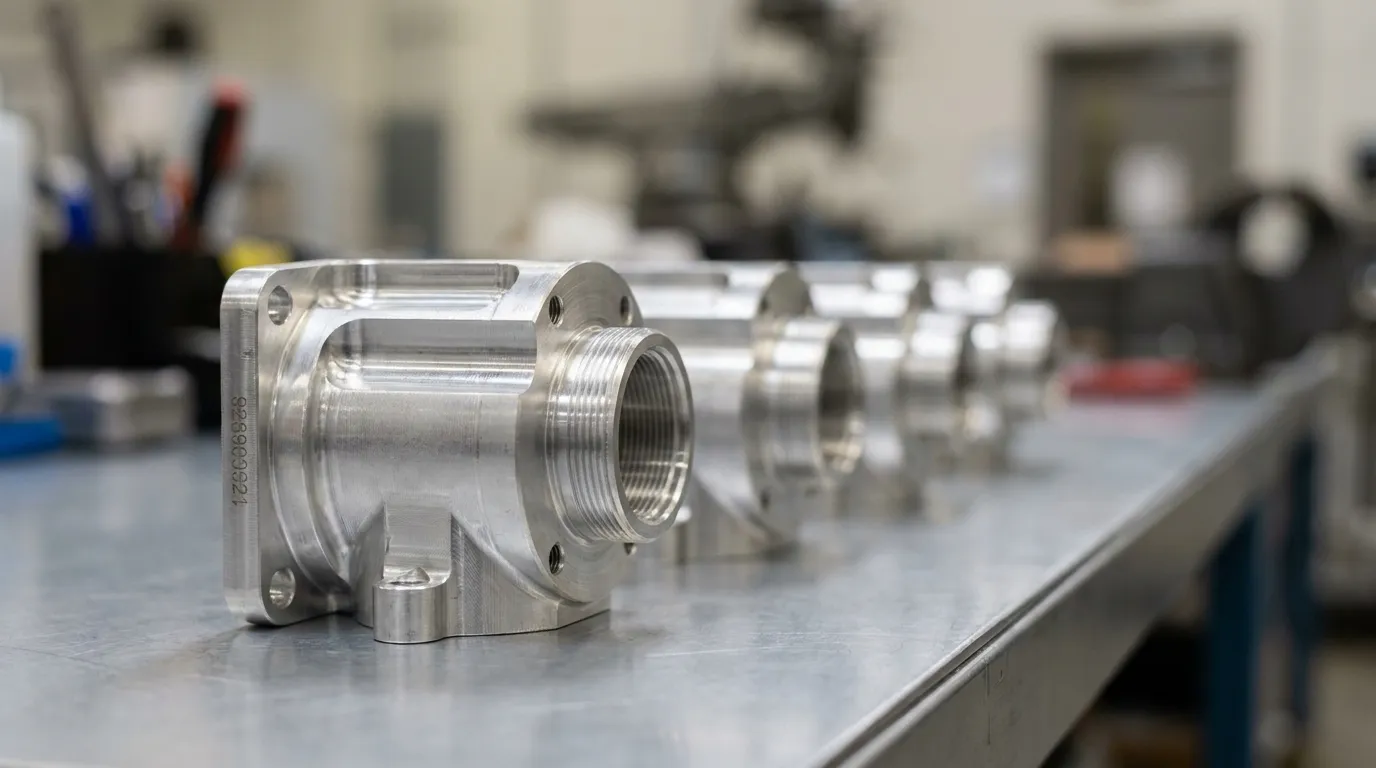
- Retain the identifier on the finished component using laser marking, stamping or a durable tag that survives handling and secondary finishing.
- Archive all traveler records so any finished part can be traced back to its raw material heat or lot.
A simple traceability matrix ties each part serial number to its material heat number, applicable drawing revision, inspection record number and certificate of conformance. Precision Advanced Manufacturing implements this structure through its AS9100D-registered quality management system, maintaining documented travelers and inspection records for every production job across its California and Texas facilities.
Material and Process Certification Chains Under AS9100D and ITAR
Physical-part identification forms the first layer of aerospace traceability. Material traceability extends that layer to the full certification chain that supports the raw stock. Under AS9100D and ITAR, the following certifications must be present and linked to each job:
- Mill certificate or material test report showing chemical composition and mechanical properties for the specific heat or lot
- Compliance statement to the applicable material specification, such as AMS, ASTM or MIL-SPEC
- Special process certifications for heat treat, surface treatment or NDT from Nadcap-accredited or customer-approved processors where required
- ITAR-controlled material handling records confirming domestic sourcing or authorized import documentation for defense articles
- First-article inspection records tied to the specific material lot used during qualification
These certifications must be contractually required from suppliers through explicit flow-down language. A flow-down clause example for purchase orders reads: “Supplier shall provide a material test report traceable to the specific heat or lot number for all raw material incorporated into deliverable hardware. Special process certifications shall identify the applicable specification, revision, process date and processor approval status.”
Precision Advanced Manufacturing maintains material certifications on file for every job, links them to the production traveler and includes them in the standard delivery package, which reduces the documentation burden on customer quality teams at receipt inspection.
Get a detailed production plan that includes the full material certification chain and shows how every link is documented from mill certificate to delivery, and request a quote.
Bidirectional Requirements Traceability for DO-178C and DO-254 Hardware
Material and process certifications establish what a part is made from and how it was produced. Programs governed by DO-178C and DO-254 add a further dimension that connects design intent to proof. These standards extend requirements traceability to the physical components that host or interface with certified software and complex electronic hardware.
Bidirectional traceability means every hardware requirement traces forward to a verification record and every verification record traces back to a requirement. For machined metal components in these programs, the checklist includes:
- Each design requirement allocated to a machined part documented in the hardware requirements specification with a unique identifier
- The drawing or model derived from that requirement carrying the same identifier in its revision block or notes
- Inspection and test records referencing the requirement identifier to confirm the part meets the allocated function
- A hardware-to-material linkage matrix that maps each requirement identifier to the part serial number, material heat number and inspection record number
- Configuration control records that capture any design change and update all downstream traceability links before re-release
Precision Advanced Manufacturing supports DO-254 hardware programs by maintaining drawing revision control, linking inspection records to customer-supplied requirement identifiers and assembling documentation packages that satisfy hardware design assurance review gates.
Source machined components for DO-178C or DO-254 programs with full bidirectional traceability documentation, and get a quote tailored to specific program requirements.
Sub-Tier Supplier Flow-Down and Documentation Control
AS9100D Clause 8.4 requires organizations to flow down applicable requirements to sub-tier suppliers so traceability extends through the entire supply chain. For traceability, the prime or Tier 1 cannot absorb documentation gaps created downstream. Standard flow-down clause language for machined component purchase orders states:
“Supplier shall maintain full material and process traceability for all deliverable hardware. Raw material shall be traceable to the original mill certificate by heat or lot number. Special processes shall be performed by approved sources and documented with certifications identifying the specification, revision and process date. All traceability records shall be retained for the period specified by the applicable contract or regulatory requirement and made available upon request.”
Sub-tier control begins at the purchase order and continues through receipt and record retention. Include traceability and certification requirements in every purchase order to sub-tier processors and raw material distributors. Before releasing those orders, verify sub-tier approval status for special processes, since an unapproved processor cannot deliver valid certifications regardless of purchase order language.
Once orders are placed, require sub-tier suppliers to submit certifications with each shipment rather than on request after delivery so documentation arrives when it can still gate the next production step. Review incoming certifications at receipt inspection before releasing material to production, then retain sub-tier certifications as part of the job record for the full retention period. Conduct periodic sub-tier audits or surveys to confirm ongoing compliance with flow-down requirements and to catch drift before it reaches an external audit.
The company AS9100D system also manages sub-tier flow-down through a structured supplier control process that maintains an approved supplier list and requires certifications at delivery for all externally processed materials and services incorporated into customer hardware.
Certificates, Inspection Reports and Record Retention Rules
The certificate of conformance and inspection reports form the core documents that auditors and prime contractors request first. Each document must contain specific data to pass review:
- Certificate of conformance: part number, revision, quantity, serial or lot numbers, applicable specifications, statement of conformance, authorized signature and date
- Dimensional inspection report: measured values against nominal and tolerance for each characteristic, inspection method, equipment calibration reference and inspector identification
- Material certifications: heat or lot number, specification compliance statement, mechanical and chemical test results
- Special process certifications: processor name, approval status, specification and revision, process date
- Nonconformance disposition records when applicable: description, disposition authority and corrective action reference
Record retention requirements vary by contract and regulation, so each program needs a defined rule set. AS9100D requires documented information to be retained for a defined period. Defense contracts commonly specify retention periods of 10 years or longer. Life-limited flight hardware may require records to be retained for the life of the aircraft plus a defined period.
Digital records must be protected against loss, corruption and unauthorized modification through access controls and backups. Paper records require controlled storage with access logs and environmental protection. Precision Advanced Manufacturing maintains digital and physical records aligned to customer and regulatory retention requirements, providing complete documentation packages that include certificates of conformance, inspection reports and material certifications with every shipment.
Common Audit Failure Points and Practical Fixes
Drawing ambiguities. Parts produced to superseded drawing revisions or to drawings with unresolved notes create immediate nonconformances. This situation usually reflects a disconnect between engineering change releases and the shop floor. A drawing control procedure that blocks job release until the current revision is confirmed and distributed to all production stations closes that gap.
Missing heat or lot data. Material certifications that arrive without heat or lot numbers, or that cannot be linked to the specific stock used in production, fail traceability requirements. This gap typically originates at receiving inspection when incoming material is released to production before certifications are reviewed. Turning receiving inspection into a hard gate by rejecting any delivery where the certification does not carry a matching heat or lot number, and holding the material until a compliant certification arrives, prevents that break in the chain.
Sub-tier documentation gaps. Special process certifications from heat treaters, platers or NDT providers that lack specification revisions or approval status appear frequently in audit findings. These issues often stem from weak purchase order requirements and lax receiving review. Applying the flow-down language described earlier to every sub-tier purchase order and verifying certifications at receipt before releasing processed parts to the next operation aligns documentation with contract and regulatory expectations.
Late design changes without traceability updates. Engineering changes issued after production begins can leave some units built to the old configuration without updated records. This problem reflects a gap between the change management process and the production floor. A formal configuration status accounting step before any changed part ships confirms that all traceability records reflect the current approved configuration and that no mixed hardware escapes.
How Precision Advanced Manufacturing Delivers End-to-End Traceability
Precision Advanced Manufacturing operates under AS910D and ISO 9001:2015 registered quality management systems and is ITAR registered for defense and space programs. Every production job runs with a documented traveler that links the part identifier to its material heat or lot, drawing revision, in-process inspection records, special process certifications and final certificate of conformance. Under the same registered QMS, sub-tier suppliers are managed through an approved supplier list with embedded flow-down requirements and structured record retention.
The integrated facility model includes multi-axis CNC machining, precision fabrication, specialty welding, secondary finishing and laser marking under one roof. This structure reduces the number of handoffs where traceability gaps often form and keeps responsibility within a single controlled system. Program managers and supplier quality engineers gain shorter incoming inspection cycles and faster audit preparation because traceability records arrive complete and organized.
Request a quote from Precision Advanced Manufacturing for machined metal components backed by AS910D, ISO 9001 and ITAR-compliant traceability from raw material to delivery.
Frequently Asked Questions
Does AS9100 require traceability?
AS9100D Clause 8.5.2 requires organizations to use suitable means to identify outputs throughout production and service provision and to control the unique identification of outputs where traceability is a requirement. For aerospace machined components, traceability functions as a standard customer or regulatory requirement, which makes compliance with this clause mandatory in practice. The clause also requires organizations to retain documented information that enables traceability.
What are the three types of traceability in aerospace manufacturing?
The three types are material traceability, process traceability and requirements traceability. Material traceability links a finished part to the specific raw material heat or lot from which it was produced, including the mill certificate and specification compliance data. Process traceability documents every manufacturing and special process operation applied to the part, including operator identification, equipment used and inspection results at each step. Requirements traceability links each design or performance requirement allocated to the part to the verification evidence, such as inspection, test or analysis, that confirms the requirement has been met.
How far down the supply chain must traceability extend?
Traceability must extend to the origin of every material and process incorporated into deliverable hardware. For raw material, this means the original mill or foundry heat or lot. For special processes such as heat treatment, plating or NDT, it means the approved processor and the specific process run. AS9100D Clause 8.4 requires organizations to flow applicable requirements to sub-tier suppliers, so the obligation continues beyond the first-tier machining shop. Prime contractors frequently audit sub-tier compliance as part of supplier oversight programs.
What documentation satisfies AS9100D material traceability?
Acceptable documentation includes a mill certificate or material test report that identifies the heat or lot number, chemical composition, mechanical properties and the applicable material specification and revision. The certificate must link to the physical stock through a receiving inspection record that confirms the heat or lot number on the certificate matches the marking on the material. That link then carries through the production traveler to the finished part identifier and the certificate of conformance issued at shipment.
How do ITAR requirements affect traceability records?
ITAR registration requires that technical data and hardware related to defense articles be controlled and disclosed only to authorized persons. Traceability records for ITAR-controlled components count as technical data and must be stored, transmitted and retained under access controls that prevent unauthorized disclosure. Digital traceability records for defense programs therefore require access restrictions, audit logs and, in some cases, storage on domestic servers. Physical records must be secured against unauthorized access. Suppliers handling ITAR-controlled hardware must be registered with the U.S. Department of State Directorate of Defense Trade Controls.
What record-retention period applies to aerospace components?
AS9100D requires organizations to define retention periods for documented information but does not specify a universal duration. Retention periods are typically established by customer contracts, regulatory requirements or both. Defense contracts commonly require retention of quality records for 10 years or more after final delivery. Life-limited flight hardware may require records to be retained for the operational life of the aircraft plus an additional defined period. Organizations should review each contract quality clause and applicable regulatory requirement to establish the correct retention period for each program and document that determination in the quality management system.