Last updated: August 6, 2026
Key Takeaways for Aerospace Supplier Selection
- Aerospace programs depend on suppliers with AS9100D, ITAR and ISO 9001 certifications to satisfy OEM flowdown on flight-critical hardware.
- Technical capabilities must cover multi-axis CNC machining, precision sheet metal fabrication, specialty welding and secondary finishing to build complex assemblies without vendor changes.
- Quality and compliance documentation, including counterfeit-part prevention and configuration management, reduce audit findings and program risk for sourcing teams.
- Scalability and vertical integration under one quality system cut handoff risks, tolerance stack-up and requalification costs from prototype through full-rate production.
- Precision Advanced Manufacturing provides certified capabilities and production continuity for aerospace programs; discuss program requirements with the team to align on scope and timing.
Technical Capabilities for Complex Aerospace Components
Out-of-spec parts and integration delays often trace to suppliers with process portfolios that are too narrow. Aerospace CNC suppliers use advanced 5-axis machining during prototyping to cut complex geometries in a single setup, which reduces handling errors and accelerates delivery for form, fit and function testing.
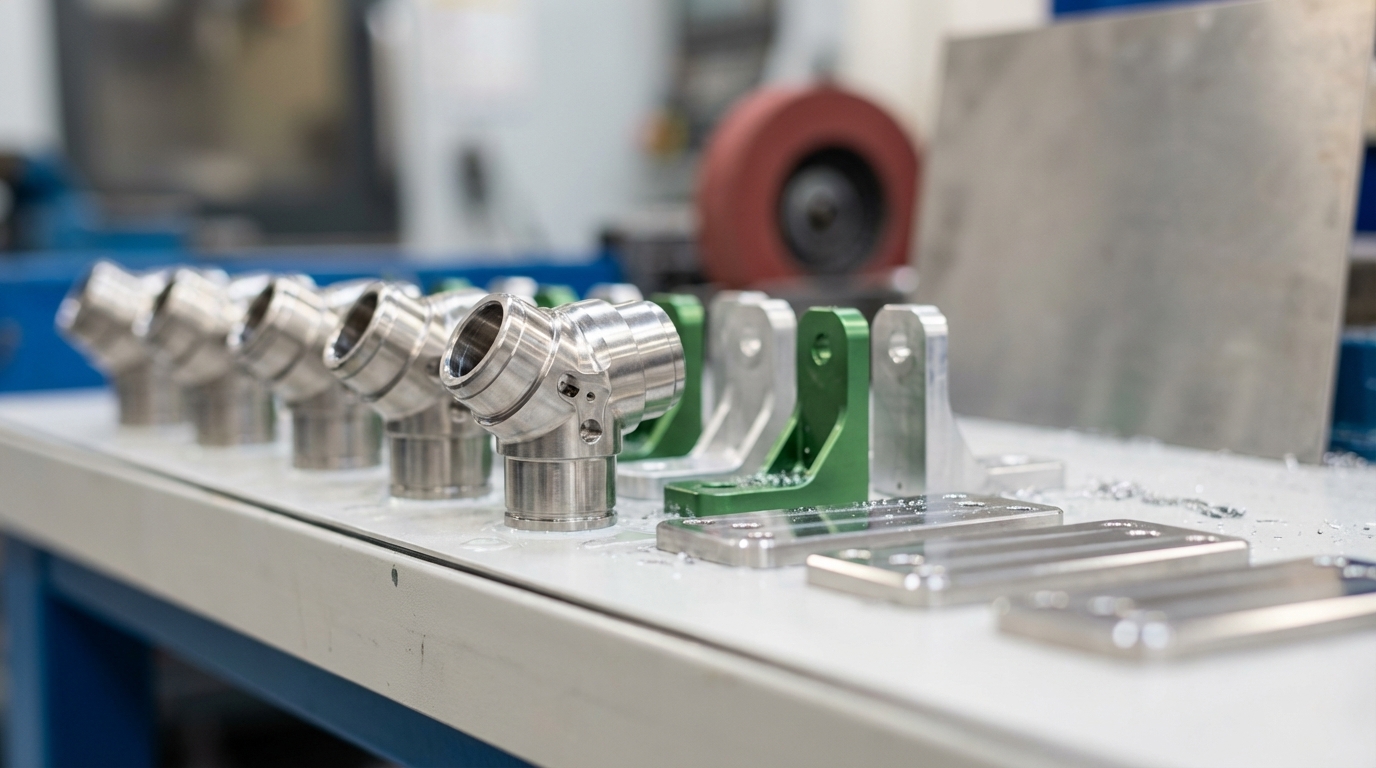
Precision Advanced Manufacturing operates multi-axis CNC milling and turning alongside precision sheet metal fabrication, specialty welding with thermal distortion control and integrated secondary finishing. This capability set covers the full process chain required for complex aerospace assemblies.
When evaluating any potential partner, buyers should confirm that the same breadth of capabilities operates under one quality system. Key technical capabilities to verify include:
- Multi-axis CNC machining for complex, tight-tolerance geometries
- Precision sheet metal fabrication including laser and waterjet cutting, bending and forming
- Specialty welding with documented thermal distortion controls
- Secondary finishing such as anodizing, passivation and plating aligned to aerospace standards
- Hardware installation, laser marking, deburring and kitting for ready-to-integrate delivery
Complete aerospace metal component suppliers offer integrated sheet metal fabrication including laser and waterjet cutting, bending, assembly and welding so avionics enclosures, heat shields and structural brackets reach scalable volumes without vendor changes.
Discuss technical requirements with Precision Advanced Manufacturing’s aerospace team to align capabilities with program tolerances and materials.
Quality, Certification and Compliance Controls
Compliance failures and audit findings disrupt schedules and consume program budgets. Major aerospace primes including Boeing, Lockheed Martin, Raytheon and Airbus typically require AS9100 certification as a gateway to contracts.
AS9100D extends far beyond ISO 9001. AS9100D Clause 8.1.4 requires documented processes for detecting, reporting and preventing suspected unapproved or counterfeit parts, with flowdown of those requirements to suppliers. Clause 8.1.2 mandates configuration management so that design authority, approved baselines and change history remain controlled and traceable throughout the product lifecycle.
Precision Advanced Manufacturing operates under AS9100D and ISO 9001:2015 registered quality management systems and is ITAR registered. Each project runs against defined quality checkpoints, full documentation and material certifications that simplify OEM audits and satisfy Tier-1 flowdown requirements.
Compliance elements buyers should confirm in any AS9100D ITAR supplier include:
- AS9100D registration with current OASIS database listing
- ITAR registration covering all relevant processes and technical data
- ISO 9001:2015 certification as the quality management baseline
- Counterfeit part prevention controls with documented supplier qualification
- Configuration management with revision-controlled build records
- Full inspection reporting and material certifications delivered with each shipment
OEMs treat AS9100 certification as necessary but not sufficient and further evaluate suppliers on nonconformance handling, traceability, delivery performance and responsiveness. Certification sets the floor for performance expectations.
Review Precision Advanced Manufacturing’s AS9100D and ITAR documentation to confirm alignment with program compliance requirements.
Scalability from Prototype to Full-Rate Production
Production ramp challenges and supplier-switch risks rank among the most common causes of program cost overruns. A manufacturing partner maintains continuity from prototype through production ramp rather than simply delivering parts that pass inspection.
Eliminating the supplier switch eliminates the associated risk. Precision Advanced Manufacturing supports the full product lifecycle from prototype development through sustained multi-shift production. Programs move from initial design validation to full-rate manufacturing without supplier changes, which preserves the quality baseline established during first article inspection.
That continuity depends on production controls that maintain part tolerances and lower cost-per-part as volumes scale. Scalability criteria to evaluate in a prototype-to-full-rate aerospace partner include:
- Demonstrated capacity for multi-shift, high-volume production runs
- Process repeatability validated through statistical process control
- First Article Inspection per AS9102 with locked manufacturing routing
- Established transition path from prototype validation to rate production
- Scheduling discipline that protects program milestones
Domestic partners with this scalability reduce lead-time and compliance risks compared with offshore sourcing.
Connect with Precision Advanced Manufacturing to map the production ramp from prototype through full-rate manufacturing.
Integration Scope and Vertical Manufacturing
Fragmented supply chains create tolerance stack-up, documentation gaps and quality-escape risks that stall programs. Vertical integration at a single facility collapses inter-supplier tolerance stack-up, process-control documentation gaps and quality-escape risks that commonly stall aerospace programs, replacing multiple supplier qualification packages and audits with one integrated process-control plan and first article inspection package.
Those capabilities described earlier, including machining, fabrication, welding and finishing, operate under one AS9100D and ITAR-compliant quality system across two specialized Precision Advanced Manufacturing facilities in California and Texas. Hardware installation, laser marking, deburring and kitting complete the ready-to-integrate delivery so components leave the facility finished and prepared for assembly.
Integration scope elements that reduce handoff risk include:
- Machining, fabrication, welding and finishing under one quality system
- Hardware installation and kitting for assembly-ready delivery
- Single audit, single corrective-action system and unified documentation package
- In-house engineering support and DFM feedback from the outset
Evaluate how Precision Advanced Manufacturing’s integrated scope aligns with assembly needs for current and future builds.
Total Cost of Ownership for Aerospace Programs
Unit price often hides the real program cost. The total cost of supplier quality failures can exceed the unit cost of defective parts once rework, logistics, lost sales and brand impact enter the calculation.
Rigorous in-process inspection, material traceability and ready-to-integrate delivery reduce downstream costs that erode program budgets. When parts ship right the first time, rework, scrap and expedited freight costs disappear. Precision Advanced Manufacturing’s certified quality processes focus on that first-time quality and prevent the out-of-spec components that drive cost accumulation at the assembly floor.
Total cost of ownership factors to assess when selecting an aerospace manufacturing partner include:
- In-process and final inspection rigor that reduces incoming inspection burden
- Material traceability and documentation that prevent compliance-driven rework
- Ready-to-integrate delivery that eliminates secondary finishing costs
- Prototype-to-production continuity that avoids requalification costs from supplier switches
- On-time delivery performance that protects program milestones and avoids expedite premiums
Build a complete cost picture with Precision Advanced Manufacturing’s sourcing specialists to compare true program economics across suppliers.
2026 Aerospace Manufacturing Trends Affecting Supplier Selection
The five evaluation dimensions above gain new urgency as 2026 technology trends reshape aerospace manufacturing. Technical capabilities, quality systems, scalability, integration scope and cost structures now must support emerging processes and data expectations.
Additive manufacturing is moving from prototyping into serial production. On-demand production can shorten lead times and deliver repeatable, certifiable parts integrated into broader workflows. The aerospace and defense additive manufacturing market is projected to reach $9.87 billion by 2029 at a 17.4% CAGR. Technical capabilities now extend beyond conventional machining to include additive qualification and integrated post-processing as frameworks mature under ISO/ASTM 52920.
Advanced composites and high-temperature materials continue to expand their share of airframe and propulsion structures. Advanced composites now account for 50-53% of the structural weight in aircraft such as the Boeing 787 and Airbus A350, and the global aerospace composites market is projected to grow from $46 billion in 2025 to $110 billion by 2035. The AIAA lists high-temperature materials among its top 10 technologies transforming aerospace, which raises expectations for material expertise within technical capability and integration dimensions.
Digital traceability has become a baseline sourcing criterion that directly affects quality and compliance evaluations. Digital thread strength, including PLM integration, revision control, serialized records and inspection data continuity from design transfer to aftermarket support, has become a key criterion in 2026 aerospace supplier selection. Partners without an unbroken digital record from raw material to delivered component introduce traceability risk that OEM quality teams must absorb.
Sourcing teams evaluating partners in 2026 benefit from suppliers that pair conventional precision manufacturing with documentation infrastructure and engineering depth. Those capabilities support programs as additive, composites and digital traceability scale into full-rate production and influence every evaluation dimension.
Evaluation Framework Recap and Next Steps
Selecting an advanced manufacturing services aerospace partner works best with a structured assessment across five core dimensions, informed by current industry trends. Each dimension maps directly to a category of program risk that sourcing, program management and supplier quality teams manage.
- Technical capabilities: Multi-axis CNC machining, sheet metal fabrication, specialty welding, secondary finishing and kitting, all verified against program-specific tolerances and materials.
- Quality and compliance: AS9100D registration, ITAR compliance, ISO 9001:2015 certification, counterfeit part prevention and full documentation with every shipment.
- Scalability: Demonstrated prototype-to-full-rate production continuity, multi-shift capacity and process repeatability under a single quality system.
- Integration scope: Multi-process capability under one roof that eliminates handoffs, reduces tolerance stack-up and delivers ready-to-integrate components.
- Total cost of ownership: In-process inspection rigor, material traceability and on-time delivery performance that reduce rework, scrap and program overrun costs.
These five dimensions work best when evaluated in the context of 2026 aerospace manufacturing trends, including additive manufacturing qualification, advanced composites expertise and digital traceability infrastructure that raise baseline expectations for supplier capabilities.
A practical three-step process for applying this framework includes:
- Internal needs assessment: Define program-specific tolerances, materials, certifications, production volumes and integration requirements before approaching suppliers.
- Supplier shortlisting: Screen candidates against all five dimensions using OASIS database verification, capability audits and documentation reviews.
- Reference checks: Request evidence of comparable programs, including part complexity, volume, certification scope and delivery performance, from existing aerospace customers.
Precision Advanced Manufacturing operates two specialized facilities in California and Texas and supports commercial aerospace, military and defense, space and satellites, advanced industrials and UAV programs from prototype through sustained production.
Apply this evaluation framework with Precision Advanced Manufacturing’s aerospace specialists to develop a tailored production plan that addresses all five dimensions.
Frequently Asked Questions
What certifications should an aerospace manufacturing partner hold?
An aerospace manufacturing partner should hold AS9100D registration from an accredited certification body, ISO 9001:2015 certification and ITAR registration when programs involve defense or space-related technical data. AS9100D serves as the quality management standard recognized by Boeing, Lockheed Martin, Raytheon and other primes as a baseline for supplier qualification. ITAR registration applies to any supplier handling controlled technical data, hardware or processes covered under the International Traffic in Arms Regulations. Precision Advanced Manufacturing holds all three, with each project backed by defined quality checkpoints, full documentation and material certifications.
How does a single integrated supplier reduce aerospace program risk compared with a fragmented supply chain?
A fragmented supply chain introduces multiple handoff points where tolerance stack-up, documentation gaps and quality escapes can occur. Each additional supplier adds a qualification package, an audit cycle and a corrective-action system that procurement and supplier quality teams must manage. An integrated partner that performs machining, fabrication, welding, finishing and kitting under one AS9100D quality system replaces that complexity with a single process-control plan, a single first article inspection package and a single point of accountability. For programs with tight tolerances and strict traceability requirements, that consolidation directly reduces the probability of compliance failures, rework and schedule disruptions.
Can a manufacturing partner support both prototype builds and full-rate production without a supplier change?
Precision Advanced Manufacturing is structured to support the full program lifecycle from prototype development through sustained multi-shift production. The same quality system, tooling knowledge and process documentation used during prototype validation carry forward into rate production. This continuity eliminates the requalification costs and schedule risk that arise when programs transfer from a prototype shop to a separate production supplier. First article inspection per AS9102 locks the manufacturing routing, including feeds, speeds and tooling paths, before production scales so the quality validated at prototype matches the quality delivered at rate.
What documentation should buyers expect with each shipment from a certified aerospace supplier?
Buyers should expect a complete documentation package that includes material certifications tracing raw stock to its original manufacturer, dimensional inspection reports covering all drawing callouts and GD&T requirements, certificates of conformance referencing the applicable revision of the drawing and purchase order and records of any special processes such as anodizing, passivation or heat treatment. For programs with serialization or lot traceability requirements, build records should be retained and retrievable for the duration specified in the contract. Precision Advanced Manufacturing delivers full traceability and documentation with each shipment, supporting OEM audit requirements and Tier-1 flowdown obligations.
How do 2026 aerospace manufacturing trends affect which supplier capabilities matter most?
Three trends are raising the bar for supplier selection in 2026. First, additive manufacturing is transitioning from prototyping into serial production, which requires suppliers to demonstrate process qualification, statistical process control and integrated post-processing rather than printer ownership alone. Second, advanced composites and high-temperature materials are expanding their share of airframe and propulsion structures, which makes material expertise and process control as important as machining accuracy. Third, digital traceability, including serialized records, revision control and inspection data continuity, has become a baseline OEM expectation rather than a differentiator. Sourcing teams benefit from partners that combine proven conventional precision manufacturing with documentation infrastructure and engineering depth as these technologies scale.