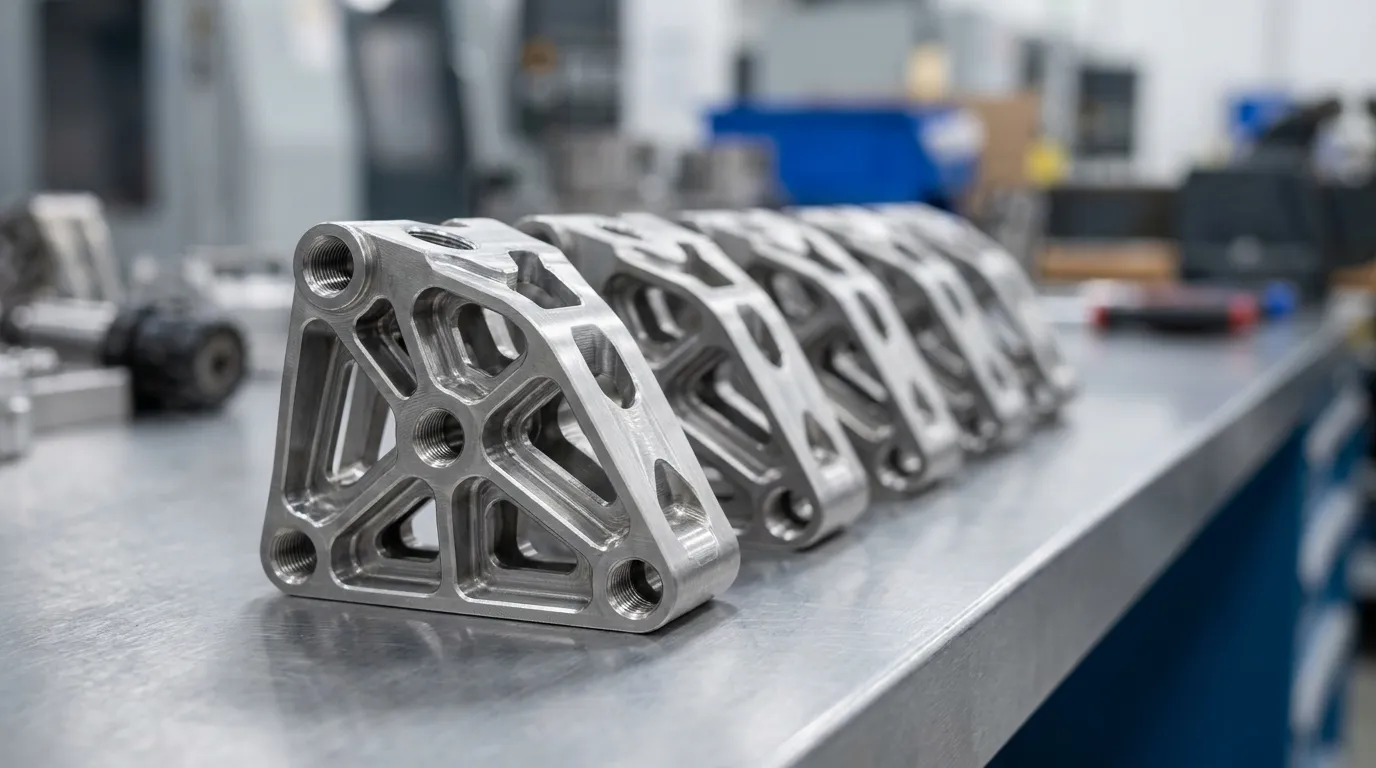
Key Takeaways for UAV Machining Teams
- Precision multi-axis machining produces complex, tight-tolerance UAV components that standard 3-axis methods cannot complete in one setup.
- Five-axis configurations reduce repositioning steps, preserve datum references and hold tighter dimensional accuracy across compound angles and undercuts.
- AS9100D and ITAR certifications create documented traceability, risk management and configuration control that lower compliance exposure for defense UAV programs.
- Consolidating multi-axis machining, finishing and engineering support with one certified supplier compresses lead times and avoids re-qualification risk from supplier changes.
- Precision Advanced Manufacturing delivers certified multi-axis machining, full traceability and scalable production for UAV programs; start a UAV machining program review with the team.
Why Multi-Axis Configurations Outperform 3-Axis for Complex UAV Geometries
Three-axis CNC machining moves along X, Y and Z planes only, which limits access to compound angles, internal contours and undercuts common in UAV components. These features often cannot be reached in a single fixturing, so the workpiece must be repositioned multiple times. Each repositioning introduces potential alignment error and extends cycle time.
Five-axis CNC UAV parts production removes most of those repositioning steps. The cutting tool approaches the workpiece from multiple orientations in one setup, which preserves datum references and reduces cumulative tolerance stack-up. This approach delivers tighter dimensional accuracy across complex geometries, a direct requirement for multi-axis machining aerospace tolerances.
Multi-axis workflows also protect thin-wall structures by reducing handling. UAV airframes rely on lightweight thin-section designs where minor distortion affects aerodynamic performance and structural integrity. Multi-axis configurations maintain those sections with fewer clamps and fewer opportunities for damage during machining.
The specific components that benefit from this approach, and the materials they use, depend on the UAV mission profile and operating environment.
Key UAV Components and Materials
UAV programs include structural, motion-control and payload components, each with distinct material and tolerance requirements. Common parts include airframe ribs and spars, gimbal brackets, payload housings, actuator mounts and sensor enclosures.
Aluminum alloys support lightweight structural members and housings where strength-to-weight ratio matters. Titanium alloys serve high-load brackets, hardpoints and landing structures that face repeated stress. High-temperature alloys such as Inconel support exhaust components and hardware near propulsion systems.
Precision Advanced Manufacturing works across these material families and applies process controls suited to each alloy’s behavior. Toolpath strategies, coolant selection and cutting parameters are tuned to maintain dimensional stability and surface finish on every component type.
Get a quote for UAV aluminum, titanium or Inconel components and review material-specific machining approaches with the team.
How AS9100D and ITAR Certifications Reduce Program Risk
ITAR-compliant UAV machining is a baseline requirement for any defense-related unmanned system. The International Traffic in Arms Regulations govern the manufacture, export and transfer of defense articles. A supplier without ITAR registration creates immediate compliance exposure for the prime contractor and the program office.
AS9100D extends ISO 9001 with aerospace-specific requirements for risk management, configuration control and first-article inspection. These requirements mandate that every production step is documented, every material lot is traceable and every nonconformance is formally dispositioned. Because the supplier quality system generates this evidence as part of normal operations, customer quality teams face a reduced inspection burden and receive the records they need.
Precision Advanced Manufacturing operates under AS9100D and ISO 9001:2015 registrations and maintains ITAR registration. These certifications represent audited, maintained systems that govern how every component is planned, produced and documented. Procurement and supplier quality teams see fewer corrective action requests, cleaner audits and traceable records from raw material through final inspection.
The Prototype-to-Full-Rate Production Workflow
Prototype-to-production UAV machining often fails at the transition point. A shop that excels at low-volume development builds may lack the scheduling discipline, tooling inventory or multi-shift capacity required for sustained delivery. Replacing that supplier mid-program introduces re-qualification risk, documentation gaps and schedule disruption.
Precision Advanced Manufacturing supports the full product lifecycle within a consistent production environment. Prototype builds use the same CNC equipment, tooling strategies and quality checkpoints that production runs use. Process parameters validated during prototyping carry directly into production without re-engineering.
Multi-shift capacity allows volume to scale as program demand increases. The certified quality system maintains the same level of traceability at high volume that it maintains at low volume. This continuity protects program managers from ramp challenges that fragmented supplier bases create.
Engineering support remains available throughout the lifecycle. Design-for-manufacturability feedback provided during prototyping informs production efficiency from the first production release.
Cost and Lead-Time Considerations for UAV Programs
Unit price tells only part of the cost story for multi-axis machining. Rework rates, scrap rates and the downstream impact of out-of-spec parts on assembly and test schedules often drive total program cost. A lower quoted price from a shop with inconsistent quality can produce higher overall spend and missed milestones.
Consolidating machining, finishing and engineering support with a single certified supplier reduces handoffs. Each handoff between vendors adds transit time, communication overhead and a potential quality gap. Precision Advanced Manufacturing eliminates most of these handoffs by integrating multi-axis CNC machining, secondary finishing such as anodizing, passivation and plating, and engineering support in two specialized facilities in California and Texas.
This integration compresses the supply chain and improves schedule predictability while maintaining quality. Program teams gain a single point of contact for machining, finishing and documentation, which simplifies coordination and change management.
Buyer Checklist for Evaluating Multi-Axis Machining Shops
The following criteria help procurement, program management and supplier quality teams assess whether a machining partner can support a UAV program from prototype through sustained production:
- Current AS9100D and ITAR credentials with recent audit records and documented corrective actions
- Multi-axis CNC equipment with proven experience on UAV or aerospace components
- Documented process capability data for critical features and materials
- In-house engineering support for design-for-manufacturability review and CNC programming
- Integrated finishing services that align with aerospace standards and reduce vendor handoffs
- Multi-shift capacity and geographic redundancy to support production scaling and continuity
- Full material traceability, inspection documentation and configuration control systems
- Experience with prototype-to-production transitions and first-article inspection requirements
Precision Advanced Manufacturing’s approach addresses each of these evaluation points through integrated capabilities and certified quality systems.
How Precision Advanced Manufacturing Consolidates Services and Reduces Risk
The company addresses core risks that UAV procurement and program management teams face: compliance exposure, quality inconsistency, scaling bottlenecks and supplier fragmentation.
Building on the consolidation benefits described earlier, the company integrates advanced multi-axis CNC machining, precision sheet metal fabrication, specialty welding with thermal distortion control, secondary finishing and kitting under the certified quality systems described earlier. Engineering support, including in-house CNC programming and design-for-manufacturability review, remains available from the first quote through sustained production.
Two specialized facilities in California and Texas provide geographic redundancy and multi-shift production capacity. Every project follows defined quality checkpoints, full material traceability and complete inspection documentation. Supplier quality engineers receive the records needed for audits and configuration control without generating them independently.
Programs transitioning from an existing supplier can start with pilot builds or validation runs. The team accepts existing documentation and engineering datasets, which shortens re-qualification time and protects program schedules.
Begin a program evaluation for 5-axis UAV components and review multi-axis machining requirements with Precision Advanced Manufacturing.
Next Steps: Engage Precision Advanced Manufacturing for Program Evaluation
UAV programs benefit from a machining partner that delivers certified quality, full traceability and scalable production without supplier changes. Precision Advanced Manufacturing provides that consolidated capability for aerospace, defense and UAV programs across the United States.
The engagement process stays straightforward. A manufacturing specialist works with program stakeholders to define requirements and part specifications. The team then prepares a tailored quote that covers capabilities, tolerances, materials, certifications and production strategy.
After approval, the program moves from prototype to full-rate manufacturing under the same certified quality system described earlier. Start a UAV component evaluation with Precision Advanced Manufacturing and review multi-axis machining options for upcoming builds.
Frequently Asked Questions
What materials does Precision Advanced Manufacturing use for UAV components?
Precision Advanced Manufacturing works with metals suited to UAV and aerospace applications, including aluminum, titanium alloys and Inconel. Material selection depends on the structural, thermal and weight requirements of each component. The company applies process controls specific to each material’s machining behavior to maintain dimensional accuracy and surface integrity throughout production.
How does Precision Advanced Manufacturing maintain traceability for defense UAV programs?
Traceability is built into every production step under the company’s AS9100D and ISO 9001:2015 certified quality management systems. Material certifications, in-process inspection records and final inspection reports are generated and retained for every job. ITAR registration governs the handling of defense-related technical data and hardware. Supplier quality engineers and program managers receive complete documentation packages that support audits and configuration control without additional verification work on their side.
Can Precision Advanced Manufacturing transition a program from an existing supplier?
Precision Advanced Manufacturing supports mid-program supplier transitions by accepting existing engineering documentation, material traceability records and CAD datasets. The team can execute pilot builds or validation runs to confirm process alignment before full-rate production begins. Engineering support remains available throughout the transition to address manufacturability questions and limit schedule impact.
What is the difference between prototype and production quality at Precision Advanced Manufacturing?
The same quality system applies to prototype and production work. Prototype builds use the same CNC equipment, tooling strategies, inspection checkpoints and documentation requirements as production runs. Process parameters validated during prototyping carry directly into production. As described in the prototype-to-production workflow section, this continuity keeps quality consistent from first article through full-rate manufacturing and avoids re-qualification risk from separate prototype and production suppliers.
Does Precision Advanced Manufacturing provide finishing services for UAV components?
Precision Advanced Manufacturing integrates secondary finishing, including anodizing, passivation, plating, sandblasting and ultrasonic cleaning aligned to aerospace standards. Additional services include brush finishing, laser marking, deburring and hardware installation. Consolidating these steps with the machining source reduces handoffs, shortens lead times and keeps finishing processes aligned with dimensional requirements from the start.