Key Takeaways for Aerospace Supply Teams
- Choosing the right aerospace parts production supplier keeps programs on schedule and avoids costly qualification delays.
- The three main bottlenecks in scaling production are certification drag, production-cell standardization and digitized traceability.
- A five-step playbook of gap review, cell standardization, digital traceability, pilot builds and full-rate ramp aligns with certification and operational needs.
- Consolidating machining, fabrication and quality systems under one certified supplier reduces sub-tier risk and documentation overhead.
- Precision Advanced Manufacturing delivers this integrated approach under AS9100D and ITAR compliance; start a scaling discussion with the team.
How Aerospace Supplier Tiers Shape Program Risk
Aerospace supply chains are organized by contractual distance from the OEM. Tier 1 suppliers sell directly to the OEM, Tier 2 suppliers sell to Tier 1s and Tier 3 suppliers sell to Tier 2s or provide raw materials. The numbering reflects contractual position, not strategic importance.
Risk compounds deeper in the chain. A disruption at a Tier 3 specialty supplier can halt a Tier 2 operation within weeks and stop an OEM production line shortly after, generating millions in expedited freight and emergency requalification costs. At the same time, only 15% of chief procurement officers report visibility beyond their Tier 1 suppliers, so sub-tier risk often remains unmanaged.
Scaling programs benefit from fewer sub-tier handoffs, because each handoff introduces delay and audit exposure. Precision Advanced Manufacturing consolidates machining, fabrication, finishing and engineering support in a single facility, acting as a Tier 2 or Tier 3 partner that reduces fragmentation and related compliance risk.
Discuss a consolidated tier strategy with Precision Advanced Manufacturing’s team.
Tier 1 Aerospace Suppliers and Their Certification Burden
Understanding the tier structure matters most when evaluating the certification load each tier carries. Tier 1 aerospace suppliers are direct contractors to OEMs such as Boeing, Airbus, GE Aviation and Pratt & Whitney. They carry the heaviest qualification burden, including AS9100D certification, ITAR registration for defense work, NADCAP accreditation for select processes and full first article inspection documentation under AS9102 Rev C.
Mid-program supplier changes increase audit load and documentation work. Process changes such as moving production to a new machine or facility, introducing new tooling or switching sub-tier suppliers for critical materials typically trigger a partial FAI under AS9102 Rev C. Each trigger adds requalification time, documentation overhead and schedule risk.
Precision Advanced Manufacturing uses documented processes, certified quality systems and integrated capabilities to reduce requalification exposure. Programs that begin with Precision Advanced Manufacturing at prototype stage carry validated records into full-rate production without restarting the qualification clock.
Review program documentation with the quality team at Precision Advanced Manufacturing.
The Three Core Bottlenecks in Scaling Aerospace Parts Production
Certification drag occurs when quality system requirements outpace production readiness. The consequences are significant, because a single traceability gap during an AS9100 audit can trigger production shutdown and loss of approved supplier status. This risk grows as programs scale, since manual ballooning and spreadsheets that support prototypes become unreliable at full-rate volumes and create demand for digital FAI tools. Precision Advanced Manufacturing addresses this risk with registered quality systems and defined checkpoints at each production step.
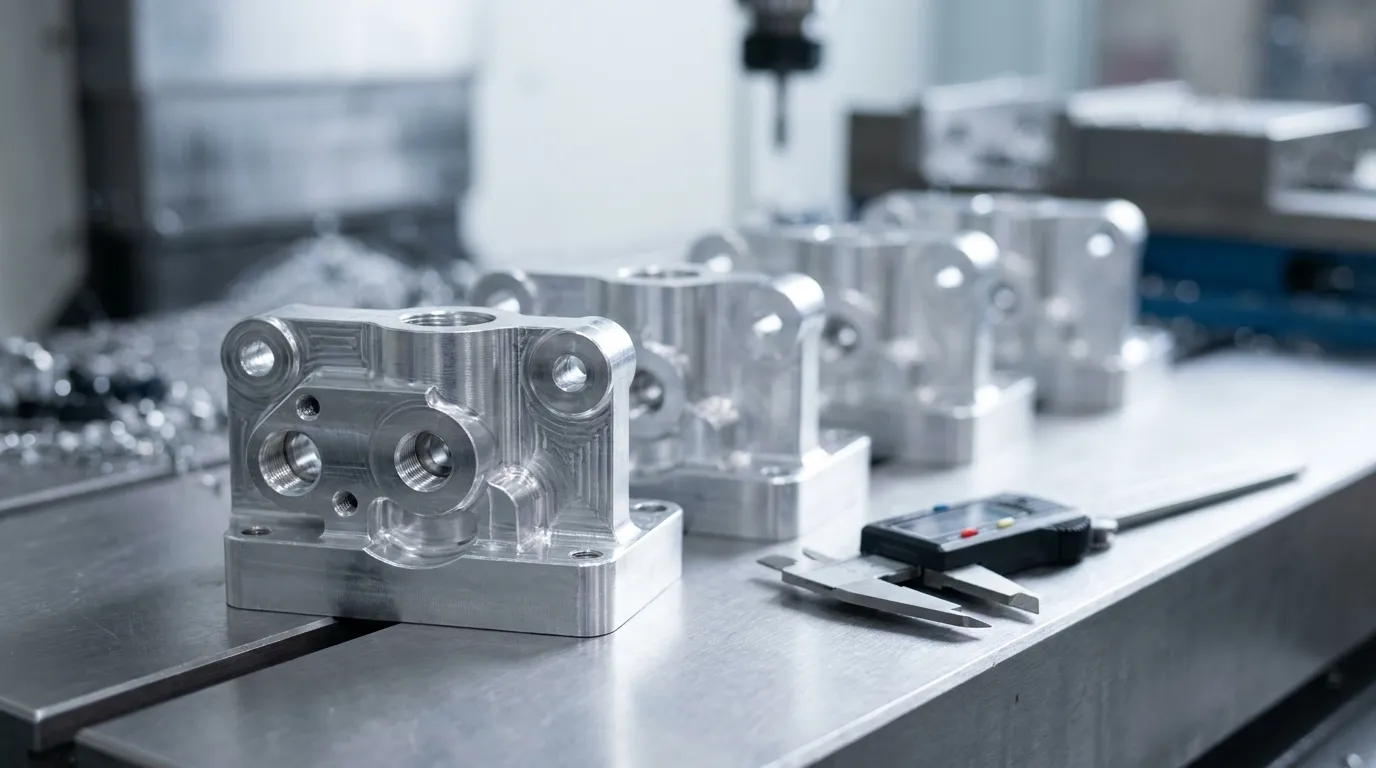
Production-cell standardization forms the second bottleneck. Moving a structural bracket from five 3-axis operations to one 5-axis operation reduces setup time and lowers positional uncertainty. As volumes rise, inconsistent manual processes limit throughput, while automation reduces human error and supports AS9100 compliance. Precision Advanced Manufacturing uses a multi-axis CNC platform that standardizes fixturing and workflows across production runs to deliver repeatable accuracy at scale.
Digitized traceability creates the third bottleneck. Aerospace material traceability to the mill heat lot through every operation adds substantial documentation work compared with commercial programs. Connecting quality and product information in a single source of truth supports design controls, sourcing, nonconformity management and CAPAs that align with AS9100 requirements while lowering audit risk. Precision Advanced Manufacturing maintains complete traceability across materials and processes, with inspection reports and material certifications available for every deliverable.
Explore how these systems relieve bottlenecks for current and upcoming programs.
5-Step Sequence from Prototype to Full-Rate Production
The following five-step sequence directly addresses certification drag, production-cell standardization and traceability bottlenecks during scale-up.
Step 1: Manufacturability and compliance gap review. Engineering support begins at program intake. Precision Advanced Manufacturing’s in-house CNC programming and tooling specialists identify design features that create downstream quality or schedule risk before the first cut. Compliance requirements such as AS9100D, ITAR and customer flow-downs are mapped against existing documentation so gaps surface early.
Step 2: Standardize production cells and fixturing. Multi-axis machining consolidates operations, reduces setups and locks in positional accuracy across the production run. Supporting this approach, standardized fixtures carry forward from prototype to production and preserve the validated process baseline without new qualification work.
Step 3: Digitize traceability and FAI documentation. AS9102 Rev C requires every ballooned characteristic, including dimensions, GD&T, notes and special requirements, to be mapped with unique identifiers, actual results and acceptance status for complete traceability. Precision Advanced Manufacturing’s quality systems support digital FAI records that remain searchable and retrievable during audits.
Step 4: Execute pilot builds with validated inspection records. Pilot runs validate the production process before full-rate commitment. Complete inspection documentation and material certifications accompany every pilot deliverable so supplier quality teams gain confidence before volume authorization.
Step 5: Ramp to full-rate production on a multi-shift platform. Precision Advanced Manufacturing’s scalable, multi-shift operations support sustained production without supplier changes or process resets. The same certified quality system that governs the prototype also governs the production run.
Supplier Transition Checklist for Mid-Program Moves
When programs cannot start with a single supplier from prototype through production, mid-stream transitions introduce additional risk. Transitioning a program to a new supplier mid-stream requires structured documentation handoff, pilot validation, process mapping and audit alignment. The documentation handoff begins with transferring all existing FAIRs, material certifications, inspection records and engineering change orders to the incoming supplier. Gaps in this package trigger partial FAI requirements and schedule delays.
Pilot validation follows documentation review. A controlled pilot build, run under the same process conditions as the intended production cell, generates inspection data that confirms the new supplier’s process capability before volume authorization. A lapse in production commonly triggers a new FAI requirement, so maintaining process continuity through the transition remains critical.
Process mapping documents every operation, tool, fixture and inspection point in the production sequence. This record supports internal quality control and external audit readiness. Audit alignment confirms that the incoming supplier’s quality management system satisfies all customer and regulatory flow-down requirements before first article submission.
The single-facility model described earlier reduces transition gaps by keeping machining, fabrication, finishing and engineering support under one quality system. This structure removes vendor handoffs, documentation silos and certification mismatches between operations.
Connect with the engineering team at Precision Advanced Manufacturing to begin a structured transition review.
Addressing Common Buyer Objections
Audit load from a mid-program supplier change. Precision Advanced Manufacturing provides complete documentation, material traceability and engineering support from the first engagement. Pilot builds generate validated inspection records that satisfy AS9102 Rev C requirements and reduce the audit burden on customer quality teams.
Cost of certified precision. Certified precision manufacturing reduces the total cost of a program by preventing the most expensive failure mode, which is scrap. Scrapped high-value billets carry significant raw material costs plus hours of already invested machining time. Delivering parts right the first time eliminates rework, scrap and expedited orders that erode program budgets. Precision Advanced Manufacturing’s controlled materials and processes, along with repeatable laser engraving on a wide range of materials, reflect the operational discipline that helps prevent those downstream costs.
ITAR compliance across the supply chain. Prime contractors hold responsibility for ensuring ITAR compliance throughout the supply chain, because requirements flow down to all subcontractors and vendors that handle controlled technical data or defense articles. Precision Advanced Manufacturing is ITAR registered and maintains controlled access to technical data, documented policies and recordkeeping practices that support prime contractor compliance obligations.
Workforce and capacity risk at scale. Labor constraints and technician skill gaps directly affect the ability to standardize processes and sustain certification-compliant operations at higher throughput. Precision Advanced Manufacturing’s established multi-shift platform and experienced machining teams provide the capacity and process discipline needed to sustain quality at full-rate production volumes.
Conclusion: A Certified Scaling Partner for Mission-Critical Programs
Scaling aerospace parts production without qualification delays depends on eliminating certification drag, standardizing production cells and digitizing traceability from the start. Fragmented supply chains, manual documentation and mid-program supplier changes each introduce risk that compounds as production volumes increase.
Precision Advanced Manufacturing executes the five-step scaling sequence of manufacturability review, cell standardization, digital traceability, pilot validation and full-rate ramp under AS9100D, ISO 9001:2015 and ITAR-compliant quality systems at facilities in California and Texas. Integrated capabilities, engineering-driven manufacturability and a scalable multi-shift platform position Precision Advanced Manufacturing as a single certified U.S. partner that carries programs from prototype to sustained production without restarting the qualification clock.
Define the program’s scaling path with Precision Advanced Manufacturing’s aerospace specialists.
Frequently Asked Questions
What certifications does Precision Advanced Manufacturing hold for aerospace production?
Precision Advanced Manufacturing operates under AS9100D and ISO 9001:2015 registered quality management systems and is ITAR registered for defense and space-related programs. Every component is produced under defined quality checkpoints with full traceability, inspection reporting and material certifications aligned to aerospace standards. These certifications cover both prototype and full-rate production programs across commercial aerospace, military and defense, space and satellites and UAV sectors.
Can Precision Advanced Manufacturing support a supplier transition mid-program?
Precision Advanced Manufacturing supports mid-program transitions by providing complete documentation, material traceability and engineering support to maintain continuity. The team begins with pilot builds or validation runs to minimize risk and generate the inspection records required under AS9102 Rev C before full-rate authorization. The single-facility model eliminates documentation gaps that typically arise when multiple vendors hand off work between operations.
How does Precision Advanced Manufacturing maintain traceability from prototype through full-rate production?
Traceability is built into every production step through certified quality systems that track materials to source, document every operation and generate complete inspection and material certification packages for each deliverable. This approach satisfies AS9100D traceability requirements and supports customer audit readiness without additional documentation work from the buyer’s quality team. The same traceability system that governs prototype builds scales directly to full-rate production volumes.
What capabilities does Precision Advanced Manufacturing offer under one roof?
Precision Advanced Manufacturing combines advanced multi-axis CNC machining, precision sheet metal fabrication, specialty welding with thermal distortion control, hardware installation, laser marking, deburring, brush finishing, kitting and secondary finishing treatments including anodizing, passivation and plating. Engineering support and CNC programming are also provided in-house. Consolidating these capabilities in a single facility reduces handoffs, eliminates supplier fragmentation and keeps the entire production process under one certified quality system.
How does Precision Advanced Manufacturing scale from prototype to full-rate production without disrupting program schedules?
Precision Advanced Manufacturing’s scalable, multi-shift production platform grows with program requirements. The process baseline validated during prototyping, including fixturing, tooling, inspection protocols and quality documentation, carries forward directly into production ramp-up. This continuity removes the requalification delays that occur when programs switch suppliers or introduce new production cells at volume. Programs move from prototype to sustained full-rate manufacturing under the same certified quality system, which protects timelines and reduces execution risk.