Key Takeaways for Satellite Component Machining
- Satellite component machining demands tight tolerances, certified processes and space-grade materials to ensure reliability in orbital environments.
- General job shops create compliance gaps, fragmented traceability and scaling bottlenecks that certified U.S. partners prevent.
- AS9100D and ITAR compliance, combined with documented traceability, support audit readiness and regulatory alignment.
- Integrated multi-axis CNC capabilities and scalable production platforms support smooth transitions from prototype to constellation-level volumes.
- Precision Advanced Manufacturing delivers certified satellite component machining with full documentation and engineering support. Connect with the team to reduce satellite program risk.
The Problem: Sourcing Risks in Satellite Component Manufacturing
Satellite programs operate under unforgiving constraints. A single out-of-spec component can trigger integration delays, schedule overruns and compliance failures that threaten the mission.
Procurement managers sourcing from general job shops or fragmented supplier networks face several compounding risks that share a common root cause: fragmentation.
- Suppliers without aerospace certifications create compliance gaps that surface during audits or acceptance testing.
- Fragmented supply chains, with separate vendors for machining, finishing and inspection, multiply handoff points and weaken traceability.
- Shops without space-program experience often lack the process discipline required for flight-ready hardware.
- Scaling from prototype to constellation-level volumes exposes bottlenecks that general manufacturers cannot resolve at pace.
These fragmentation-driven risks increase schedule exposure and audit findings. An integrated, AS9100D-certified U.S. partner reduces these risks by consolidating capabilities, certifications and documentation under one roof.
See how Precision Advanced Manufacturing eliminates sourcing risks in satellite programs.
Space-Grade Materials for Satellite Machining
Material selection sets the foundation for satellite component performance. Components must survive launch vibration, thermal cycling between extreme heat and cold and the vacuum of space without dimensional change or structural failure.
Common materials include aerospace-grade aluminum alloys for lightweight structural applications, titanium for high strength-to-weight requirements and Invar for components that need dimensional stability under thermal variation. Specialty alloys and composites support applications that require specific electromagnetic, thermal or mechanical properties.
Machining these materials to flight-ready standards requires more than capable equipment. It requires certified process controls, documented material traceability from mill certification to finished part and machinists experienced with each alloy under real cutting conditions.
Precision Advanced Manufacturing maintains this material expertise across the families most often specified for satellite hardware and aligns each program with documented traceability.
Precision Tolerances for Thermal Components and Structural Brackets
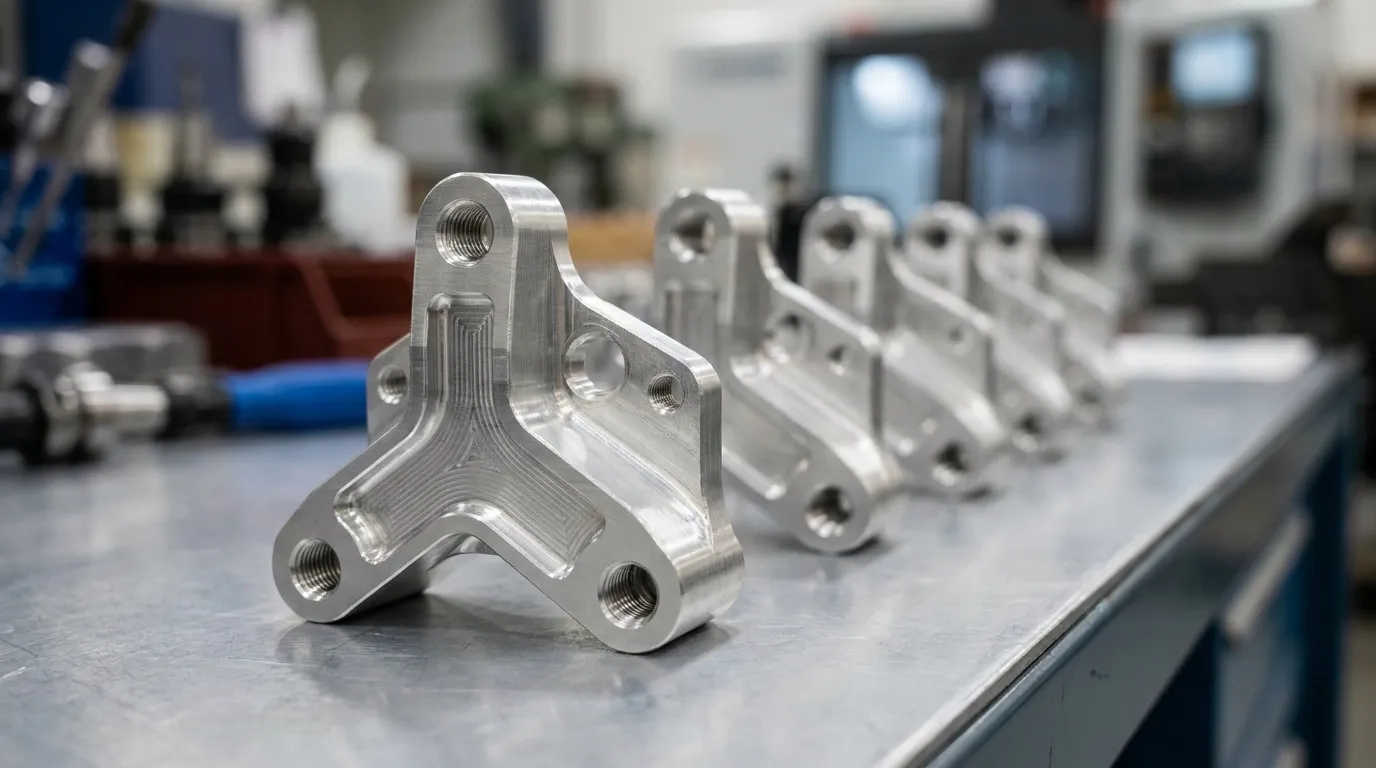
Satellite thermal management components and structural brackets carry demanding geometric and dimensional requirements. Thermal interface surfaces must hold consistent flatness and finish to transfer heat predictably. Structural brackets must maintain positional tolerances that keep payloads, antennas and optical systems aligned after launch loads.
Consistent results across a production run require multi-axis CNC machining centers that handle complex geometry in a single setup, in-process inspection integrated into the workflow and a quality management system that documents every step. Fewer setups reduce accumulated error and improve repeatability, which directly benefits flight hardware.
Precision Advanced Manufacturing applies advanced multi-axis milling and turning with rigorous inspection protocols to deliver flight-ready satellite brackets and structures that meet defined program specifications.
ITAR and AS9100D Requirements for Satellite Component Suppliers
U.S. satellite programs, both commercial and government, operate within a defined regulatory framework. ITAR (International Traffic in Arms Regulations) governs the manufacture and export of defense-related articles, including many satellite components. AS9100D defines the quality management system standard for aviation, space and defense manufacturers. ISO 9001:2015 provides the quality framework that supports AS9100D.
Suppliers without these registrations create immediate compliance risk. Program managers cannot rely on undocumented processes to produce consistent results, and procurement teams face audit exposure when traceability records are incomplete.
Precision Advanced Manufacturing is ITAR registered and operates under AS9100D and ISO 9001:2015 certified quality management systems. Every production step follows defined quality checkpoints, material certifications, inspection records and full documentation. This structure simplifies customer audits and supports regulatory alignment from first article through production delivery.
Scaling Satellite Machining from Prototype to Production
Transitioning from a validated prototype to constellation-level production volumes often creates the most damaging bottlenecks in satellite programs. A supplier that produces a handful of prototype brackets may lack the process maturity, capacity or scheduling discipline to sustain high-volume delivery without quality drift.
Common scaling failure points include process drift between prototype and production tooling, inspection capacity that cannot keep pace with volume and single-shift operations that cannot absorb schedule compression.
Precision Advanced Manufacturing operates a scalable production platform that supports the full program lifecycle, from initial prototype development through multi-shift, sustained production, without a supplier change. Processes validated during prototyping carry forward directly into production and preserve quality.
This continuity reduces re-qualification risk and protects program schedules. Eliminate re-qualification risk with a scalable production partner.
Machined Satellite Component Types and Requirements
Satellite hardware spans a wide range of machined component types, and each category carries distinct manufacturing requirements.
- Structural brackets and frames: Lightweight, stiff structures that position and protect satellite subsystems through launch and orbital operation.
- Thermal management components: Heat spreaders, cold plates and interface structures that manage thermal loads across the satellite bus and payload.
- RF housings and waveguide structures: Precision-machined enclosures and transmission components where dimensional accuracy directly affects signal performance.
- Optical mounts and instrument structures: Components that require exceptional stability and surface quality to maintain alignment of imaging and sensing payloads.
Each component type requires material expertise, appropriate surface finishing and full documentation. Precision Advanced Manufacturing integrates machining, specialty welding, secondary finishing such as anodizing, passivation and plating, and laser marking within a single facility to deliver ready-to-integrate hardware.
General Job Shops Compared with Certified Aerospace Manufacturers
General job shops serve a broad range of industries and often operate under ISO 9001 or no formal quality registration. They may offer competitive pricing on simple parts but lack the process infrastructure needed for flight-critical satellite hardware.
Specialized aerospace-certified manufacturers operate under AS9100D, maintain ITAR registration and build traceability into every production step. Their quality systems support regulated industries where documentation, repeatability and compliance remain central requirements.
The practical difference appears in audit readiness, first-article acceptance rates and the ability to sustain quality across production volumes. For satellite programs where a single nonconformance can delay integration, the distinction between a general shop and a certified manufacturer carries direct program risk.
Supplier Selection Framework and Due Diligence Checklist
Qualifying a precision machining partner for satellite hardware requires evaluation across several dimensions beyond price and lead time.
- Certifications: Confirm active AS9100D and ISO 9001:2015 registrations and ITAR compliance. Request current certificates.
- Documentation samples: Review first article inspection reports, material certifications and nonconformance records to assess quality system maturity.
- Process capabilities: Evaluate multi-axis CNC equipment, in-process inspection methods and finishing capabilities relevant to required component types.
- Material expertise: Confirm experience with the specific alloys and material forms specified for the program.
- Scalability evidence: Assess whether the supplier has transitioned programs from prototype to sustained production without quality degradation.
- Pilot run evaluation: Structure initial orders as pilot builds with defined acceptance criteria before full production commitments.
- Supplier transition support: For mid-program transitions, confirm that the supplier provides engineering support, documentation continuity and validation runs to reduce risk.
Frequently Asked Questions
What materials does Precision Advanced Manufacturing work with for satellite components?
Precision Advanced Manufacturing works with a broad range of metals and alloys relevant to satellite hardware, including aerospace-grade aluminum, titanium, stainless steel, Invar and other specialty alloys. The team applies material-specific process controls and documents full traceability from mill certification through finished part delivery.
Does Precision Advanced Manufacturing accept CAD files for satellite component programs?
Precision Advanced Manufacturing uses an advanced CAD/CAM system that accepts digital datasets in most standard file formats. Engineering support reviews designs for manufacturability and refines tolerances before production begins.
How does Precision Advanced Manufacturing handle the transition from prototype to full production?
The scalable production platform carries validated prototype processes directly into multi-shift production without a supplier change or re-qualification. This continuity protects program schedules and preserves the quality established during initial builds.
What compliance documentation does Precision Advanced Manufacturing provide with satellite components?
Each program includes complete quality documentation, including material certifications, in-process and final inspection records, first article inspection reports and traceability records aligned with AS9100D and ITAR requirements. This documentation supports customer audits and acceptance testing.
Can Precision Advanced Manufacturing support a mid-program supplier transition?
The team supports mid-program transitions with engineering support, documentation continuity and pilot build validation to integrate into existing supply chains with minimal disruption. Full traceability and process documentation remain in place throughout the transition.
Decision Framework for Selecting an Integrated U.S. Partner
Satellite program managers and procurement teams benefit from a supplier that reduces risk at every stage, from first article through sustained production. A practical decision framework centers on four criteria: certified quality systems, integrated capabilities, demonstrated scalability and full traceability.
Precision Advanced Manufacturing meets each criterion. With AS9100D and ISO 9001:2015 registrations and ITAR compliance in place across two U.S. facilities in California and Texas, the company consolidates multi-axis CNC machining, precision fabrication, specialty welding, secondary finishing and engineering support under one roof. This structure reduces handoffs and maintains production control while the scalable platform supports prototype through multi-shift production without supplier transitions.
For satellite programs where precision, compliance and reliability are nonnegotiable, an integrated certified U.S. partner represents the lowest-risk sourcing decision.
Make the lowest-risk sourcing decision for a satellite program.