Last updated: July 10, 2026
Key Takeaways for Defense CNC Sourcing
- Compliant CNC machining for military aircraft requires ITAR registration, AS9100D certification, full material traceability and multi-axis capabilities that meet defense standards.
- Procurement teams evaluate suppliers on regulatory compliance, technical capability, traceability systems, integration scope and scalability to avoid delays and compliance failures.
- ITAR and AS9100D together create the compliance baseline for flight-critical components, and non-compliant suppliers introduce regulatory and schedule risk.
- Integrated traceability workflows, advanced 5-axis machining for titanium and exotic alloys, and rigorous CMM inspection support consistent quality from prototype through full-rate production.
- Precision Advanced Manufacturing delivers certified, scalable CNC machining solutions for military aircraft programs, and defense teams can start a new project here.
Evaluation Framework for CNC Machining Partners
Defense procurement teams benefit from a structured method to compare CNC machining suppliers before selecting a program partner. The criteria below align with risk categories that drive delays, compliance failures and cost overruns.
- Regulatory compliance: Confirm ITAR registration with the Directorate of Defense Trade Controls and AS9100D and ISO 9001:2015 certification. These requirements are mandatory for military aircraft programs.
- Technical capability: Verify multi-axis CNC machining for complex geometries and experience with titanium, Inconel, aluminum and stainless steel.
- Traceability and documentation: Require full material certifications, in-process records, CMM inspection reports and audit-ready documentation packages.
- Integration scope: Prioritize suppliers that combine machining, fabrication, finishing and engineering support in one operation to reduce handoffs and fragmentation risk.
- Scalability: Confirm that the supplier can move from prototype to multi-shift, full-rate production without a supplier change or quality reset.
- Total program risk: Assess financial stability, cybersecurity posture, foreign national access controls and supply chain integrity for downstream ITAR compliance.
These six criteria form a complete risk assessment framework for defense CNC suppliers. Precision Advanced Manufacturing meets each criterion through certified quality systems, integrated capabilities and a scalable production platform operating across two specialized U.S. facilities.
ITAR and AS9100D Requirements for Military Aircraft CNC Machining
ITAR, administered by the U.S. Department of State Directorate of Defense Trade Controls, governs manufacturing, handling, storage and export of defense-related articles, services and technical data on the U.S. Munitions List. ITAR applies when a component, drawing, model, technical data package or manufacturing information connects to a defense article on the USML, including precision-machined parts for military aircraft, weapons systems and aerospace subassemblies.
ITAR compliance must be embedded into quoting, programming, machining, inspection and delivery processes, not treated as a one-time registration. This operational integration requires suppliers to control facility access, data security, U.S.-person-only personnel restrictions and downstream supply chain integrity.
AS9100D builds on ISO 9001:2015 with aerospace-specific requirements for risk management, configuration control, first-article inspection and product traceability. Together, ITAR registration and AS9100D certification form the compliance baseline for any supplier producing flight-critical military aircraft components.
Non-compliant suppliers expose buyers to schedule delays, data control failures, compliance investigations, civil or criminal penalties and program disqualification. As a result, selecting an unregistered or uncertified supplier creates direct and avoidable program risk.
Precision Advanced Manufacturing is ITAR registered and operates under AS9100D and ISO 9001:2015 certified quality management systems. Every component produced for military aircraft programs includes documented quality checkpoints and full regulatory alignment.
Traceability Workflows for Flight-Critical Components
The AS9100D and ITAR compliance described above depends on traceability systems that document each step from raw material to finished part. Traceability for flight-critical components begins at material receipt and continues through every production step to final delivery.
- Material certifications: Mill certificates and material test reports are received, verified and linked to each job traveler at incoming inspection.
- Job traveler documentation: Each part or lot carries a traveler that records operations, operator signoffs, tooling used and inspection results at defined checkpoints.
- In-process inspection records:</strong Dimensional checks at critical stages are documented and retained, creating an audit trail from raw stock to finished part.
- Final inspection and CMM reports: Coordinate measuring machine data and final inspection results are compiled into a quality package delivered with each shipment.
- Audit-ready records: All documentation is retained and organized to support customer audits, regulatory reviews and first-article inspection requirements.
Traceability gaps at any supplier tier can compromise the entire program. Precision Advanced Manufacturing uses traceability systems structured to close those gaps from the first operation forward.
5-Axis and Multi-Axis Machining for Titanium and Exotic Alloys
Defense and aerospace sectors now favor 5-axis CNC machines that support complex, multi-material processing for lightweight components. Military aircraft structures, engine components and hydraulic systems often require geometries that 3-axis equipment cannot produce reliably.
5-axis and multi-axis CNC machining enable simultaneous cutting along multiple planes, which reduces setups, improves geometric accuracy and maintains tight tolerances on contoured surfaces. For titanium and exotic alloys, which generate high cutting forces and heat, multi-axis capability supports dimensional integrity and surface finish.
Precision Advanced Manufacturing applies advanced multi-axis milling and turning to produce complex, high-tolerance components from titanium, Inconel, aluminum and stainless steel. In-house CNC programming and tooling expertise set feeds, speeds and fixturing for each alloy, which reduces the risk of material distortion or dimensional drift across production runs.
Typical Flight-Critical Machined Parts for Military Aircraft
Military aircraft programs depend on a broad range of precision-machined components, each with specific tolerance, material and documentation requirements. The following part families represent core categories where machining quality directly affects flight safety and mission readiness.
- Structural airframe elements and gusset plates
- Landing gear components and actuator housings
- Hydraulic manifolds and fluid system fittings
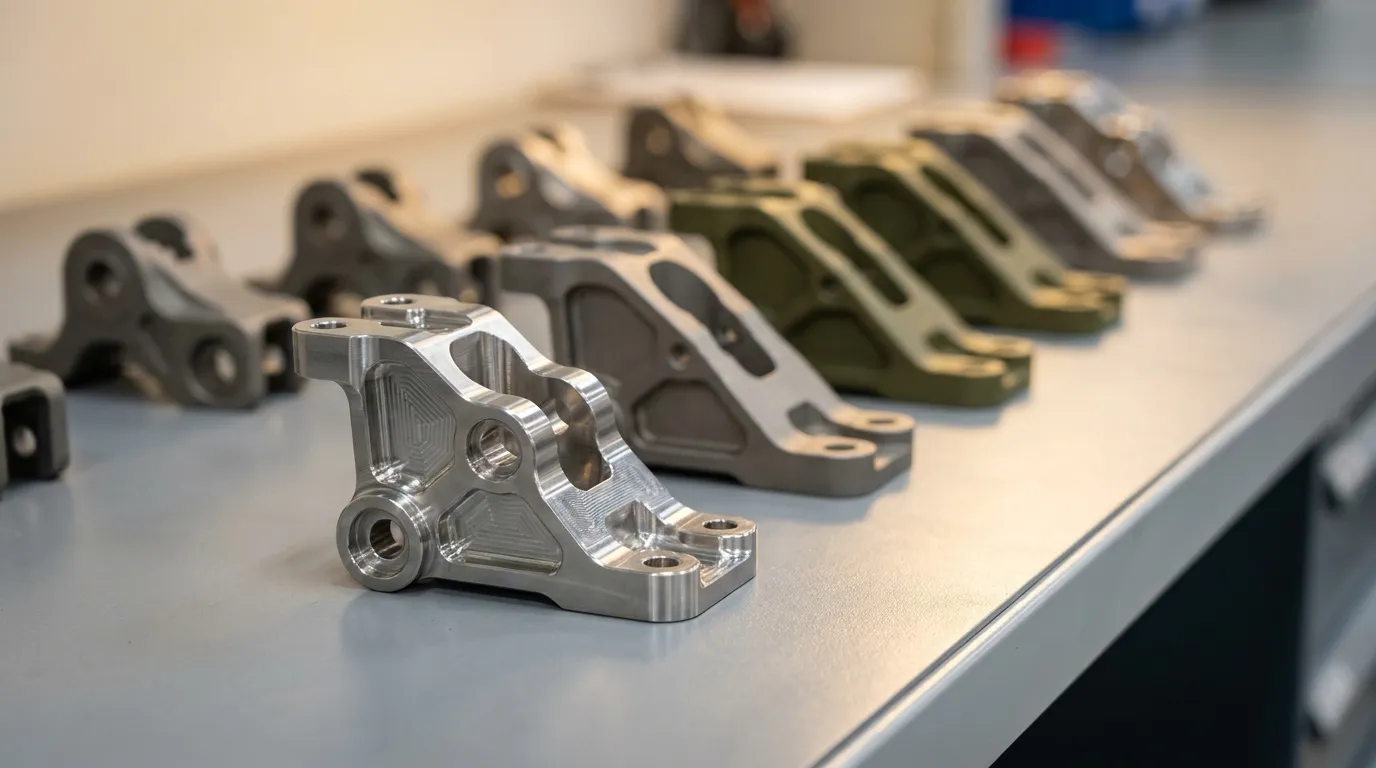
- Engine mounts, brackets and turbine-adjacent components
- Avionics housings and electronic enclosures
- Control surface brackets and linkage assemblies
Each part family requires material-specific process controls, full traceability and inspection documentation aligned with AS9100D and program quality requirements.
Quality Inspection and CMM Practices
Inspection at Precision Advanced Manufacturing integrates with production rather than occurring only at the end. In-process checks at defined control points catch dimensional deviations before they move into later operations, which reduces scrap and rework.
Final inspection uses coordinate measuring machine validation to verify critical dimensions against engineering drawings and customer specifications. CMM data is compiled into inspection reports that accompany each shipment, giving supplier quality engineers documented evidence of conformance without added verification work for their teams.
This inspection strategy reduces the workload that supplier quality engineers face when working with less rigorous suppliers. Parts arrive validated, documented and ready for integration.
Material Selection and Machinability for Military Aircraft Alloys
Material selection for military aircraft components balances structural performance, weight, corrosion resistance and machinability. Each alloy requires distinct process controls.
- Titanium: High strength-to-weight ratio and corrosion resistance make titanium common for structural and engine-adjacent parts. Low thermal conductivity requires controlled cutting speeds and coolant strategies to limit work hardening and tool wear.
- Aluminum: Widely used for airframe structures and housings where weight reduction matters. High machinability supports faster cycle times, but thin-wall sections need careful fixturing to prevent distortion.
- Inconel and nickel superalloys: Used in high-temperature environments near engines and exhaust systems. Work hardening and abrasive wear demand rigid setups, sharp tooling and conservative parameters.
- Stainless steel: Applied in hydraulic fittings, fasteners and structural brackets that require corrosion resistance and strength. Passivation typically follows as a secondary finishing step.
Precision Advanced Manufacturing applies material-specific process controls from the first operation, which supports dimensional stability and surface integrity across alloy families used in military aircraft programs.
Full Documentation and Inspection Reporting
Complete documentation packages simplify customer audits, regulatory reviews and program milestone reporting. A standard documentation package from Precision Advanced Manufacturing includes material certifications, job traveler records, in-process inspection data, CMM reports and certificates of conformance.
For programs that require first-article inspection, AS9102 documentation is prepared and delivered as part of the standard quality package. This documentation level reduces the administrative workload on procurement and supplier quality teams while providing audit-ready records for ITAR-controlled programs.
Get a detailed production plan that includes documentation and inspection reporting aligned to program requirements.
Prototype-to-Full-Rate Production Scalability
Military aircraft programs often start with prototype builds of dozens of units, then expand to full-rate production volumes of hundreds or thousands of components each year. This volume growth requires suppliers that scale without quality degradation or mid-program supplier transitions.
Precision Advanced Manufacturing supports the full product lifecycle from prototype development through sustained, multi-shift production. The same quality systems, tooling strategies and inspection protocols validated during prototyping continue into full-rate manufacturing.
Programs move forward without new suppliers, requalification cycles or documentation gaps. Multi-shift capacity and disciplined scheduling provide the throughput needed for sustained delivery commitments, and a single-facility model reduces coordination risk from fragmented supply chains.
Addressing Common Sourcing Pitfalls in Defense Aerospace
Defense procurement teams face recurring sourcing risks that increase program exposure when left unaddressed.
- Fragmented suppliers: Using separate vendors for machining, finishing and inspection creates handoff risk, documentation gaps and unclear accountability. A single-facility partner removes these failure points.
- Inadequate traceability: Suppliers without embedded traceability systems cannot produce audit-ready records, which creates compliance exposure for the prime contractor and the program.
- Mid-program supplier transitions: Changing suppliers after production begins introduces requalification delays, documentation resets and schedule risk. Selecting a scalable partner at program entry helps prevent this scenario.
- Uncertified suppliers: Defense buyers evaluating CNC machining suppliers should verify ITAR registration, documented procedures for handling controlled technical data, physical security measures and full traceability support. As discussed in the compliance section, suppliers without these controls create the program risks outlined earlier.
A comprehensive supplier risk assessment reviews financial stability, operational performance, regulatory compliance, cybersecurity threats and supply chain integrity. Precision Advanced Manufacturing is structured to perform well across each dimension.
How Precision Advanced Manufacturing Reduces Program Risk
Each role in defense aerospace procurement faces distinct risks, and Precision Advanced Manufacturing’s integrated model addresses them directly.
- For procurement and sourcing teams: AS9100D, ISO 9001:2015 and ITAR-compliant processes with full documentation support audits and regulatory alignment. Consistent delivery backed by proven aerospace performance keeps programs on schedule.
- For program and project managers: Finished, ready-to-integrate components remove secondary work and integration delays. Scalable production with predictable performance protects timelines and budgets from prototype through full-rate delivery.
- For supplier quality engineers: Rigorous in-process and final inspection with complete quality documentation reduces the verification workload on customer teams. Certified processes and material expertise help ensure conformance is built in, not inspected in after the fact.
The facilities mentioned earlier support multi-axis CNC machining, integrated finishing and engineering support under one quality system. This structure delivers mission-ready components with the traceability and documentation that defense programs require.
Frequently Asked Questions
What certifications support military aircraft programs at Precision Advanced Manufacturing?
Precision Advanced Manufacturing is ITAR registered and operates under AS9100D and ISO 9001:2015 certified quality management systems. These registrations and certifications cover CNC machining, fabrication, finishing and inspection. Every component produced for military aircraft programs runs under these quality systems with full documentation and traceability.
How does Precision Advanced Manufacturing manage material traceability for flight-critical components?
Traceability starts at material receipt with verification of mill certificates and material test reports. Each job carries a traveler that records every operation, inspection checkpoint and operator signoff through final delivery. CMM inspection data and certificates of conformance are compiled into a documentation package that ships with every order and supports customer audits and regulatory reviews.
Can Precision Advanced Manufacturing support a transition from prototype to full-rate production?
Precision Advanced Manufacturing operates a production platform designed to scale from prototype builds through sustained, multi-shift manufacturing. The same quality systems, tooling strategies and inspection protocols validated during prototyping continue into full-rate production, so programs avoid requalifying a new supplier or resetting documentation when volume increases.
What materials does Precision Advanced Manufacturing machine for military aircraft components?
Precision Advanced Manufacturing works with alloys common to military aircraft programs, including titanium, aluminum, Inconel, nickel superalloys and stainless steel. The engineering team applies material-specific process controls for each alloy to maintain dimensional integrity, surface finish and structural performance across production runs.
How does Precision Advanced Manufacturing support a mid-program supplier transition?
Precision Advanced Manufacturing supports supplier transitions with complete documentation, material traceability and engineering support from the start of the engagement. The team can begin with pilot builds or validation runs to confirm conformance before moving to full production volume, which maintains program continuity and reduces schedule exposure during a supplier change.
Conclusion and Next Steps for Defense Programs
Non-compliant or fragmented CNC suppliers create program risk that procurement, quality and program management teams cannot accept on military aircraft programs. ITAR registration, AS9100D certification, full material traceability, multi-axis machining capability and seamless scalability now function as baseline requirements for a qualified defense aerospace partner.
Precision Advanced Manufacturing meets each requirement through integrated capabilities, certified quality systems and a production platform built to support mission-critical programs from first article through sustained delivery. As military aircraft production volumes rise, the cost of selecting the wrong supplier increases with them.
Connect with our defense aerospace specialists to receive a tailored production plan for military aircraft component requirements.