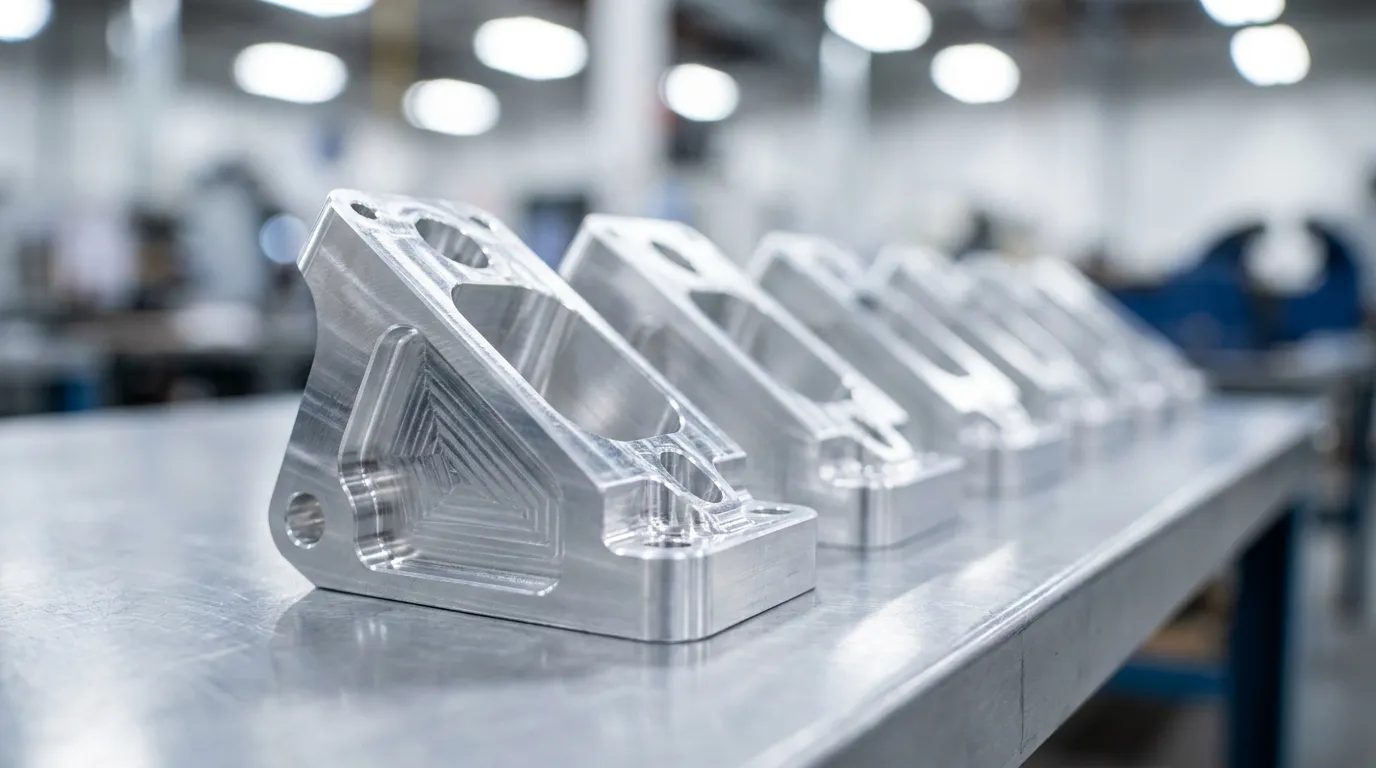
Key Takeaways for Defense CNC Buyers
- Multi-axis CNC machining supports single-setup production of complex, tight-tolerance defense components from high-performance materials.
- Certified ITAR-registered and AS9100D partners reduce program delays, compliance failures and quality escapes.
- Five-axis capability removes multiple setups and cumulative error for angled holes, undercuts and compound-angle features.
- Integrated machining, fabrication, finishing and kitting under one roof protects traceability and accelerates prototype-to-production scaling.
- Connect with Precision Advanced Manufacturing to secure compliant, scalable multi-axis capacity for the next defense program Request a quote.
Certified Multi-Axis CNC Partners Reduce Defense Program Risk
Aerospace and defense is the fastest-growing end-user segment in the global machining centers market, expanding at a 7.89% CAGR through 2031. This growth creates real program demand and real supplier exposure. As more buyers compete for qualified multi-axis capacity, the gap between certified and noncertified shops becomes a program liability. Defense procurement, program and supplier-quality professionals face three compounding risks when sourcing multi-axis CNC capacity:
- Program delays from suppliers that cannot hold tolerances or meet delivery schedules on mission-critical parts.
- Compliance failures from shops without ITAR registration, AS9100D certification or documented traceability systems.
- Quality escapes from cumulative errors introduced by fragmented multi-vendor supply chains.
A certified ITAR-registered partner with integrated multi-axis machining, fabrication, finishing and kitting under one roof removes each of these risks at the source.
Complex Geometries Drive Multi-Axis Requirements
Defense components such as missile and propulsion parts, valve bodies, manifolds, housings, mechanical assemblies and structural parts require complex geometries, tight tolerances and high repeatability. These features create direct pressure on program timelines and quality. Standard 3-axis equipment cannot reach all features in a single setup, which forces multiple repositions that introduce cumulative error.
Five-axis machining adds two rotational axes that allow the cutting tool to approach the workpiece from nearly any angle in a single continuous setup. This capability supports angled holes, smooth curves and compound-angle features without manual repositioning.
Key considerations for complex defense geometries:
- Five-axis and multi-axis capability is required for components with undercuts, internal features and multiple angled surfaces that 3-axis equipment cannot reach in one setup.
- ITAR registration is mandatory when machining components listed on the U.S. Munitions List. ITAR compliance must be embedded into quoting, programming, machining, inspection and delivery, not treated as a one-time certification.
- AS9100D documentation provides structured quality checkpoints and revision-controlled records that defense programs require at every production stage.
Reduced Setups Improve Accuracy and Schedule
Reduced setups deliver three direct program benefits:
- Single-setup processing removes fixture-to-fixture repositioning that compounds tolerance stack-up on precision defense parts.
- Error reduction results from maintaining consistent datums throughout the machining cycle, which preserves accurate hole locations, slots and compound-angle features.
- Full material traceability is easier to maintain when a part moves through fewer production handoffs, which reduces the documentation burden on supplier quality teams.
Compliance and Traceability in Multi-Axis Defense Work
Defense and aerospace buyers sourcing multi-axis CNC machining should prioritize suppliers that are DDTC/ITAR registered and AS9100D and ISO 9001:2015 certified. Compliance functions as an operational discipline embedded in every production step.
A compliant defense CNC partner maintains:
- ITAR registration with physical security, restricted access for authorized U.S. persons and controlled technical data handling. Noncompliance can result in significant financial penalties, loss of export privileges and disqualification from government and defense contracts.
- AS9100D and ISO 9001:2015 quality systems with defined inspection checkpoints, calibrated measurement equipment and controlled revision history across all production documentation.
- Inspection reporting that includes first article inspection, in-process verification and material certifications retained for every lot to provide full visibility into material sourcing and composition.
- Multi-shift production capacity that supports program schedules without reducing the quality discipline required for mission-critical components.
Prototype-to-Production Scalability with Multi-Axis Capacity
Reshoring and contract manufacturing outsourcing by OEMs are pushing work into flexible automation-ready cells, which increases demand for advanced multi-axis machining centers. Defense programs need suppliers that can absorb that ramp without a supplier change mid-program.
Scalability requirements for defense programs include:
- Seamless prototype-to-production transition that uses the same certified processes, tooling strategies and quality documentation validated during the prototype phase.
- Integrated capabilities such as multi-axis machining, precision fabrication, welding, finishing and kitting under one roof that reduce handoffs, remove supplier fragmentation and protect program timelines.
- Multi-shift production capacity that scales to full-rate manufacturing without new supplier qualifications or revalidation cycles.
Selecting a Defense CNC Partner with Scalable Compliance
The capabilities outlined above, including complex geometry handling, reduced setups, compliance infrastructure and scalable capacity, define a qualified defense CNC partnership. The following checklist converts these capabilities into verification criteria that procurement, program and supplier-quality professionals can confirm before awarding multi-axis CNC machining work. AS9100D and ISO 9001:2015 certifications show that a supplier maintains structured quality processes, inspection discipline, traceability practices and continuous improvement systems for moving defense parts from prototype to full-scale production. Defense contracts mandate domestic production, which concentrates aerospace machine tool demand within U.S. facilities and limits import substitution risk.
Addressing common objections:
On cost: Certified precision manufacturing reflects the cost of doing it right the first time. Rework, scrap and program delays from out-of-spec parts carry a higher total cost than a well-structured quote from a certified supplier.
On supplier transitions: Transitioning to a new supplier mid-program becomes manageable with a partner that provides complete documentation, material traceability and engineering support. Pilot builds and validation runs reduce risk during integration.
On scaling risk: The multi-shift capacity mentioned earlier removes the qualification bottleneck that occurs when a supplier cannot absorb production ramp internally.
Next Steps with Precision Advanced Manufacturing
Defense programs benefit from a machining partner that combines ITAR registration, AS9100D certification, multi-axis capability and scalable production under one roof. Precision Advanced Manufacturing operates two specialized U.S. facilities in California and Texas that deliver finished, ready-to-integrate components with full traceability and documentation for military and defense, commercial aerospace, space and satellite and UAV programs. Program teams can connect with a Precision Advanced Manufacturing aerospace and defense specialist to define requirements, review part specifications and receive a tailored production strategy.
Request a quote to get started.
Frequently Asked Questions
What defense components are typically produced using multi-axis CNC machining?
Multi-axis CNC machining supports production of missile and propulsion components, valve bodies and manifolds, housings and enclosures, structural assemblies, actuators and weapon system components. These parts share common characteristics such as complex geometries, multiple angled surfaces, internal features and tight tolerances that standard 3-axis equipment cannot achieve reliably. High-performance materials such as titanium, stainless steel, aluminum alloys and high-temperature alloys are common in this work. Precision Advanced Manufacturing applies advanced multi-axis milling and turning to produce these components with the repeatability and documentation that defense programs require.
What does ITAR registration mean for a CNC machining supplier and why does it matter to defense buyers?
ITAR registration means a manufacturer is registered with the U.S. Department of State Directorate of Defense Trade Controls and is authorized to manufacture, handle and store defense articles and related technical data listed on the U.S. Munitions List. For a CNC machining supplier, this status requires physical security controls, restricted access limited to authorized U.S. persons, secure handling of CAD files and technical drawings and full audit readiness. For defense buyers, sourcing from an ITAR-registered supplier protects the program from compliance violations that can result in financial penalties, loss of export privileges and contract disqualification. Precision Advanced Manufacturing is 100 percent ITAR registered across its operations.
How does AS9100D certification support defense program traceability requirements?
AS9100D is the aerospace quality management standard that requires structured quality checkpoints, controlled documentation, calibrated inspection equipment and continuous improvement systems. For defense programs, this structure makes every production step traceable, from raw material certifications through in-process inspections to final delivery documentation. AS9100D-certified suppliers can provide first article inspection reports, material certifications and revision-controlled records that satisfy supplier quality engineers and simplify audits. Precision Advanced Manufacturing operates under AS9100D and ISO 9001:2015 certified quality systems, with full documentation and inspection reporting built into every program.
Can a single supplier handle both prototype development and full-rate production for defense programs?
A single supplier can support both phases when it combines engineering support, multi-axis machining capability and scalable production infrastructure. The risk in using separate prototype and production suppliers is that the quality and process discipline validated during prototyping does not automatically transfer to a new production vendor. Precision Advanced Manufacturing supports the full product lifecycle, from prototype development through multi-shift, full-rate manufacturing, using the same certified processes, tooling strategies and quality systems at every stage. This approach removes the requalification burden and schedule risk associated with supplier transitions mid-program.
What integrated capabilities should a defense CNC partner offer beyond machining?
Defense programs gain the most value from a partner that consolidates machining, fabrication, finishing and kitting under one roof. Each handoff between separate vendors introduces schedule risk, documentation gaps and potential quality escapes. An integrated supplier provides multi-axis CNC machining, precision sheet metal fabrication, specialty welding, secondary finishing such as anodizing and passivation, hardware installation, laser marking and kitting in a single facility. Precision Advanced Manufacturing offers this full capability set across its California and Texas locations and delivers finished, ready-to-integrate components that reduce assembly time and remove the coordination burden of managing multiple suppliers.