Last updated: June 29, 2026
Key Takeaways for Regulated Aerospace and Defense Machining
- 5-axis CNC machining produces complex aerospace and defense components in a single setup with higher accuracy and fewer fixtures.
- Texas-based certified suppliers reduce logistics complexity and create a single point of accountability for regulated programs.
- AS9100D, ISO 9001:2015 and ITAR registration support traceability, compliance and lower supplier-audit workload.
- Integrated machining, fabrication, welding, finishing and kitting deliver ready-to-integrate parts without extra vendor handoffs.
- Precision Advanced Manufacturing offers scalable prototype-to-production support with full documentation continuity; discuss program requirements with the team.
Certified 5-Axis CNC Partners in Texas for Aerospace, Defense and UAV Programs
Aerospace, defense and UAV programs operate under strict performance and schedule requirements. A single out-of-spec part can trigger integration delays, rework cycles and cost overruns that compound across a program lifecycle.
Austin precision machining has grown as a strategic sourcing option because Texas-based suppliers reduce logistics complexity for programs concentrated in the South and Southwest. Access to a 5 axis CNC Austin TX partner with integrated capabilities means fewer vendor handoffs, tighter schedule control and a single point of accountability for complex components.
Procurement managers, program managers and supplier quality engineers consistently identify supplier reliability as a primary risk driver. A certified Texas partner with documented quality systems addresses that risk at the source rather than downstream during inspection or integration.
Share aerospace or defense program details with the Precision Advanced Manufacturing team.
Quality and Compliance Systems That Lower Program Risk
That reliability starts with the quality frameworks that govern every production step. Regulated programs require suppliers to operate under auditable, documented quality systems.
Precision Advanced Manufacturing holds AS9100D and ISO 9001:2015 registrations and is ITAR registered, making it a qualified ITAR registered machine shop Austin procurement teams can add to approved supplier lists without additional compliance remediation.
AS9100D CNC machining in Texas means every production step follows defined quality checkpoints, material certifications, in-process inspection records and final documentation packages. Traceability is built into the process, not added after the fact. This structure reduces inspection workload for customer quality teams and simplifies supplier audits.
ITAR registration is a non-negotiable requirement for suppliers that produce components under the U.S. Munitions List. Work with a non-registered shop on defense or space programs creates legal exposure and program risk. Precision Advanced Manufacturing maintains current ITAR compliance that applies across all production activities at its Texas facility.
Review current certifications and compliance documentation with the quality team.
Integrated Machining, Fabrication, Welding, Finishing and Kitting in Austin
Precision Advanced Manufacturing operates as a precision CNC machine shop Austin programs can rely on for integrated production instead of fragmented vendor management. Core capabilities include advanced multi-axis CNC milling and turning, precision sheet metal fabrication, specialty welding, secondary finishing and kitting.
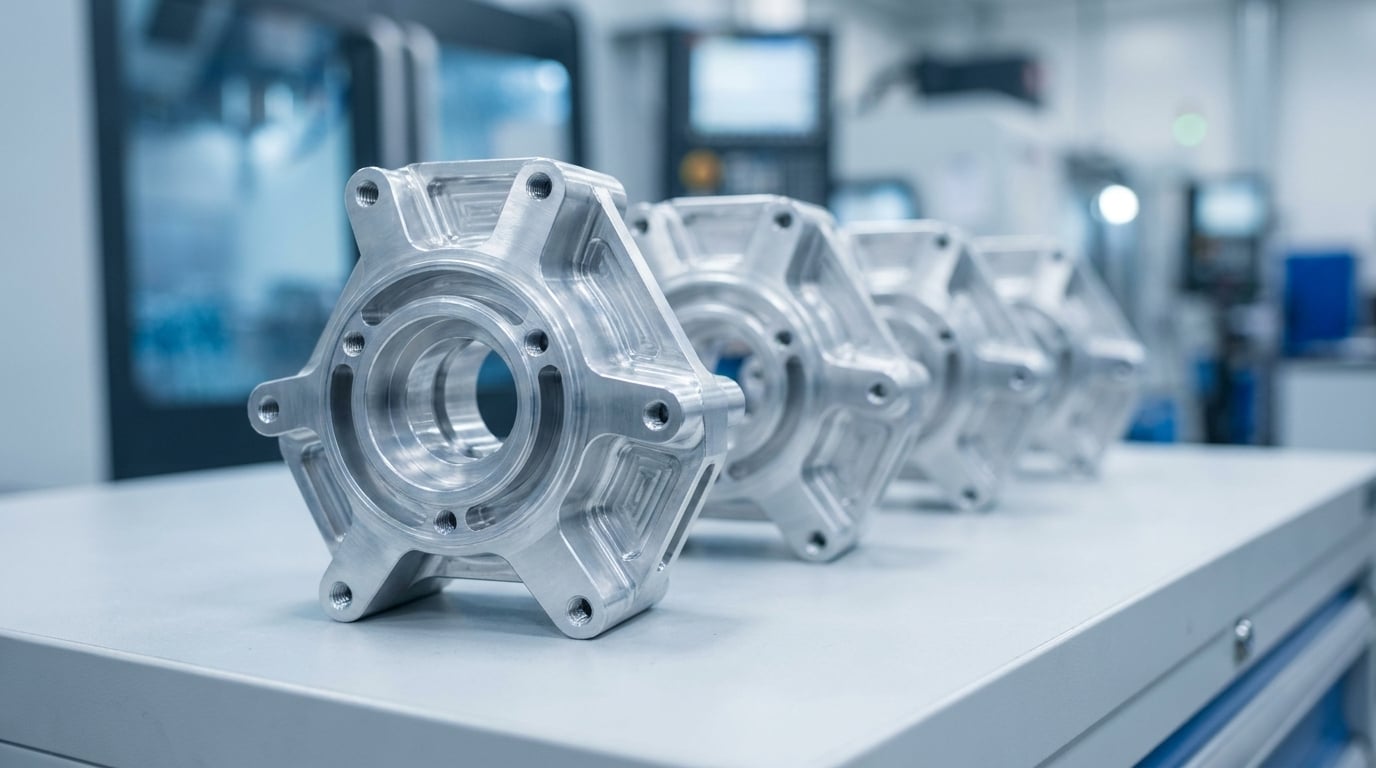
Multi-axis machining handles complex tight-tolerance components for 5 axis CNC machining Austin aerospace applications, including structural airframe elements, UAV housings and satellite brackets. These parts often require multiple setups at standard shops, while multi-axis equipment completes them in fewer operations with higher repeatability.
Fabrication services combine CNC machining, waterjet cutting, laser cutting, stamping, forming and bending under one roof. When machining and fabrication share a single supplier, programs avoid handoff delays, mixed documentation standards and quality gaps between separate vendors.
Welding operations include TIG, MIG and precision laser welding with thermal distortion control. This control is critical for lightweight aerospace assemblies where structural integrity and dimensional stability must remain intact after joining.
Secondary finishing integrates anodizing, passivation, plating, sandblasting and ultrasonic cleaning to deliver components ready for assembly without extra vendor steps. Consolidated finishing improves schedule predictability and keeps full traceability within one quality system.
Kitting consolidates individual components into organized, labeled kits that reduce handling time and lower assembly costs. Hardware installation, brush finishing, laser marking and deburring complete a capability set built to deliver fully finished, ready-to-integrate parts from a single supplier.
Discuss specific machining, fabrication and finishing needs for current programs.
Prototype-to-Production Operations and Delivery Model
Prototype to production CNC Austin programs require a supplier that maintains consistent quality standards at every volume level. Precision Advanced Manufacturing supports the full product lifecycle, from initial prototype development through sustained, multi-shift high-volume manufacturing.
As a south Austin machine shop 5 axis operation, the facility runs multi-shift capacity with disciplined scheduling that supports demanding timelines. In-house CNC programming, tooling development and engineering support start at project kickoff. This structure strengthens manufacturability and shortens iteration cycles during prototyping.
When programs move from prototype to full-rate production, the same certified processes and quality documentation that governed the prototype phase continue forward. This continuity removes re-qualification risk that appears when programs change suppliers mid-lifecycle. Engineering support remains available throughout production to address design changes or process refinements without disrupting output.
Plan a prototype-to-production transition with the engineering and operations team.
Industry Segments Served and Typical Use Cases
Precision Advanced Manufacturing serves five primary industry segments, each with distinct performance and compliance requirements.
Commercial aerospace programs require flight-critical reliability, strict regulatory alignment and components that integrate cleanly into high-performance aviation systems. Military and defense programs demand mission-ready components built for durability and dependable performance in operational environments where failure carries serious consequences.
Space and satellite programs operate in extreme conditions where high-tolerance manufacturing, lightweight structures and materials suited for orbital environments are essential. UAV programs require tight-tolerance components produced with the same rigor applied to manned aircraft, as UAV platforms take on more complex mission profiles.
Advanced industrial programs benefit from precision-engineered components that enhance equipment performance, extend service life and support consistent, scalable production across high-demand manufacturing environments.
Explore solutions aligned with specific industry segment requirements.
Evaluation Criteria for 5-Axis CNC Suppliers
Sourcing managers and supplier quality engineers evaluating 5-axis CNC suppliers for regulated programs can use several core criteria.
Start with certifications and registrations. Confirm AS9100D, ISO 9001 and ITAR registration are current and apply to the specific facility and scope of work. These credentials establish the baseline quality and compliance framework.
Within that framework, review traceability and documentation. Verify that the supplier provides material certifications, in-process inspection records and final documentation packages for every order. This evidence shows whether traceability is built into daily operations or added later as a patch.
Next, examine integrated capabilities. Determine whether the supplier can deliver finished, ready-to-integrate components or must use external vendors for finishing, welding or kitting. External vendors reintroduce handoff risk, schedule uncertainty and mixed documentation standards.
Scalability forms the next evaluation layer. Confirm that the supplier has demonstrated capacity to move from prototype to full-rate production without quality degradation or process re-qualification. Scalability issues often surface only after programs commit to a vendor.
That scalability depends in part on engineering support. Evaluate whether in-house programming and manufacturability review are available to reduce iteration cycles and prevent downstream issues during ramps.
Finally, review supplier transition support. Assess the supplier’s ability to onboard mid-program with pilot builds, validation runs and full documentation continuity. This capability matters most when replacing an underperforming incumbent while protecting program schedules.
Begin a structured supplier evaluation with Precision Advanced Manufacturing.
Frequently Asked Questions
What certifications does Precision Advanced Manufacturing hold?
Precision Advanced Manufacturing holds AS9100D and ISO 9001:2015 registrations and is ITAR registered. These certifications apply to all production activities and are supported by defined quality checkpoints, material traceability, inspection reporting and complete documentation packages aligned with aerospace and defense standards.
Can Precision Advanced Manufacturing handle both prototype and full-rate production?
The company structures operations to support the full product lifecycle. Programs begin with prototype development under the same certified quality systems used in production. This structure allows a smooth transition to multi-shift, high-volume manufacturing without re-qualification or supplier changes.
What materials and geometries can Precision Advanced Manufacturing machine?
Precision Advanced Manufacturing works with a wide range of metals and advanced materials, including exotic alloys, composites and materials suited for aerospace and defense environments. Multi-axis CNC capabilities support complex geometries that standard three-axis shops cannot produce in a single setup, which reduces fixturing requirements and improves dimensional accuracy.
How does Precision Advanced Manufacturing support supplier transitions mid-program?
The team provides complete documentation, material traceability and engineering support to maintain continuity when transitioning from an existing supplier. Pilot builds or validation runs help minimize risk while integrating into existing supply chains. This approach protects program schedules and reduces disruption during mid-program supplier changes.
What finishing and post-processing services are available in-house?
The secondary finishing services detailed in the core capabilities section operate in-house, along with brush finishing, laser marking, deburring and hardware installation. These capabilities allow delivery of fully finished, ready-to-integrate components without reliance on external vendors.
Conclusion: Single-Source Texas Partner for Regulated Programs
Supplier risk remains one of the most controllable variables in aerospace and defense program management. Selecting an ITAR-registered, AS9100D-certified partner with integrated multi-axis capabilities and full traceability removes a major source of schedule, quality and compliance risk.
For sourcing managers, program managers and supplier quality engineers managing regulated programs, that single point of accountability, spanning the capabilities, quality systems and production capacity detailed above, is available from prototype through full-rate manufacturing at Precision Advanced Manufacturing’s Texas facility.
Connect with Precision Advanced Manufacturing’s aerospace and defense manufacturing specialists.