Key Takeaways
- AS9100D certification sets the quality baseline for aerospace CNC machining and is required by major prime contractors.
- Procurement teams verify AS9100D certification through the IAQG OASIS database, confirming scope, status and certification body recognition.
- AS9100D adds more than 100 aerospace-specific requirements to ISO 9001:2015, including risk management, configuration control and AS9102 First Article Inspection.
- Certified CNC machining reduces total cost of ownership by limiting rework, scrap and program delays, even with higher documentation costs.
- Precision Advanced Manufacturing holds current AS9100D and ISO 9001:2015 certifications, is ITAR registered and operates two U.S. facilities. Start a project review with a certified partner.
How AS9100D Certification Shapes CNC Machining Quality
AS9100D is the aerospace quality management standard that adds risk management, traceability and configuration control to ISO 9001:2015. For CNC machining, it establishes consistent processes, documented traceability and First Article Inspection compliance for mission-critical components.
The International Aerospace Quality Group (IAQG) developed and maintains the standard, which SAE International publishes. The current version, AS9100 Rev D, was released in September 2016 and remains active.
Several core requirements directly affect CNC machining operations.
- Risk-based thinking appears as a formal operational requirement under Clause 8.1.1 and requires documented mitigation strategies.
- Configuration management under Clause 8.1.2 mandates unique identification and control of every revision of drawings, BOMs, work instructions, fixtures and test programs.
- Product safety under Clause 8.1.3 identifies safety-critical characteristics and controls processes that affect them.
- Counterfeit parts prevention under Clause 8.1.4 requires approved vendor controls and full material traceability.
- Production process verification under Clause 8.5.1.3 typically requires a complete AS9102 First Article Inspection package.
Certification means an IAQG-recognized certification body accredited under the ICOP scheme has audited and registered the shop’s quality management system. A certificate from a non-ICOP body does not satisfy prime contractor supplier qualification requirements.
AS9100D and ISO 9001 in Aerospace CNC Machining
ISO 9001:2015 is a general-purpose quality management framework used across many industries. AS9100D contains the entire text of ISO 9001:2015 verbatim and adds more than 100 aerospace-specific requirements on top. Every AS9100D-certified manufacturer therefore satisfies ISO 9001 requirements, while ISO 9001 alone does not meet AS9100D expectations.
Key AS9100D additions without direct ISO 9001 equivalents include:
- Formal operational risk management with documented mitigation and monitoring
- Configuration management for drawings, BOMs, work instructions and CNC programs across the product lifecycle
- Product safety as a documented process with defined responsibilities
- Counterfeit parts prevention with approved vendor lists, certificate of conformance checks and quarantine procedures
- Foreign object debris (FOD) control requirements
- Human factors consideration in process design and error prevention
- Special process qualification for welding, heat treatment and chemical processing
For aerospace CNC machining, a supplier holding only ISO 9001 certification cannot satisfy AS9100D flowdown requirements on flight-critical or safety-critical programs. Precision Advanced Manufacturing holds both AS9100D and ISO 9001:2015 certifications under a single quality management system.
Why AS9100D Certification Matters in Daily Machining Work
AS9100D-certified machining reduces the risk of out-of-spec parts, rework and program delays through structured process controls beyond commercial machining requirements. The standard mandates material traceability from raw stock through every manufacturing operation to the finished-part certificate of conformance, with lot traceability and segregation by grade, lot and heat number as baseline controls.
First Article Inspection per AS9102 validates production processes before a full run begins. A complete AS9102 FAI package includes dimensional verification, material certifications, process documentation and a formal review package retained as a quality record. New or partial FAI runs occur whenever engineering changes, process changes or production interruptions could affect product conformity.
For procurement teams, certified machining supports predictable quality, on-time delivery and audit readiness. AS9100D documentation requirements add overhead to a standard commercial machining estimate, and that overhead helps prevent the higher costs of rework, scrap and schedule slips.
Precision Advanced Manufacturing uses certified processes that include in-process inspection, final inspection, full material traceability and complete documentation packages. Parts arrive ready to integrate without extra verification burden on customer quality teams.
How Procurement Teams Verify AS9100D Certification
Procurement teams treat certificate copies as supporting documents, not primary proof. Verification runs through the IAQG OASIS database at iaqg.org/oasis, which is publicly accessible and searchable by company name, country or certification body. The OASIS record lists certificate number, certification body, scope of certification, certificate status and next surveillance audit date.
A practical verification sequence keeps the process consistent.
- Search the supplier in the IAQG OASIS database and confirm the certificate status is active.
- Read the scope statement carefully and confirm it explicitly covers CNC machining operations.
- Confirm the issuing certification body is IAQG-recognized. Common ICOP-accredited bodies include BSI Group, Bureau Veritas, DNV, Intertek, DEKRA, NQA, Perry Johnson Registrars and SGS.
- Check the certificate expiry date. AS9100D certificates remain valid for three years with annual surveillance audits and a full recertification audit in year three.
- Request the supplier’s recent audit history, nonconformance reports and corrective action records.
- Request sample AS9102 FAI reports and material traceability documentation linking finished parts to raw material heat numbers.
Common red flags include missing certificate numbers, absence from OASIS, nonrecognized issuing bodies, reluctance to share audit results and lack of FAI reports. Fake certificates appear in aerospace supply chains, so direct OASIS verification remains essential.
Precision Advanced Manufacturing’s AS9100D certificate is current, covers CNC machining operations and aligns with ITAR registration. Certification details are available upon request and verifiable through OASIS.
Supplier Evaluation Checklist for AS9100D CNC Machining
A structured checklist supports objective comparison across candidate suppliers and clarifies tradeoffs. Each category below contributes to overall risk, cost and schedule performance.
Certifications and Compliance
- Current AS9100D certification, OASIS-listed and scoped to CNC machining
- ISO 9001:2015 registration
- ITAR registration for defense and space programs
Technical Capabilities
- Multi-axis CNC machining for complex geometries and tight tolerances
- Experience with aerospace-grade materials and demanding specifications
- Precision sheet metal fabrication, welding and finishing under one roof
Quality Systems
- In-process and final inspection with calibrated equipment
- AS9102 First Article Inspection as standard practice
- Full material traceability from raw stock to finished part
- Nonconformance and corrective action records available for review
Scalability
- Capability from prototype through full-rate production
- Multi-shift capacity for sustained production programs
- Smooth production ramp without supplier changes or disruption
Integrated Services
- Secondary finishing, welding, assembly and kitting under one roof
- Engineering support and design for manufacturability review
- Delivery of fully finished, ready-to-integrate components
Documentation
- Material certifications, inspection reports and certificates of conformance
- Compliance records aligned with AS9100D and customer-specific requirements
- Openness to customer audits and source inspection
Precision Advanced Manufacturing meets every criterion on this checklist. Integrated capabilities across multi-axis CNC machining, precision sheet metal fabrication, welding, finishing, kitting and assembly reduce supplier fragmentation and handoffs on mission-critical programs.
Review capabilities and qualification details with the Precision Advanced Manufacturing team.
Cost and Lead-Time Planning for AS9100D Machining
AS9100D-certified CNC machining includes cost drivers that do not appear in commercial machining. Compliance documentation, first-article inspection, material certification and traceability represent distinct cost elements that reflect real labor and administrative work.
Primary cost drivers include material and buy-to-fly ratio, part complexity and tolerance requirements, inspection scope, FAI documentation, compliance overhead for AS9100D and ITAR and secondary operations such as finishing and heat treatment. Inspection and documentation can consume a significant portion of total manufacturing lead time on complex aerospace parts.
Certified machining often carries a higher initial quote than noncertified alternatives and reduces total cost of ownership by limiting rework, scrap and program delays. A quote omitting required inspection or finishing represents an incomplete scope rather than a lower-cost source.
Lead times at certified shops reflect rigorous quoting, process planning and FAI requirements. Quoted lead times often exclude FAI completion and outsourced special processes, a common source of schedule slippage on first orders. Buyers benefit from confirming whether quoted lead times include FAI, finishing and any outside processing.
Precision Advanced Manufacturing provides tailored quotes that cover capabilities, tolerances, materials, certifications and production strategy. Scalable production from prototype to full-rate manufacturing allows programs to balance cost and speed with a single supplier.
Common Pitfalls and Red Flags in Supplier Selection
Structured due diligence prevents many common pitfalls in AS9100D supplier selection. Many compliance failures trace to quality management systems that operate reactively rather than continuously.
Frequent pitfalls include:
- Selecting a supplier with a lapsed certificate or one not listed in OASIS
- Accepting a certificate without reading the scope for machining coverage
- Failing to confirm traceability documentation before production begins
- Underestimating documentation requirements for FAI and material certifications
- Overlooking ITAR registration requirements for defense and space programs
Red flags during evaluation include missing OASIS listings, nonrecognized certification bodies, reluctance to share audit history or corrective action records, lack of AS9102 FAI samples and no ITAR registration for defense work. An unusually low nonconformance report count can also signal that issues are not recorded.
Mitigation steps include direct OASIS verification, requesting sample documentation before commitment and conducting facility audits for critical programs. Precision Advanced Manufacturing welcomes customer audits and provides full documentation packages on request.
Why Precision Advanced Manufacturing Stands Out as an AS9100D Partner
Precision Advanced Manufacturing holds current AS9100D and ISO 9001:2015 registrations and is ITAR registered, with specialized U.S. facilities in California and Texas. Every project follows defined quality checkpoints with full traceability and documentation aligned with aerospace standards.

Integrated capabilities under one roof cover the full production chain: multi-axis CNC machining, sheet metal fabrication, specialty welding, finishing, hardware installation, laser marking, kitting and assembly. Consolidating these services reduces handoffs, limits supplier fragmentation and strengthens production control for mission-critical applications.
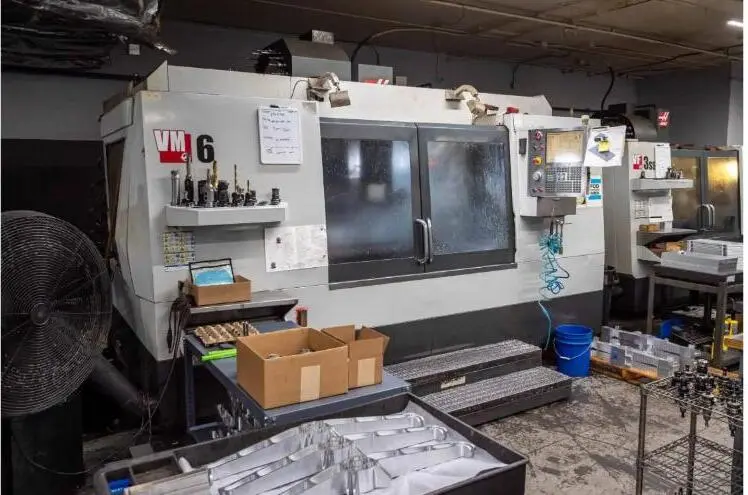
Precision Advanced Manufacturing supports the full product lifecycle from prototype through sustained multi-shift production across commercial aerospace, military and defense, space and satellites, advanced industrials and UAV programs. Engineering support and in-house CNC programming strengthen manufacturability from the outset.

The company’s quality systems deliver complete inspection and documentation, including material certifications, inspection reports, certificates of conformance and FAI packages. These records reduce verification workload for customer quality teams and support audits and program reviews.
Connect with Precision Advanced Manufacturing’s aerospace specialists to review program requirements.
Frequently Asked Questions
What Does AS9100D Certified Mean for CNC Machining?
AS9100D is the aerospace quality management standard published by the International Aerospace Quality Group. It incorporates all ISO 9001:2015 requirements and adds a large set of aerospace-specific requirements covering risk management, configuration management, product safety, counterfeit parts prevention, traceability and First Article Inspection. For CNC machining, certification means an accredited third-party registrar has audited the shop’s quality management system and confirmed it meets these requirements. Certification supports consistent processes, documented material traceability and inspection compliance for mission-critical components.
How Can a Buyer Verify a Supplier’s AS9100D Certification?
The IAQG OASIS database at iaqg.org/oasis provides the definitive verification method. Search by company name and confirm the certificate status is active, the scope covers CNC machining, the issuing certification body is IAQG-recognized and the certificate remains current. OASIS records list the certificate number, certification body, scope, status and next surveillance audit date. Additionally, request sample FAI reports, material traceability documentation and recent nonconformance and corrective action records.
What Is the Difference Between AS9100D and ISO 9001?
ISO 9001:2015 is a general-purpose quality management standard. AS9100D builds on ISO 9001:2015 with aerospace-focused additions such as formal operational risk management, configuration management for drawings and CNC programs, product safety as a documented process, counterfeit parts prevention with approved vendor controls, foreign object debris control, human factors consideration and special process qualification for welding and heat treatment. AS9100D certification satisfies ISO 9001 requirements, while ISO 9001 alone does not meet aerospace flowdown expectations.
What Is a First Article Inspection?
A First Article Inspection is a documented review of the first production article against engineering drawings and specifications before series production begins. AS9102 governs this process and applies to new parts and significant design or process changes. A complete FAI package includes a ballooned engineering drawing, characteristic-by-characteristic dimensional results, measurement equipment identification, calibration traceability, material certifications, special-process certifications and functional test results where applicable. FAI confirms that the production process can consistently produce conforming parts and provides documented evidence before shipment.
How Much Does AS9100D CNC Machining Cost?
AS9100D-certified CNC machining includes cost drivers such as compliance documentation, First Article Inspection, material certification and traceability. These activities represent planned labor and administrative work. Certified machining often carries a higher initial quote than noncertified options and reduces total cost of ownership by limiting rework, scrap and program delays. Cost varies by material, part complexity, tolerance requirements, inspection scope and order quantity. Precision Advanced Manufacturing provides tailored quotes that cover all relevant cost elements. Get a program-specific cost assessment.
What Are Common Red Flags When Evaluating AS9100D Suppliers?
Key red flags include missing or expired OASIS listings, nonrecognized certification bodies, certificate scopes that exclude CNC machining, reluctance to share audit history or corrective action records, lack of AS9102 FAI samples and absence of ITAR registration for defense-related work. An unusually low nonconformance count can also indicate that issues are not recorded. Direct OASIS verification and documentation reviews reduce these risks.
Can Precision Advanced Manufacturing Handle Both Prototypes and High-Volume Production?
Precision Advanced Manufacturing supports the full product lifecycle from prototype development through sustained, multi-shift high-volume manufacturing. The scalable production platform allows programs to move from initial prototype runs to full-rate production without supplier changes or quality tradeoffs. Certified processes, full traceability and consistent documentation apply at every production stage.
Is Precision Advanced Manufacturing ITAR Registered?
Precision Advanced Manufacturing is ITAR registered and operates under AS9100D and ISO 9001:2015 certified quality management systems. ITAR registration supports manufacturing and handling of defense-related components under the U.S. Munitions List. Components for defense and space programs run under ITAR-compliant processes with appropriate documentation and access controls.
Next Steps for Qualifying an AS9100D CNC Machining Partner
AS9100D certification establishes the baseline requirement for aerospace CNC machining, and effective qualification extends beyond the certificate. Procurement teams confirm scope, traceability and documentation coverage for the specific work being sourced.
The checklist in this guide supports assessment across certifications, technical capabilities, quality systems, scalability, integrated services and documentation. OASIS verification, sample FAI and traceability reviews and facility audits for critical programs complete a robust qualification process.
Precision Advanced Manufacturing maintains current AS9100D and ISO 9001:2015 registrations, ITAR registration and integrated CNC machining, fabrication, welding, finishing and assembly capabilities across two U.S. facilities. The company supports commercial aerospace, military and defense, space and satellites, advanced industrials and UAV programs from prototype through full-rate production.
Begin the qualification process with Precision Advanced Manufacturing’s AS9100D-certified team.