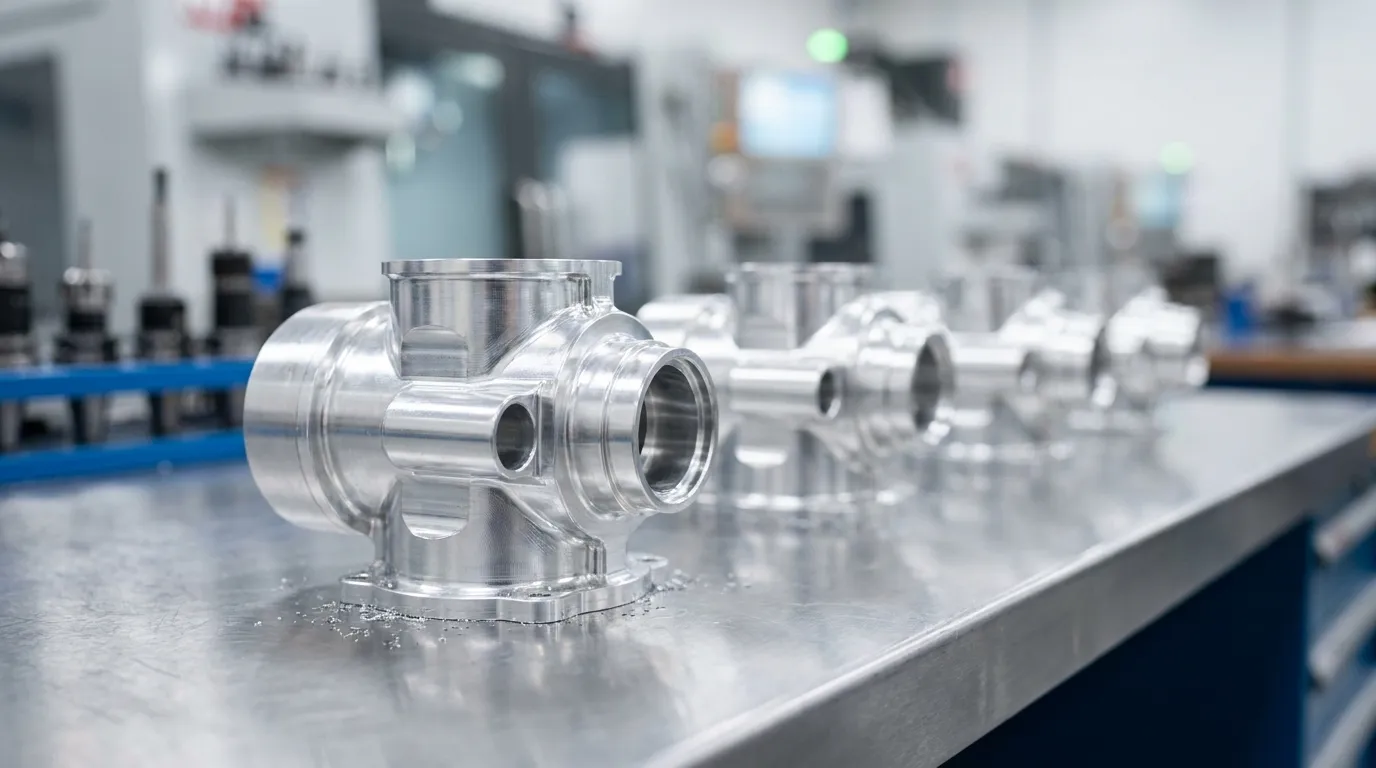
Key Requirements for UAV Precision Machining
- UAV precision machining services require tight tolerances and full compliance with AS9100D and ITAR standards to protect flight-critical component reliability.
- Integrated multi-axis CNC machining, fabrication, welding and finishing in one U.S. facility reduces supplier fragmentation and shortens program timelines.
- AS9100D and ITAR registration provide complete material traceability, serialized tracking and FAI/AS9102 documentation required for defense UAV programs.
- Scalable production platforms support a smooth move from prototype to high-volume manufacturing without requalification or quality loss.
- Precision Advanced Manufacturing delivers certified, traceable UAV machining services that reduce compliance risk and protect program schedules, and a specialist can be reached through the request a quote form.
UAV Flight Component Tolerances That Protect Airworthiness
Tolerance requirements for UAV flight components rank among the tightest in commercial manufacturing. Motor mounts require tight tolerances on mounting face flatness and hole position to ensure thrust transmission and minimize vibration. Propeller shaft runout must stay controlled to prevent rotor-frequency vibration that can damage payloads and shorten component life.
Industry standards require tolerances for critical aluminum UAV frame components to stay controlled within narrow ranges. These standards apply most strongly at critical mating surfaces such as motor mounting surfaces and arm joints, where dimensional variation affects load transfer and structural integrity. Aerospace and defense applications drive these tight geometric controls because weight limits restrict overdesign and place more responsibility on precision.
GD&T annotations define critical dimensions including flatness, parallelism and concentricity for efficient manufacturing and inspection of UAV parts. GD&T follows ASME Y14.5-2018 in the United States. AS9100 and ISO 9001 certified manufacturers must execute GD&T specifications precisely with quality systems that support full traceability.
Precision Advanced Manufacturing uses multi-axis CNC machining, in-process CMM inspection and GD&T expertise to hold the tolerances demanded by motor mounts, frames, gimbal housings and propeller shafts. Surface finish requirements are met through integrated secondary finishing processes including anodizing, passivation and precision grinding.
Compliance Standards That Shape UAV Machining Workflows
ITAR and AS9100D shape every stage of UAV component production, from raw material sourcing to final documentation. AS9100D mandates comprehensive traceability from raw material to finished part, requiring serialized part tracking, auditable inspection records and full chemical and physical certifications for all raw materials.
Defense UAV programs face intense schedule pressure when ITAR compliance is treated as a post-design hurdle. Late classification of drawings and models, unclear handling rules for U.S. persons and insecure data flows cause rework and accidental disclosures that create compliance issues during audits.
ITAR registration requires U.S.-based manufacturing facilities with controlled access to technical data and no foreign national access without proper authorization. The June 2025 Executive Order 14307, “Unleashing American Drone Dominance,” established strengthening the American UAS industry as a key policy priority, which reinforced the strategic importance of domestic, ITAR-registered suppliers.
Precision Advanced Manufacturing operates under these standards with controlled data handling and U.S-only production that reduce export-control exposure. Centralized quality systems keep documentation, traceability and compliance aligned with defense program expectations.
Supplier Reliability Issues That Delay UAV Programs
Failure to involve manufacturing in early design reviews results in DFM constraints, tooling requirements and inspection plans not being incorporated into CAD models, causing prototype-to-production delays. Supplier fragmentation compounds these risks, because each handoff between a machinist, welder and finishing vendor introduces opportunity for dimensional variation, documentation gaps and schedule slippage.
Precision Advanced Manufacturing consolidates multi-axis machining, sheet metal fabrication, precision welding, kitting and secondary finishing in one facility. In-house CNC programming and engineering support apply DFM analysis at the outset, which reduces downstream rework. Integrated operations remove inter-vendor handoffs and deliver right-first-time parts with predictable lead times.
Scaling UAV Production While Preserving Proven Quality
Once supplier reliability is established, programs face a second challenge, which involves maintaining that reliability as production volumes increase. Drone defense OEMs face pressure to scale UAV manufacturing while maintaining strict quality standards, as supply chain instability, rising production demand and shorter lead times make repeatable precision more difficult to achieve. Early technical success does not always translate into repeatable, high-volume builds, which creates tension across engineering, manufacturing and supply chain functions.
Precision Advanced Manufacturing uses a scalable production platform that supports the full product lifecycle, from single-piece prototype builds through multi-shift, high-volume manufacturing runs. Established processes, validated quality documentation and consistent tooling carry over from prototype to production, which reduces the requalification risk that supplier changes introduce. Programs maintain the same quality standards and documentation packages at every volume level.
Request a quote to discuss prototype-to-production transition planning for a UAV program.
UAV Structural and Propulsion Components That Need Precision Machining
A broad range of UAV structural and propulsion components demand precision machining. Recommended materials for high-precision UAV parts include aluminum alloys, titanium alloys and carbon fiber composites. Titanium alloys hold strong presence in the aerospace high-performance alloys market because they combine strength-to-weight benefits with corrosion resistance.
These materials are selected based on the specific mechanical and thermal demands of each component type. Components that commonly require precision machining in UAV programs include:
- Motor mounts and propulsion frames requiring tight flatness and hole-position tolerances
- Gimbal housings with precision bearing seats for payload stabilization
- Propeller shafts requiring controlled runout for vibration management
- Landing gear brackets designed to absorb landing loads at defined attachment points
- Sensor and antenna mounting brackets with tight angular-sensitivity tolerances
- Structural frame connectors requiring symmetry control on mating surfaces
- Payload integration hardware requiring alignment features for optical and electronic systems
Precision Advanced Manufacturing uses CNC milling and turning, sheet metal fabrication, TIG and MIG precision welding and secondary finishing to support the full range of materials and geometries present in current UAV programs.
UAV Precision Machining Services Due-Diligence Checklist
Procurement and supplier quality teams evaluating UAV machining partners should verify the following before awarding work. This checklist covers ten verification points that reduce supplier risk and support compliance from program start.
- Certifications: Confirm AS9100D and ISO 9001:2015 registration scope covers the specific processes required, including machining, fabrication and finishing.
- ITAR registration: Verify U.S.-based production, controlled data access and documented compliance programs covering technical data handling.
- Traceability: Confirm serialized part tracking, material certifications, heat lot traceability and auditable inspection records are standard deliverables.
- FAI/AS9102 documentation: Confirm the supplier provides First Article Inspection reports, Certificates of Conformance and dimensional inspection packages.
- CMM inspection capability: Verify in-process and final CMM inspection with calibrated equipment and documented repeatability.
- GD&T expertise: Confirm in-house programming and engineering teams interpret and execute ASME Y14.5-2018 GD&T requirements.
- Integrated capabilities: Assess whether machining, fabrication, welding and finishing are available in one facility to remove inter-vendor handoffs.
- Scalable capacity: Confirm multi-shift production capacity and established processes that support volume transitions without requalification.
- DFM support: Verify early engineering engagement to refine designs for manufacturability before production begins.
- Supplier transition protocols: Confirm the supplier can execute pilot builds, validation runs and documentation transfer when transitioning from an existing source.
Frequently Asked Questions
How does Precision Advanced Manufacturing support supplier transitions mid-program?
Precision Advanced Manufacturing supports supplier transitions by providing complete documentation, material traceability and engineering support that preserve continuity. The team can begin with pilot builds or validation runs to reduce risk while integrating into existing supply chains. Full quality documentation, including material certifications, inspection records and serialized tracking, transfers with the program so the audit trail remains intact.
What documentation packages are provided with each UAV order?
Each order includes documentation aligned to AS9100D and AS9102 requirements. Standard packages include Certificates of Conformance, First Article Inspection reports, dimensional inspection records, material certifications and heat lot traceability. Serialized part tracking is maintained throughout production. Documentation supports customer audits, regulatory reviews and program qualification milestones.
Can the same quality be maintained when scaling to thousands of parts?
Precision Advanced Manufacturing uses a scalable production platform designed to maintain validated quality from prototype through high-volume manufacturing. Established processes, controlled tooling and multi-shift capacity allow programs to increase volume without requalifying the supplier or accepting weaker documentation standards. The same inspection protocols, traceability systems and quality checkpoints applied during prototyping continue into full-rate production.
Which materials and finishes are most common for 2025–2026 UAV programs?
Current UAV programs most often use 7075-T6 and 6061-T6 aluminum alloys for structural frames and motor mounts, Ti6Al4V titanium for weight-critical structural and propulsion components and nickel-based superalloys for high-temperature propulsion applications. Secondary finishes including anodizing, passivation and plating are standard for corrosion resistance and surface protection. Precision Advanced Manufacturing works with materials and finishing processes that meet the durability and reliability expectations of aerospace and defense UAV programs.
Selecting a Certified Partner for UAV Precision Machining Services
The decision framework for selecting a UAV precision machining partner centers on three criteria, which include compliance, capability and continuity. A supplier must hold current AS9100D and ITAR registration with scope that covers every process in the production flow. Capability must span machining, fabrication, welding and finishing in a single facility to remove handoffs. Continuity means the supplier can support the program from first prototype through sustained production without a supplier change that resets qualification and documentation.
The December 2025 FCC decision to add foreign-built UAS and critical components to the Covered List, combined with Executive Order 14307, accelerated the shift toward domestic, compliant sourcing for UAV programs. Programs that rely on foreign or non-registered suppliers face growing compliance exposure and supply disruption risk.
Precision Advanced Manufacturing is a U.S.-based, ITAR-registered, AS9100D- and ISO 9001:2015-certified precision machining and fabrication provider with facilities in California and Texas. Integrated multi-axis CNC machining, sheet metal fabrication, precision welding, kitting and secondary finishing operate under a single quality system with full traceability and documentation. The production platform scales from prototype to multi-shift, high-volume manufacturing without reducing the quality standards validated at program entry.
For procurement managers, program managers and supplier quality engineers managing mission-critical UAV programs, Precision Advanced Manufacturing provides a certified, traceable and scalable manufacturing partnership that reduces compliance risk, removes supplier fragmentation and protects program schedules.
Request a quote to begin a conversation with Precision Advanced Manufacturing’s UAV manufacturing specialists.